








1. Introduction
During procurement or construction, engineers are sometimes asked whether ASTM A500 Grade B hollow sections can replace ASTM A53 Grade B pressure pipe because the products appear similar. The temptation to substitute one for the other can feel like a practical, low-risk decision. Yet this line of thinking, rooted in the oversimplification that “steel is just steel,” has been the starting point for numerous piping failures. When a hollow section engineered to hold up a building is quietly routed into a system designed to carry compressed air, steam, or flammable fluids, the original safety margin is no longer valid. The root cause is not a material defect in the steel itself, but a fundamental mismatch between the product standard and the intended function. Understanding this mismatch begins with recognising that ASTM A53 Grade B is a pressure pipe specification, developed for an entirely different engineering purpose.
An experienced engineering team would not treat a structural member as a pressure vessel. The following sections unpack the manufacturing, testing, and metallurgical divides that make such substitution not merely a code violation, but a genuine threat to plant integrity and personnel safety.
2. Manufacturing Divergence: How A500 Hollow Sections Differ from Fluid–Conveying A53 Pipes
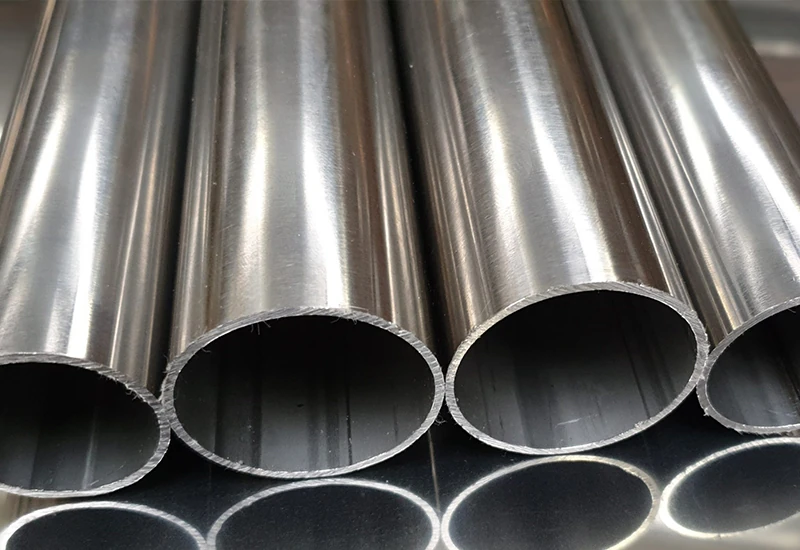
ASTM A500 pipe is produced with tight dimensional control. Mills optimise the cold-forming process to deliver precise outside dimensions, tight corner radii, and uniform wall thickness — all critical for predictable structural behaviour in a truss or column. The weld seam, most often created by high-speed electric resistance welding, is validated through flattening tests and visual examination. The acceptance criteria centre on the joint’s ability to hold the section together under bending and compression, not on its ability to contain a pressurised medium without weeping.
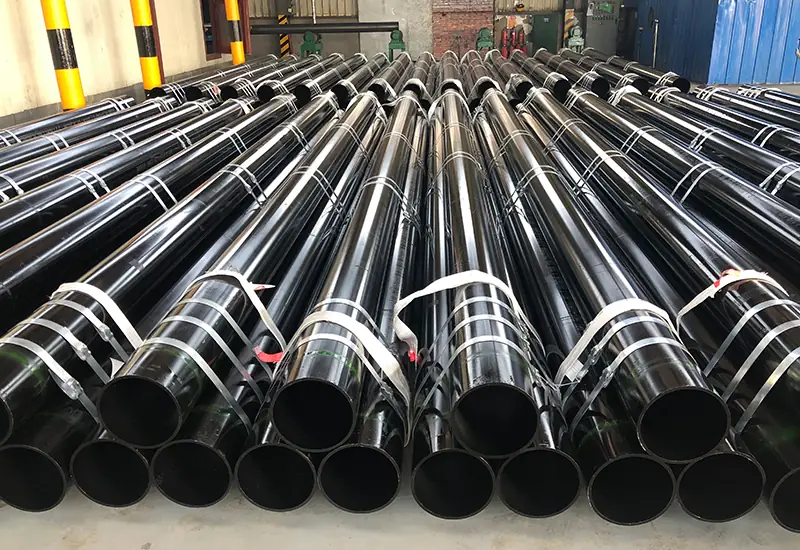
A pressure pipe is manufactured under different requirements from the moment the coil or plate is unwound. The forming and welding procedures for ASTM A53 are designed to produce a continuous, metallurgically sound bond along the entire length of the pipe, and the standard demands supplementary non-destructive inspection of that seam when certain conditions are met. The goal is leak tightness and ductile behaviour under hoop stress, two qualities that are irrelevant to a beam supporting a floor load.
This contrast becomes even more instructive when engineers examine large-diameter transmission lines. The industry’s best-practice solution for critical fluid arteries frequently takes the form of LSAW steel pipe. Produced by longitudinally submerging the arc and welding from both the inside and outside, this pipe undergoes full-penetration welds that are subsequently checked by ultrasonic or radiographic methods across 100% of the joint. The manufacturing culture behind LSAW pipe — complete with edge milling, tack welding, and carefully controlled heat input — represents a level of quality assurance that a structural pipe mill, geared toward tonnage for columns and braces, does not attempt to replicate.
No amount of over-specified wall thickness in an A500 section can compensate for a weld philosophy that was never aimed at pressure integrity in the first place. The two products occupy parallel worlds, each supremely capable within its own envelope, but dangerously mismatched when swapped.
3. Chemical Composition and Tensile Strength Discrepancies
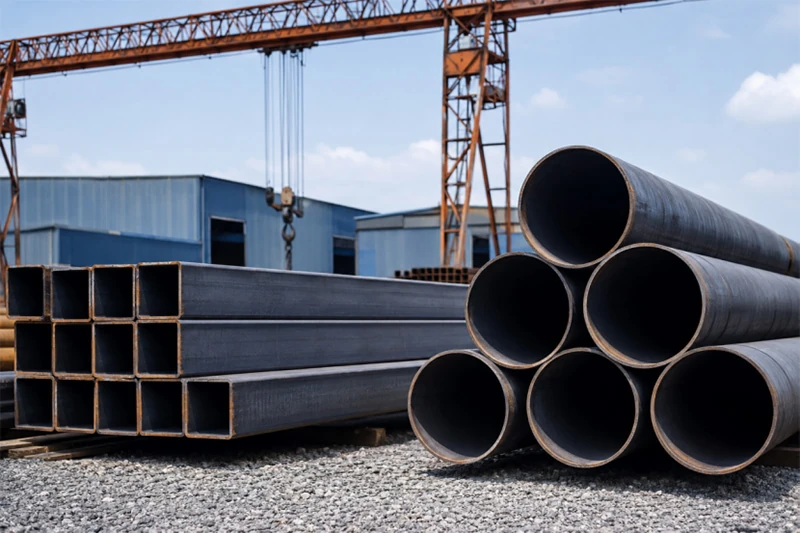
Even when both mill certificates carry the label “Grade B,” the chemistries are tuned to different purposes. The pressure pipe specification places tighter limits on phosphorus and sulfur such as phosphorus and sulfur to safeguard ductility and weld soundness under sustained stress. The structural grade allows slightly wider compositional bands because the primary manufacturing tool — cold-forming — manages cracking risk through bend radii and section geometry rather than through metallurgical purity. Mechanical testing further exposes the philosophical split. In a structural hollow section, yield strength is the headline number: the engineer needs assurance that the column will resist buckling at the calculated load. In a pressure pipe, tensile strength and elongation are equally important, confirming that the material can stretch plastically before rupturing, a vital attribute when a pipeline experiences thermal expansion or an unexpected surge.
A hidden danger imported by the cold-forming process is residual stress. The permanent deformation locked into the corners and weld zone of an A500 section creates tensile stresses that lie dormant in the steel. If that same section is later exposed to internal pressure and even a mildly aggressive fluid, the residual stresses align with the hoop stress generated by the contained medium. That combination dramatically accelerates stress-corrosion cracking. What starts as a geometric irregularity or a shallow flaw can progress to a through-wall leak at a rate that increases the likelihood of premature cracking, all because the steel was pre-loaded in a way that a pressure pipe standard never allows.
| Property | A500 Grade B (HSS) | A53 Grade B (Type E/S) |
| Carbon, max % | 0.26 | 0.30 |
| Manganese, max % | – (not specified) | 1.20 |
| Phosphorus, max % | 0.035 | 0.05 |
| Sulfur, max % | 0.035 | 0.045 |
| Tensile Strength, min | 58 ksi (400 MPa) | 60 ksi (415 MPa) |
| Yield Strength, min | 46 ksi (315 MPa) | 35 ksi (240 MPa) |
| Elongation requirement | 23% in 2 in. (typical) | Higher minimums enforced |
| Primary engineering focus | Structural stability | Pressure retention & ductility |
| Mandatory mill hydrotest | Not required | Required |
| Typical weld NDT | Visual & dimensional | Electromagnetic or ultrasonic |
Data drawn from ASTM A53/A53M–24 and ASTM A500/A500M–24, accessible via www.astm.org.
4. The Danger of Hydrostatic Absence: Why A500 Is Never Pressure–Tested at the Mill
A mill hydrostatic test is the simplest, most direct proof that a pipe can hold fluid without leaking. Every length of genuine pressure piping is required to undergo this test, or a non-destructive electric examination deemed equivalent by the specification, before it is approved for shipment. The procedure catches through-wall weld anomalies, pinholes, and laminations that no amount of surface inspection can detect. For a piece of pipe destined to carry steam or natural gas, that factory test is not an optional extra; it is the last line of defence in a quality system built around containment.
A structural hollow section is never subjected to such a test, because the standard that governs it does not imagine it will ever need one. ASTM A500 is silent on hydrostatic requirements. The implication is clear: placing an untested, cold-formed structural pipe into a pressurised network bypasses the very safeguard that defines a high pressure steel pipe. A weld micro-tear or a forming-induced flaw that would have been flagged at the pressure pipe mill remains hidden, which may only become apparent during service. Industry failure reports consistently underline that installations relying on this swap do not just fall short of code compliance — they behave as latent points of failure that can release energy with little warning. The cost of a hydrostatic test at the factory is negligible compared to the cost of a burst pipe in a live plant.
Engineers who have spent their careers in piping design regard the hydrotest certificate not as bureaucratic paperwork, but as the pipe’s birth certificate for pressure service. Its absence on an A500 document is the clearest possible signal that the product has been made for a different job entirely.
5. Structural Applications: Proper Sourcing of Welded Pipes for Heavy Foundation Piles
ASTM A500 has earned its reputation in the built environment honestly. Columns, roof trusses, portal frames, and architectural exposed steel all benefit from the shape control and reliable yield strength that the standard provides. In those applications, the load paths are predominantly axial or flexural, and the weld’s job is to keep the cross-section closed under structural demand — a task it performs very effectively.
When the structural challenge moves into heavy civil works, such as deep foundation piling, marine jacket legs, or large-diameter combi-walls, the specification frequently steps up to a heavier class of material. These projects demand not just a hollow shape but a fully engineered structural steel pipe that can withstand hard driving through boulders, resist buckling under soil pressure, and absorb energy during seismic events. At this tier of construction, generic off-the-shelf hollow sections give way to pipe manufactured with supplementary impact testing, through-thickness tensile verification, and project-specific weld toughness requirements.
This is also the stage where the choice of supply partner becomes a genuine risk management decision. A dedicated carbon steel pipe manufacturer with the capability to produce both LSAW and SSAW pipes to standards such as EN 10219, API 2B, or DNV-OS-C401 can also apply corrosion-protection coatings — FBE, 3LPE, or coal tar enamel — under the same roof, ensuring single-source traceability. Allland Pipes regularly supplies large-diameter LSAW structural pipes and piling pipes that satisfy supplementary project specifications, from Charpy toughness at low temperatures to dimensional tolerances tighter than those required by generic structural standards. Engaging such a manufacturer early in the design phase helps procurement teams avoid the standard-mismatch trap and ensures that the pipe arriving on site is engineered for the actual load case, whether that is thousands of tonnes of axial compression or a 360-degree pressure envelope.
When a project’s safety philosophy demands that every link in the chain is verified, the mill becomes an extension of the design team, not just a commodity supplier. That collaborative approach turns technical specifications into delivered confidence.
6. Conclusion: Specifying the Right Pipe for the Right Purpose
The engineering principle at the heart of this discussion is surprisingly simple and completely non-negotiable. A structural hollow section and a pressure pipe exist in separate universes of code, testing, and metallurgical control, and they cannot stand in for one another without sacrificing the very safety they are intended to provide.
Where a system demands reliable fluid containment, the specification must point unequivocally to a pipe standard that requires hydrostatic proof and weld integrity designed for hoop stress. ASTM A53 Grade B remains one of the most widely referenced benchmarks for this service, precisely because its requirements were written by engineers who understood the consequences of a leak. Its insistence on pressure testing at the mill is not a commercial obstacle but an essential verification that separates a safe pipeline component from a risk item.
When the pipeline diameter grows to the range of major transmission mains, the technology shifts to longitudinal submerged-arc welded construction. A properly manufactured LSAW steel pipe takes the pressure-containment philosophy even further, combining full-penetration double-sided welding with 100% volumetric inspection of the seam. The technical distance between that product and a cold-formed structural hollow section could hardly be greater.
In the realm of heavy civil structures, the language changes but the principle of right-purpose specification remains identical. A driven pile or a marine caisson requires a certified structural steel pipe with the toughness and dimensional control demanded by the foundation conditions, not an opportunistic substitute drawn from a building-frame inventory.
Navigating these distinctions is easier with a technically grounded supply chain. Allland Pipes, as a manufacturer operating across LSAW, SSAW, and coated pipe categories, works daily with engineering firms and contractors to match material grades to their precise functional environment. In a discipline where the margin of error is often measured in a few thousandths of an inch but the consequence of error is measured in human and environmental safety, the myth that “steel is steel” deserves to be retired permanently. Thoughtful specification, backed by auditable mill data, remains the cheapest form of project insurance.
Frequently Asked Questions
Q1: Can I use an ASTM A500 Grade B hollow section for a low–pressure chilled water line if I derate the allowable stress?
Derating calculations, no matter how conservative, cannot repair the fact that the pipe was never proven leak-tight at the factory. Pinhole weld defects and residual forming stresses remain in the material, and most plumbing and piping codes do not recognise a structural pipe as a legitimate pressure-bearing component, regardless of the stress level assumed in a calculation spreadsheet.
Q2: What non–destructive test can reliably replace the missing hydrotest on an A500 section?
No single post-purchase NDT technique provides an equivalent guarantee. A full volumetric inspection of the weld seam can find many flaws, but it cannot replicate the combined proof of strength and leak tightness that a hydrostatic test delivers. Furthermore, performing such advanced NDT on stock structural pipe often costs more than sourcing the correct high pressure steel pipe from the outset.
Q3: Is there a cost–effective way to obtain structural pipe for marine piling without over–specifying pressure grade material?
Yes, and it starts with talking to mills that specialise in both markets. By specifying a dedicated structural pipe standard such as ASTM A252 or EN 10219, and by engaging a structural steel pipe producer that understands piling dynamics, you can obtain material with the right toughness and weldability without paying for redundant hydrotesting or chemistry aimed at fluid service. The key is matching the specification to the actual ground and driving conditions.

ASTM A53 vs. API 5L: A Guide to Selection and Application
In the field of industrial piping, ASTM A53 and API 5L are two key standards that are widely used, but have very different positions. ASTM...

Introduction:Technology differences determine success or failure, and selection needs to be “precise”
In oil and gas transmission, municipal infrastructure and other major projects, the reasonable choice of steel pipe welding process directly affects the project...
Steel Density Analysis: Core Differences between Mild and Medium Carbon Steels and Industrial Applications
The density of steel is one of the key parameters that determine its physical properties and industrial applications. Theoretical state of steel density...
3LPE coated steel pipe: a solid barrier in the field of industrial corrosion protection
In the harsh environment of oil and gas, chemical industry, urban pipe network, etc., the long-term reliability and corrosion resistance of pipeline system...
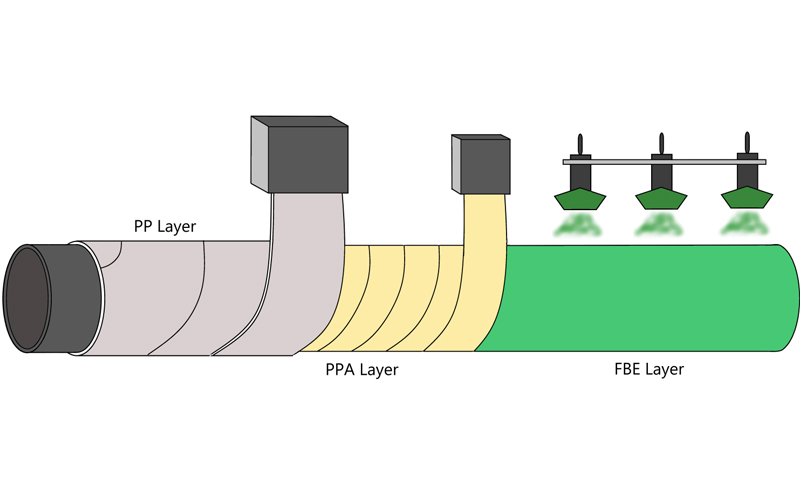
3LPP coated pipe: anti-corrosion guard in high temperature and high pressure environment
In some challenging special environments such as deep-sea oil and gas exploration and high-temperature crude oil transportation, traditional anti-corrosion coatings face significant challenges,...
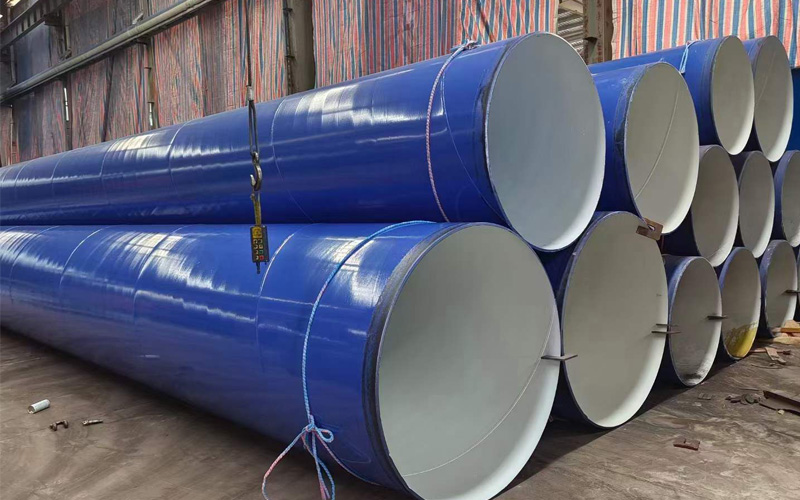
FBE steel pipe: the technological armor of the steel defense line
I In the icy waters beneath the Norwegian Sea pipeline, a section of FBE Lined Carbon Steel Pipe has been in service for 25...