



FAQ
Candidature et sélection
Découvrez les principaux critères de sélection des tubes en acier : type d'application, spécifications, revêtements et exigences du projet afin de garantir des performances optimales.
La stabilité à long terme d'un grand pont, d'une installation portuaire ou d'un immeuble de grande hauteur repose entièrement sur la solidité et l'intégrité de ses fondations. Dans la construction moderne, les pieux tubulaires en acier sont une solution éprouvée et de grande capacité pour ces fondations profondes, mais une question fréquente et cruciale que nous posons est de savoir quel type de pieu est le mieux adapté à la tâche.
D'un point de vue technique, il est essentiel de faire le bon choix pour que les fondations soient à la fois sûres et rentables. Ce guide vous présente les principales options et les facteurs à prendre en compte.
La norme en vigueur pour les pieux : ASTM A252
Avant d'aborder les tuyaux spécifiques types, Il est essentiel d'établir les règles de gouvernance. standard. Pour les applications de pieux en Amérique du Nord et dans de nombreux projets internationaux, cette norme est très largement utilisée. ASTM A252.
Comme nous l'avons vu précédemment, cette spécification est rédigée exclusivement pour les tuyaux en acier destinés à être utilisés comme éléments structurels et porteurs. Tout tuyau sélectionné pour un projet de pieux, qu'il soit LSAW ou SSAW, doit être spécifié pour répondre ou dépasser les exigences de l'ASTM A252, généralement Grade 2 (35 ksi d'élasticité) ou Grade 3 (45 ksi d'élasticité).
Évaluation des options primaires : SSAW vs. LSAW
Les tubes SSAW (Spiral Weld) et LSAW (Longitudinal Weld) sont tous deux largement utilisés avec succès pour les pieux. Le meilleur choix dépend des conditions géotechniques spécifiques de votre projet, des charges structurelles et du budget.
Pieux tubulaires SSAW (Spiral SAW) : Le cheval de bataille de l'industrie
Pour un grand nombre de projets de pieux, le tube SSAW est le choix préféré, et ce pour de bonnes raisons.
- Avantage principal - Rentabilité : Le processus de fabrication continu et efficace des tubes SSAW en fait souvent l'option la plus économique, en particulier pour les projets nécessitant de grandes quantités de pieux.
- Performance : Les tubes SSAW offrent une excellente capacité structurelle et sont parfaitement adaptés à la plupart des conceptions de fondations où le tube est enfoncé à une profondeur spécifique et souvent rempli de béton. La nature en spirale de la soudure peut également contribuer à la rigidité globale du tube.
- Cas d'utilisation idéaux : Les pieux tubulaires SSAW constituent une solution exceptionnelle pour un large éventail d'applications, notamment les fondations de bâtiments et d'entrepôts, les ponts à chevalets, les murs de soutènement et les tours de communication.
Pieux tubulaires LSAW (Longitudinal SAW) : La solution pour les charges lourdes
Lorsque les exigences du projet deviennent plus extrêmes, Tube LSAW offrent un niveau supplémentaire de performance et de sécurité.
- Avantage principal - Possibilité de murs épais : Le processus de fabrication JCOE permet de produire des tuyaux LSAW avec des épaisseurs de paroi extrêmement importantes. Cela leur confère une résistance exceptionnelle aux dommages et au flambage lors de la conduite sur des sols très durs ou obstrués.
- Performance : L'utilisation de plaques d'acier uniques de haute qualité garantit des propriétés mécaniques très uniformes dans l'ensemble du tube, ce qui est un avantage pour les conceptions avec des charges élevées et concentrées.
- Cas d'utilisation idéaux : Les pieux tubulaires LSAW sont le choix indispensable pour les projets les plus exigeants, tels que les fondations de grands ponts à longue portée, les terminaux maritimes en eau profonde et les enveloppes d'éoliennes offshore, où les pieux sont soumis à des charges axiales, latérales et dynamiques extrêmes.
Facteurs clés de sélection pour votre projet
Nos spécialistes techniques conseillent généralement aux clients de tenir compte de ces trois facteurs :
- Conditions géotechniques : Conduisez-vous dans des argiles molles ou dans un till glaciaire dense avec des blocs rocheux ? Les conditions de conduite plus difficiles favorisent la robustesse d'un tube LSAW à paroi épaisse.
- Charges structurelles : Quelles sont les charges finales que la fondation doit supporter ? Des charges de compression ou latérales exceptionnellement élevées peuvent nécessiter les capacités de parois lourdes de LSAW.
- Économie du projet : S'agit-il d'une conception de fondation standard dans des conditions de sol modérées ? Dans l'affirmative, les performances élevées et la rentabilité des tubes SSAW en font un choix très convaincant.
La recommandation d'Allland Steel
Notre conseil est de considérer Pieux tubulaires SSAW comme la solution de base très performante et économique pour la majorité des projets de fondation. Pour les projets impliquant des charges de conception exceptionnelles, des exigences de parois lourdes ou des conditions de conduite particulièrement difficiles, la mise à niveau en Pieux tubulaires LSAW offre une marge supérieure de sécurité et de performance.
La solution optimale en matière de fondations dépend d'une analyse approfondie du rapport géotechnique et de la conception structurelle de votre projet. Les spécialistes de Acier Allland a l'expérience de la fourniture de pieux tubulaires LSAW et SSAW pour de grands projets d'infrastructure dans le monde entier et peut vous aider à faire le choix du matériau le plus efficace.
Contactez un spécialiste des pieux chez Allland Steel pour examiner les exigences de votre projet en matière de fondations.
La planification d'un gazoduc à longue distance est l'une des entreprises les plus complexes de l'infrastructure moderne. En tant que fournisseur de matériaux clés, nous comprenons que si un projet implique la planification du tracé, des évaluations environnementales et des approbations réglementaires, l'intégrité du gazoduc lui-même est au cœur de l'ensemble du système.
Ce guide présente les considérations techniques essentielles pour la sélection des conduites, qui sont fondamentales pour garantir un réseau de transport de gaz naturel sûr, fiable et efficace pour les décennies à venir.
Les quatre piliers de la spécification des pipelines
La spécification d'une conduite pour le transport de gaz naturel repose sur quatre piliers essentiels. Il est essentiel de bien les définir au stade de la planification pour assurer la réussite du projet.
Pilier 1 : Niveau des normes et des spécifications (le fondement de la sécurité)
C'est le point de départ non négociable de tout gazoduc.
- La norme : La norme internationale obligatoire pour cette application est API 5L.
- Le niveau de spécification : Pour la grande majorité des lignes de transport de gaz naturel, PSL2 (Product Specification Level 2) est le choix requis.
Nos conseils d'experts : Si la norme API 5L PSL1 est valable pour les applications moins critiques, la nature à haute pression et les implications importantes pour la sécurité publique du transport de gaz rendent essentielles les exigences supérieures de la norme PSL2. La résistance à la rupture obligatoire, les contrôles chimiques plus stricts et les protocoles d'essai plus stricts de la PSL2 sont essentiels pour prévenir les défaillances et garantir l'intégrité du pipeline.
Pilier 2 : Sélection de la qualité des matériaux (équilibre entre résistance et économie)
La qualité de l'acier détermine sa résistance. Les nuances courantes pour cette application sont API 5L X52, X65 et X70.
- Le principe : Un acier de qualité supérieure (comme le X70) a une limite d'élasticité plus élevée qu'un acier de qualité inférieure (comme le X52). Cela signifie qu'un tuyau dont la paroi est plus fine peut contenir en toute sécurité la même quantité de pression.
- L'avantage : Pour les pipelines de longue distance, l'utilisation d'une qualité supérieure se traduit souvent par une réduction de la consommation d'énergie. coût total installé. Bien que le coût par tonne d'acier puisse être plus élevé, la réduction de l'épaisseur des parois permet de réaliser des économies significatives :
- Réduction du tonnage global d'acier nécessaire.
- Réduction des coûts de transport et de manutention.
- Des temps de soudage plus rapides et des coûts de consommables plus faibles sur le site.
Le choix de la nuance d'acier est une décision économique et technique essentielle qui doit être prise dès le début de la phase de conception.
Pilier 3 : Type de tuyau et fabrication (assurer la fiabilité)
Pour les conduites de gaz naturel de grand diamètre, le processus de fabrication est essentiel pour garantir la fiabilité.
- Le choix : Haute qualité LSAW (scie à ruban longitudinale) est un choix privilégié pour cette application. Les tubes soudés à haute fréquence (HFW) et les tubes sans soudure sont également utilisés, généralement pour des conduites de plus petit diamètre.
- La raison : Comme nous l'avons expliqué précédemment, le procédé de fabrication LSAW est parfaitement adapté à la production de tubes à paroi épaisse, de qualité supérieure et de précision dimensionnelle nécessaires à ces projets critiques. Le cordon de soudure droit peut également être contrôlé facilement et de manière fiable à l'aide de méthodes de contrôle non destructif (CND) avancées.
Pilier 4 : Système de revêtement extérieur (garantissant la longévité)
Un gazoduc est conçu pour durer plus de 50 ans. Sa principale menace à long terme est la corrosion externe due au sol.
- Le système : La référence de l'industrie pour une protection de haute performance est un système de revêtement à trois couches, tel que 3LPE (polyéthylène à trois couches) ou 3LPP (Polypropylène à trois couches).
- La raison d'être : Ce système offre une double défense : la couche interne de FBE offre une excellente protection anticorrosion et une excellente adhérence, tandis que la couche externe robuste de polyoléfine assure une protection mécanique solide contre les dommages survenant au cours de l'installation. Investir dans un système de revêtement de qualité supérieure est une décision cruciale pour protéger le pipeline pendant toute sa durée de vie.
Le partenariat Allland Steel : De la spécification à la fourniture
La planification et l'exécution réussies d'un gazoduc nécessitent une expertise approfondie à chaque étape. À l'heure actuelle, le projet de gazoduc est en cours de réalisation. Acier Allland, Nous fournissons des produits de haute qualité API 5L PSL2 Tube LSAW qui constitue l'épine dorsale de ces projets d'infrastructures critiques.
Nos spécialistes techniques comprennent parfaitement ces quatre piliers et sont prêts à travailler avec votre équipe d'ingénieurs. Nous pouvons vous aider à faire en sorte que les spécifications de vos matériaux soient optimisées en termes de sécurité, de performance et de valeur à long terme.
Pour discuter des exigences de votre projet de gazoduc, contacter un spécialiste technique d'Allland Steel.
Lorsqu'il s'agit de spécifier des canalisations pour l'eau potable, les critères de sélection vont bien au-delà de la simple protection contre la corrosion. La responsabilité première est de garantir la santé publique en préservant la qualité et la sécurité de l'eau transportée.
Les ingénieurs municipaux et les autorités chargées de la gestion de l'eau nous posent une question cruciale : quels sont les systèmes de revêtement et de garnissage qui sont à la fois certifiés sûrs pour l'eau potable et suffisamment durables pour garantir une longue durée de vie. De notre point de vue, il s'agit à la fois d'une question de conformité sans compromis et de performances éprouvées.
L'exigence non négociable : Certification NSF/ANSI/CAN 61
Avant d'aborder la question des revêtements spécifiques types, Il faut donc répondre à l'exigence la plus importante : certification de sécurité.
Tout matériau, revêtement ou enduit entrant en contact avec l'eau potable doit être certifié pour NSF/ANSI/CAN 61 : “Composants des systèmes d'eau potable - Effets sur la santé”.” Il s'agit d'une norme internationalement reconnue qui garantit qu'un produit ne lixivie pas dans l'eau des niveaux nocifs de contaminants, de métaux ou de produits chimiques.
Nos conseils d'experts : Exigez toujours la preuve de cette certification pour toute formation interne que vous envisagez. Il s'agit d'un critère non négociable pour garantir la sécurité du public et répondre aux exigences réglementaires.
Systèmes de revêtement et d'enduit recommandés
Une fois la certification NSF/ANSI/CAN 61 confirmée, vous pouvez choisir parmi plusieurs systèmes excellents et performants pour l'intérieur et l'extérieur du tuyau.
Revêtements internes (surfaces en contact avec l'eau)
1. Revêtement en mortier de ciment C'est la solution de confiance de l'industrie de l'eau depuis des décennies, et ce pour de bonnes raisons. Une couche de mortier de ciment est appliquée par centrifugation à l'intérieur du tuyau, créant une surface dense et lisse.
- Avantages : Il crée une barrière stable et inerte qui non seulement empêche l'acier de se corroder, mais qui passive activement la surface de l'acier. Il est exceptionnellement résistant, durable et très rentable, en particulier pour les conduites de transport d'eau de grand diamètre.
2. Revêtements époxydiques liquides Ces systèmes sont constitués d'une résine époxy en deux parties, à base de 100% (sans solvant), qui est appliquée par pulvérisation à l'intérieur du tuyau.
- Avantages : Les époxy liquides créent une surface extrêmement lisse et brillante qui peut améliorer l'efficacité hydraulique de la conduite (connue sous le nom de facteur “C” de Hazen-Williams), réduisant potentiellement les coûts de pompage à long terme.
- Facteur critique : Il est essentiel que la formulation spécifique de l'époxy soit certifiée NSF/ANSI/CAN 61 et qu'elle soit appliquée sous des contrôles de qualité stricts afin de garantir une épaisseur correcte et un durcissement complet.
3. Revêtements époxydiques fusionnés (FBE) Il s'agit d'un revêtement en poudre thermodurcissable appliqué en usine. Comme pour les époxydes liquides, la poudre FBE utilisée doit être certifiée pour le contact avec l'eau potable.
- Avantages : Le FBE constitue un revêtement interne très robuste, résistant aux dommages et homogène. Le processus d'application contrôlé en usine garantit un niveau élevé de contrôle de la qualité et une finition fiable. Il s'agit d'un choix de premier ordre pour combiner la sécurité de l'eau avec une surface robuste et durable.
Revêtements extérieurs (protection contre l'environnement)
Alors que le revêtement interne protège l'eau, le revêtement externe protège la conduite de la corrosion du sol, de l'humidité et d'autres facteurs environnementaux. Comme ces revêtements n'entrent pas en contact avec l'eau potable, ils ne nécessitent pas de certification NSF. Parmi les excellents choix à haute performance, on peut citer
- 3LPE / 3LPP Systèmes
- Epoxy fusionné (FBE)
- Revêtements en polyuréthane
Le choix du revêtement extérieur dépend des conditions du sol, de la méthode d'installation et de l'environnement opérationnel.
L'engagement d'Allland Steel en faveur de la sécurité aquatique
La protection de nos ressources en eau est une responsabilité partagée. À l'heure actuelle, la protection des ressources en eau est une responsabilité partagée. Acier Allland, Dans le cadre de notre activité, nous fournissons des solutions de canalisation qui répondent aux normes rigoureuses de sécurité et de performance exigées pour les infrastructures modernes de distribution d'eau. Nous pouvons fournir des tuyaux avec une gamme de revêtements internes certifiés NSF/ANSI/CAN 61 et des systèmes de revêtements externes très durables.
Nos spécialistes sont prêts à vous aider à analyser les exigences de votre projet afin de concevoir la solution optimale et la plus sûre en matière de canalisations.
Contactez un spécialiste d'Allland Steel pour discuter de votre projet de canalisation d'eau potable.
Commerce et logistique
Découvrez la FAQ sur la logistique commerciale d'Allland : solutions d'emballage, de transport, de stockage et d'expédition mondiale pour les tubes d'acier de grand diamètre.
Au Acier Allland, Nous nous engageons à vous fournir un devis rapide, précis et compétitif pour les besoins de votre projet. Pour que notre équipe de vente puisse répondre avec la plus grande efficacité et la plus grande précision, il est essentiel que vous nous fournissiez un ensemble complet de spécifications techniques et logistiques.
Considérez ceci comme une liste de contrôle pour réussir. En fournissant les informations suivantes lors de votre demande initiale, vous nous permettrez d'éviter les questions préliminaires et de passer directement à la préparation d'une proposition complète pour vous.
Votre liste de contrôle pour les devis : Les 7 éléments d'information clés
Veuillez inclure les détails suivants dans votre courriel ou dans le formulaire de demande de renseignements. Plus les informations seront complètes, plus votre devis sera rapide et précis.
1. La norme
Il s'agit du fondement technique de votre demande. Veuillez préciser la norme internationale à laquelle le tuyau doit se conformer.
- Exemple : API 5L, ASTM A252, ASTM A53
2. Qualité des matériaux
Dans la norme, le grade spécifique détermine les propriétés mécaniques du tube, telles que sa résistance.
- Exemple : Grade B, X60 PSL2, Grade 3
3. Dimensions complètes
Nous avons besoin de trois mesures clés pour comprendre le produit physique dont vous avez besoin.
- Exemple : Diamètre extérieur (OD) 610 mm, épaisseur de la paroi (WT) 12,7 mm, longueur 12 m
4. Quantité totale
Veuillez indiquer la quantité totale nécessaire. Cela nous permet de calculer le temps de production et de proposer le meilleur prix possible.
- Exemple : 5 000 tonnes ou 1 200 pièces
5. Extrémités des tuyaux et exigences en matière de revêtement
Ces détails garantissent que le tuyau arrive prêt pour votre application spécifique.
- Extrémités des tuyaux : Il s'agit généralement d'extrémités biseautées pour le soudage ou d'extrémités lisses.
- Revêtement : Spécifiez le revêtement interne et/ou externe requis. Par exemple, “revêtement externe 3LPE” ou “revêtement interne FBE”.
6. Port de destination
Pour vous fournir un prix CFR (coût et fret) ou CIF (coût, assurance et fret), nous devons connaître le grand port maritime le plus proche.
- Exemple : Port de Jebel Ali, EAU ; Port de Rotterdam, Pays-Bas
7. Exigences supplémentaires éventuelles
Indiquez toute autre exigence particulière liée à votre projet.
- Exemple : “Nécessite la certification EN 10204 3.2” ou “Un emballage spécial avec une enveloppe imperméable est nécessaire”.”
Pourquoi cette information est-elle importante ?
D'après notre expérience, disposer de cet ensemble complet d'informations est la clé d'un processus d'approvisionnement fluide et professionnel. Il permet à notre équipe technique de confirmer immédiatement nos capacités de fabrication et à notre équipe commerciale de calculer les coûts les plus précis pour les matériaux, la production et la logistique.
Notre objectif est d'être plus qu'un simple fournisseur ; nous voulons être votre partenaire le plus efficace et le plus fiable. Nous nous réjouissons de recevoir votre demande détaillée.
Vous êtes prêt à soumettre votre demande ? Cliquez ici pour accéder à notre page de demande de devis.
C'est une question excellente et pratique. Nous savons que chaque projet, qu'il s'agisse d'une infrastructure à grande échelle ou d'applications industrielles spécialisées, a une portée et des besoins en matériaux uniques.
Au Acier Allland, Notre objectif est d'être un partenaire flexible et accessible. Bien que nous soyons entièrement équipés pour les commandes de gros tonnage, nous reconnaissons également le besoin de quantités plus petites ou plus spécialisées.
Nos directives générales en matière de qualité de fabrication
En règle générale, notre quantité minimale de commande (QMC) est déterminée en fonction de chaque spécification. Pour la plupart des séries de production standard, notre MOQ est de :
- 20 à 25 tonnes par spécification unique.
Une “spécification unique” fait référence à une combinaison spécifique de diamètre extérieur, d'épaisseur de paroi et de nuance d'acier (par exemple, 610 mm de diamètre extérieur x 12,7 mm d'épaisseur de paroi), API 5L X70 PSL2).
Pourquoi avons-nous un MOQ ?
Du point de vue de la fabrication, une QMOS est nécessaire pour assurer une production efficace. Le réglage de notre usine pour une taille et une qualité de tube spécifiques est un processus complexe. Une MOQ nous permet d'optimiser cette configuration, de gérer efficacement l'approvisionnement en matières premières et, en retour, de vous offrir le prix le plus compétitif pour cet article.
Nous sommes flexibles : Discutez de votre projet avec nous
Bien que la norme de 20 tonnes soit notre standard, nous croyons fermement qu'il faut trouver des solutions pour nos clients. Nous reconnaissons que certaines situations nécessitent une approche différente.
Nous vous encourageons à nous contacter même si votre demande est inférieure à notre MOQ standard, en particulier pour.. :
- Ordonnances de première instance : Si vous êtes un nouveau partenaire ou si vous testez une nouvelle application de produit.
- Projets spécialisés ou de grande valeur : Lorsque la quantité requise est naturellement inférieure en raison de la nature spécifique du projet.
- Accords d'approvisionnement en cours : Lorsque des livraisons plus petites et régulières font partie d'un plan d'approvisionnement plus large et à long terme.
Dans ce cas, nos équipes de vente et de production travailleront ensemble pour examiner votre demande et explorer toutes les options possibles. Il peut être possible de combiner votre commande avec une production existante ou de développer une solution sur mesure.
L'approche d'Allland Steel
Notre objectif premier est d'établir des partenariats à long terme. Ne laissez pas une exigence de quantité vous empêcher d'entamer une conversation avec nous. Nous sommes toujours prêts à discuter des besoins uniques de votre projet et nous nous engageons à trouver un moyen de vous aider.
Contactez notre équipe de vente pour discuter de vos besoins spécifiques en termes de quantité. Nous sommes prêts à vous aider.
C'est une question cruciale pour tout acheteur international. Nous comprenons que le voyage d'un tube d'acier de notre usine à votre site de projet peut être long et ardu. De notre point de vue, notre responsabilité en matière de qualité ne s'arrête pas au moment où le tube quitte notre usine ; elle s'arrête lorsqu'il arrive à destination en parfait état.
Pour s'en assurer, Acier Allland a mis au point un protocole d'emballage et de manutention robuste et multicouche conçu pour protéger votre investissement des dommages mécaniques et de la corrosion environnementale tout au long du processus logistique.
Notre protocole standard d'emballage et de protection
Sauf demande spécifique, tous nos tubes destinés à l'exportation sont préparés en utilisant les mesures de protection suivantes.
1. Protection des extrémités : Sauvegarde de la partie la plus critique
Les extrémités biseautées d'un tuyau sont essentielles pour un soudage efficace, et leur protection est notre première priorité.
- Ce que nous faisons : Nous installons des embouts en plastique ou en acier sur chaque tuyau.
- Pourquoi c'est important : Cette simple étape offre une protection très efficace contre les chocs lors de la manutention et du chargement, garantissant que les extrémités des tubes ne sont pas bosselées ou déformées et qu'elles sont prêtes pour un montage et un soudage immédiats.
2. Un groupage sûr : Pour la sécurité et l'efficacité de la manutention
Pour les tuyaux de petits et moyens diamètres, il est essentiel d'assurer une bonne mise en faisceau.
- Ce que nous faisons : Les tubes sont regroupés en faisceaux hexagonaux à l'aide de bandes d'acier plat à haute résistance.
- Pourquoi c'est important : Cela permet non seulement de stabiliser et de sécuriser la cargaison dans le conteneur ou la cale du navire, mais aussi d'améliorer considérablement l'efficacité et la sécurité des opérations de chargement et de déchargement aux deux extrémités du voyage.
3. Pratiques de levage sûres : Prévenir les dommages à la surface
L'intégrité du corps du tuyau et de son revêtement est primordiale.
- Ce que nous faisons : Pour toutes les opérations de levage effectuées dans nos installations, nous utilisons exclusivement des élingues de levage larges, en tissu/nylon. Nous interdisons strictement l'utilisation de câbles métalliques directement sur le corps du tube.
- Pourquoi c'est important : Les câbles métalliques peuvent créer des “charges ponctuelles” susceptibles de bosseler le tuyau ou, plus grave encore, d'endommager le revêtement anticorrosion. Les élingues souples répartissent uniformément la force de levage, préservant ainsi l'intégrité de l'acier et de ses couches protectrices.
4. Protection supplémentaire pour les conduites revêtues
Les tuyaux revêtus (tels que le 3LPE) nécessitent une attention particulière pour les protéger de la dégradation par les UV et de l'abrasion de la surface.
- Ce que nous faisons : Pour les clients qui le souhaitent, nous pouvons fournir des emballages de protection supplémentaires, tels que des bâches imperméables ou des feuilles de plastique bien enveloppées.
- Pourquoi c'est important : Il constitue une barrière efficace contre la pluie, les embruns et la saleté, et offre une protection supplémentaire contre les rayures et les éraflures pendant le transport.
L'engagement d'Allland Steel en faveur de l'excellence en matière de livraison
Notre équipe logistique travaille en étroite collaboration avec des compagnies maritimes de confiance pour s'assurer que votre cargaison est entreposée en toute sécurité et traitée de manière professionnelle. Nous pensons qu'un emballage professionnel est un indicateur clair de l'engagement global d'un fabricant en faveur de la qualité. Lorsque vous recevez un envoi de Acier Allland, Le soin que nous apportons à nos emballages est la première chose que vous verrez - un signe clair de la qualité qu'ils contiennent.
Si votre projet présente des exigences logistiques uniques ou difficiles, nous vous invitons à contactez notre équipe logistique pour concevoir une solution d'emballage et d'expédition sur mesure.
Produits et fabrication
Explorer la FAQ sur les produits et la fabrication : des sujets clés tels que les diamètres des tubes, les qualités, le formage JCOE, les technologies LSAW/SSAW et les options de revêtement.
L'une des questions les plus fréquentes et les plus importantes que posent nos clients, qu'il s'agisse de responsables des achats ou d'ingénieurs de projet, est la suivante : “Quelle est la véritable différence entre les tubes LSAW et SSAW ?” Bien qu'il s'agisse dans les deux cas de tuyaux soudés à l'arc submergé (SAW), leurs méthodes de fabrication sont fondamentalement différentes, ce qui se traduit par des caractéristiques de performance distinctes et des applications idéales.
En tant que spécialistes des tubes soudés, nous pensons qu'un choix éclairé est un choix intelligent. Notre objectif est de fournir une comparaison claire et pratique pour vous aider à déterminer quel tube est la solution optimale pour les besoins spécifiques de votre projet.
La distinction des noyaux : Comment ils sont fabriqués
La principale différence entre les tubes LSAW et SSAW réside dans le processus de formage et le format de la matière première. Cette distinction initiale détermine presque toutes les autres caractéristiques.
- Tube LSAW (Longitudinal SAW) : Il est fabriqué à partir d'une seule plaque d'acier. La plaque est formée en cylindre et le joint est soudé en ligne droite sur toute la longueur du tuyau. C'est comme si l'on enroulait une feuille de papier rectangulaire dans un tube et que l'on collait un ruban adhésif sur le bord droit.
- Tube SSAW (Spiral SAW) : Fabriqué à partir d'une bobine d'acier continue. La bobine est déroulée et formée en cylindre de manière spiralée ou hélicoïdale, un peu comme le tube de carton dans un rouleau d'essuie-tout. Le cordon de soudure s'enroule autour du tuyau.
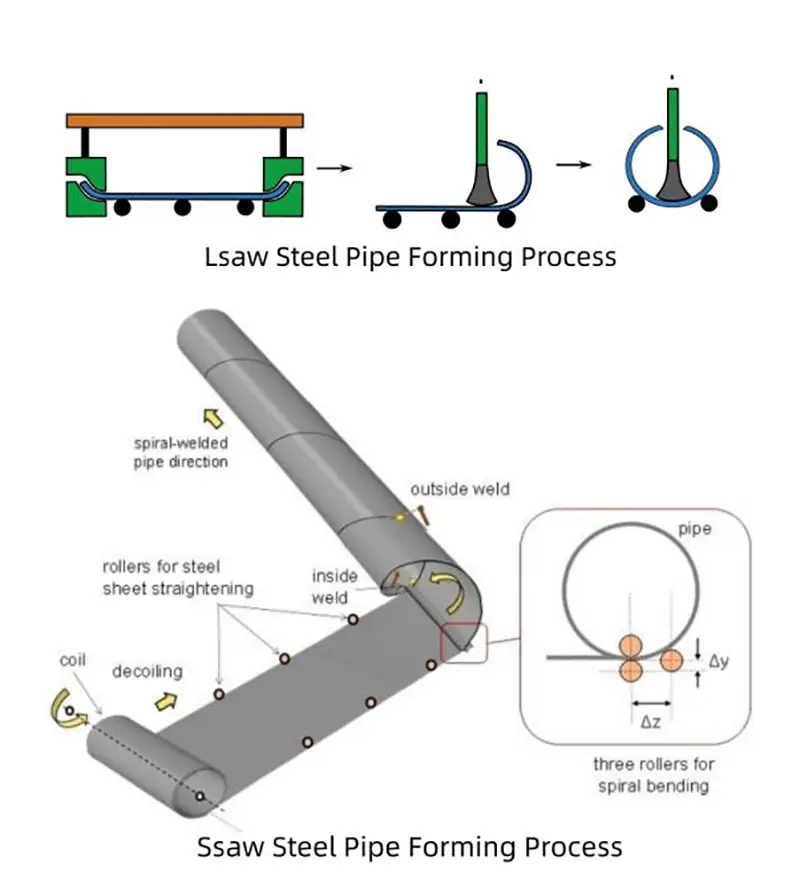
Cette différence fondamentale dans la fabrication est la clé pour comprendre leurs forces et faiblesses respectives.
Comparaison tête à tête : Performance et application
Voyons comment ces différences de fabrication se traduisent en termes de performances réelles.
1. Caractéristiques du cordon de soudure
Le cordon de soudure est un élément structurel essentiel du tube.
- LSAW : Se caractérise par un cordon de soudure court et droit. Du point de vue de la gestion des risques, il s'agit d'un profil d'inspection plus simple et plus fiable pour les essais non destructifs. La contrainte résiduelle résultant du processus de soudage est également plus faible et plus localisée.
- SSAW : La soudure est longue et hélicoïdale et peut être plus longue que le tuyau lui-même. Il peut s'agir d'un point de concentration de contraintes plus élevé, et la géométrie complexe peut rendre plus difficile une inspection complète par CND.
2. Précision dimensionnelle
Dans la construction de pipelines, des dimensions précises sont essentielles pour une installation efficace.
- LSAW : Le processus JCOE, en particulier la phase d'expansion mécanique, confère aux tubes LSAW une tolérance dimensionnelle supérieure, y compris une excellente rondeur et rectitude.
- SSAW : Le processus de formage en spirale, qui s'appuie sur une bobine continue, peut parfois donner lieu à un contrôle dimensionnel moins précis que la méthode des plaques discrètes du LSAW.
3. Gamme de production et rentabilité
Le choix implique souvent un compromis entre la production à haut rendement du procédé SSAW et la capacité de spécification élevée du procédé LSAW.
- LSAW : Elle excelle dans la production de tuyaux de très grand diamètre et, surtout, dans la production de tuyaux de très grand diamètre et, surtout, dans la production de tuyaux de très grand diamètre, fortes épaisseurs de paroi. Le processus est plus méticuleux et le coût par tonne est généralement plus élevé.
- SSAW : Il s'agit d'un procédé très efficace, capable de produire une très large gamme de diamètres à partir d'une seule largeur de bobine d'acier. Cela en fait souvent un choix plus rentable pour les applications où ses performances sont suffisantes.
4. Performances mécaniques
- LSAW : L'utilisation de plaques d'acier uniques garantit une grande uniformité et une grande cohérence du matériau de base. Ceci, combiné à l'intégrité vérifiée de la soudure droite, fait du LSAW l'étalon-or pour les applications critiques à haute pression.
- SSAW : La soudure hélicoïdale permet de répartir efficacement les contraintes de la ligne. Cependant, pour les services critiques à haute pression, la longueur du cordon de soudure et les variations potentielles à l'intérieur d'une bobine d'acier sont des considérations clés qui doivent être soigneusement évaluées par les ingénieurs de projet.
Tableau récapitulatif : LSAW vs. SSAW en bref
| Attribut | LSAW (Longitudinal) | SSAW (spirale / hélicoïdal) |
| Matières premières | Plaque d'acier simple | Bobine d'acier |
| Soudure | Droit, court, parallèle à l'axe du tuyau | Spirale, longue, hélicoïdale autour de l'axe du tube |
| Précision dimensionnelle | Excellent | Bon à la norme |
| Épaisseur de la paroi | Idéal pour les murs lourds et extra-lourds | Murs standards à moyens |
| Application typique | Pétrole et gaz à haute pression, offshore, service acide | Eau à basse/moyenne pression, structure, pieux |
| Avantage principal | Haute intégrité, capacité de paroi épaisse | Rentabilité, large gamme de diamètres |
La recommandation d'Allland Steel : Choisir le bon tuyau
Il n'y a pas de “meilleur” tuyau, mais seulement le tuyau le plus approprié pour une application spécifique. Nos conseils sont simples :
- Pour applications critiques impliquant une pression élevée, des parois lourdes, un service acide, un placement offshore, ou lorsque l'intégrité à long terme est la priorité absolue, Le tube LSAW est le choix le plus judicieux et le plus nécessaire.
- Pour applications générales comme la transmission d'eau à basse ou moyenne pression, les pieux structurels, ou lorsque la rentabilité des grands diamètres est un facteur déterminant, Le tube SSAW est souvent une solution excellente et appropriée.
L'équipe de Acier Allland est là pour vous aider à faire ces choix. Nous vous encourageons à nous contacter pour discuter des exigences techniques et commerciales spécifiques de votre projet afin de vous assurer que vous obtenez la solution de tuyauterie optimale.
Découvrez nos Tube LSAW et Tube SSAW pour obtenir des spécifications détaillées.
Ou Contactez un spécialiste chez Allland Steel pour une consultation personnalisée.
Dans le monde des tuyaux industriels, de nombreuses options existent, et une question fréquente posée par nos clients est de savoir pourquoi les tuyaux LSAW (Longitudinal Submerged Arc Welded) sont si souvent spécifiés pour les projets les plus critiques. Bien que d'autres tuyaux comme le SSAW ou le ERW aient certainement leur place, lorsque vous entrez dans le domaine des applications à haute pression et à enjeux élevés, les avantages des tuyaux LSAW ne sont pas seulement bénéfiques, ils sont irremplaçables.
Notre objectif ici est d'aller au-delà des simples définitions et d'expliquer les principes fondamentaux de l'ingénierie et de la science des matériaux qui font du LSAW le choix définitif pour les projets où la performance et la sécurité ne sont pas négociables.
Tout commence par les fondations : Une matière première et un façonnage de qualité supérieure
Un facteur critique souvent négligé est que la qualité finale d'un tube est prédéterminée par sa matière première et sa méthode de formage. La production de tubes LSAW commence par une seule et unique plaque d'acier laminée à chaud.
Du point de vue de la science des matériaux, il s'agit d'un avantage significatif. Une plaque unique présente des propriétés mécaniques plus cohérentes et une structure interne plus propre et plus uniforme que les bobines d'acier utilisées pour d'autres tuyaux soudés. Cette intégrité inhérente au matériau est la base sur laquelle reposent tous les autres avantages en termes de performances.
Principaux avantages des tubes LSAW dans les scénarios exigeants
Voici les avantages spécifiques, axés sur la performance, qui font des tubes LSAW le meilleur choix pour les applications haut de gamme.
1. Intégrité et sécurité des soudures inégalées
La soudure est le cœur de tout tube soudé. Le tube LSAW se caractérise par un seul cordon de soudure, droit et relativement court. Dans la pratique, cette géométrie simple présente deux avantages majeurs :
- Soudure minimaliste : Il présente le chemin de soudure le plus court possible, ce qui réduit statistiquement le risque d'imperfections.
- Inspection fiable : Le joint droit est idéal pour des contrôles non destructifs (CND) précis et très fiables, tels que l'inspection par ultrasons et par rayons X. Il permet de garantir un niveau d'intégrité de la soudure qu'il est difficile d'obtenir avec un joint hélicoïdal long. Cela nous permet de garantir un niveau d'intégrité de la soudure qui est difficile à atteindre avec le long joint hélicoïdal d'un tube SSAW.
2. Précision dimensionnelle exceptionnelle
Pour les ingénieurs et les équipes sur place, la stabilité dimensionnelle est cruciale. Grâce au processus de formage JCOE et en particulier à l'étape d'expansion mécanique, les tubes LSAW présentent une rondeur, une rectitude et un diamètre uniforme exceptionnels. Dans un scénario réel, cela se traduit directement par.. :
- Des délais plus courts pour les projets en raison d'un montage et d'un soudage plus faciles.
- Réduction des coûts de main-d'œuvre associés aux travaux de reprise et aux ajustements.
- Meilleure dynamique des flux dans le pipeline achevé.
3. Capacité inégalée pour les parois lourdes et l'acier de qualité supérieure
Lorsqu'un projet nécessite de repousser les limites de la pression et de la profondeur, il est essentiel d'utiliser des tuyaux à paroi épaisse. Le processus de fabrication de JCOE est le seul à pouvoir transformer des plaques d'acier extrêmement épaisses en tuyaux, ce qui représente un défi technique et économique pour les méthodes basées sur les bobines. Cela nous permet de produire des tubes LSAW d'une épaisseur de paroi importante, parfaitement adaptés aux applications en eaux profondes, en mer et aux applications gazières à haute pression. En outre, ce procédé est idéal pour les aciers de qualité supérieure tels que le X70, le X80 et d'autres encore, qui répondent aux exigences du transport moderne de l'énergie.
4. Performances supérieures en cas de service dégradé (environnements H₂S)
Pour nos clients du secteur pétrolier et gazier, la performance en service acide est une préoccupation majeure. L'acier propre des plaques simples et l'état stable et détendu des tubes LSAW (grâce à l'expansion mécanique) leur confèrent une résistance supérieure à la fissuration induite par l'hydrogène (HIC) et à la fissuration sous contrainte par les sulfures (SSC). Il s'agit d'une caractéristique de sécurité et de performance essentielle pour le transport de pétrole brut acide et de gaz naturel.
Le verdict d'Allland Steel : le bon tuyau pour la mission
Notre rôle en tant que spécialistes n'est pas seulement de vendre des tubes, mais de vous aider à choisir le bon produit en fonction des exigences spécifiques de votre projet. Si les tubes ERW sont excellents pour les applications à basse pression et les tubes SSAW offrent une solution rentable pour les conduites à basse pression de grand diamètre, les faits sont clairs.
Pour les infrastructures critiques où la sécurité, la fiabilité et la performance à long terme sont primordiales, le tube LSAW est le seul choix possible.
Pour découvrir les spécifications techniques de nos produits, veuillez consulter notre site web. Page de produits sur les tubes LSAW.
Ou Contactez un spécialiste chez Allland Steel pour discuter des exigences particulières de votre projet
Dans les industries à fort enjeu comme le pétrole et le gaz ou la construction offshore, où les spécifications du projet sont exigeantes et où l'échec n'est pas une option, le choix du tube de conduite est une décision d'ingénierie critique. D'après notre vaste expérience, les tubes LSAW (Longitudinal Submerged Arc Welded) constituent le meilleur choix pour ces applications. Sa performance supérieure n'est cependant pas un fait acquis - elle est forgée grâce à une méthode de production précise et avancée : le soudage à l'arc submergé (LSAW). Processus JCOE.
Pour apprécier à sa juste valeur la qualité d'un tube LSAW de première qualité, il est essentiel de comprendre l'ingénierie qui entre en jeu. Cet article fournit une vue d'ensemble claire et experte du processus JCOE, expliquant comment chaque étape méticuleuse contribue à l'intégrité et à la fiabilité du produit final.
Qu'est-ce que le processus JCOE ?
Le nom JCOE est un moyen mnémotechnique pour désigner les principales étapes mécaniques qui transforment une plaque d'acier plate en un tube haute performance : J-ing, C-ing, O-ing et Expanding.
Le procédé JCOE est une méthode de formage progressif hautement contrôlée. Contrairement à d'autres méthodes susceptibles d'introduire des contraintes imprévisibles, ce procédé est conçu pour la précision et la stabilité. Le principal avantage pour nos clients est que cette méthode permet de produire un tuyau d'une précision dimensionnelle exceptionnelle et aux propriétés matérielles uniformes du début à la fin.
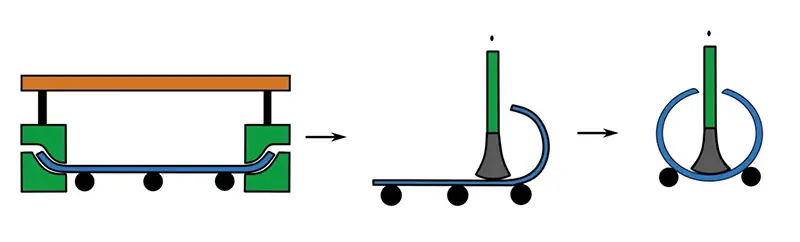
Le processus JCOE en détail : Un parcours d'ingénierie
Chaque tube LSAW que nous produisons suit un processus de fabrication rigoureusement contrôlé. Un facteur critique souvent négligé est l'impact direct de ces étapes initiales sur la qualité finale.
Étape 1 : Fraisage des bords de plaque et pré-pliage
Une soudure parfaite commence par un bord parfait. Il s'agit d'une première étape non négociable au cours de laquelle nous utilisons des fraiseuses de haute précision pour préparer les bords longs de la plaque d'acier. Cela permet de s'assurer que les bords sont parfaitement parallèles et profilés, ce qui est une condition préalable à une bonne soudure. Ensuite, les bords sont pré-pliés. D'un point de vue technique, cela permet d'éviter la formation de “pics” aigus au niveau du joint lors du formage final, ce qui garantit une courbure lisse et uniforme sur toute la circonférence du tuyau.
Étape 2 : Formation de J-C-O
C'est le cœur du processus de façonnage, où la géométrie brute est transformée en une forme cylindrique. La plaque passe par une série de puissantes presses hydrauliques :
- J-ing Press : Un côté de la plaque est pressé en forme de “J”.
- C-ing Press : Le côté opposé est ensuite formé, créant ainsi une forme de “C”.
- O-ing Press : Le tube est fermé dans sa forme finale en “O” à l'intérieur d'un ensemble de matrices, ce qui permet d'obtenir un joint étanche et uniforme pour le soudage.
Étape 3 : Soudage par points et soudage interne/externe
Notre engagement en faveur de l'intégrité des soudures est absolu. Le tube formé est d'abord soudé par points pour en fixer la géométrie. Ensuite, le soudage primaire est effectué à l'aide de l'outil de soudage Soudage à l'arc submergé (SAW) réputé pour sa stabilité et sa qualité. Nous le réalisons à la fois en interne et en externe pour garantir une soudure à pénétration totale, d'une résistance et d'une uniformité exceptionnelles.
Étape 4 : Expansion mécanique (l'étape “E”)
C'est sans doute l'étape la plus critique qui distingue les tuyaux fabriqués par JCOE. Le tube soudé est équipé d'une tête d'expansion interne. Cette tête exerce une pression immense et uniforme de l'intérieur vers l'extérieur, élargissant légèrement le diamètre du tube. Les avantages de cette étape sont considérables :
- Soulagement du stress : Il neutralise efficacement les tensions internes qui s'accumulent pendant les phases de formage et de soudage.
- Perfection dimensionnelle : Il garantit un niveau supérieur de rondeur et de rectitude, ce qui est essentiel pour un soudage et une installation efficaces sur site.
- Amélioration de la propriété : Ce processus permet d'obtenir un tuyau non seulement solide, mais aussi incroyablement stable et fiable sous pression.
Étape 5 : Essais hydrostatiques et essais non destructifs (END)
La vérification n'est pas seulement une étape finale, c'est une philosophie permanente. Chaque tuyau est soumis à une essai hydrostatique, La soudure est ensuite soumise à un test de résistance, qui consiste à la pressuriser bien au-delà de ses limites opérationnelles afin de confirmer sa solidité. L'ensemble du cordon de soudure subit également 100% Inspection NDT, L'inspection de la qualité de l'air et de l'eau, généralement par ultrasons et par rayons X, permet de détecter les imperfections invisibles à l'œil nu.
Étape 6 : Biseautage de l'extrémité du tube et inspection finale
Enfin, les extrémités des tuyaux sont biseautées selon des spécifications précises. Ainsi, lorsque le tuyau arrive sur le chantier, il est prêt pour une intégration sans faille et un soudage efficace, ce qui permet de gagner un temps précieux sur le projet. Un dernier contrôle visuel et dimensionnel confirme que le produit répond à tous les aspects de la norme requise.
Comment le processus JCOE garantit fondamentalement une qualité supérieure des tubes LSAW
Qu'est-ce que ce processus hautement contrôlé signifie pour votre projet ? Les avantages sont clairs et directs :
- ✅ Dimensions prévisibles et de haute précision : Pour les ingénieurs et les installateurs, cela signifie un montage plus rapide, moins de fabrication sur site et des soudures plus fiables.
- ✅ Fiabilité mécanique améliorée : Le tuyau détendu et dimensionnellement stable offre une plus grande marge de sécurité et une durée de vie plus longue, en particulier sous des charges cycliques ou à haute pression.
- ✅ Intégrité sans faille des soudures : Avec une soudure SAW double face contrôlée 100%, vous pouvez avoir une confiance absolue dans la solidité de la canalisation.
- ✅ Capacité à répondre à des spécifications exigeantes : Le procédé JCOE est la méthode définitive de production des tubes à paroi épaisse, de grand diamètre et de haute qualité nécessaires aux projets d'énergie et d'infrastructure les plus ambitieux du monde.
Choisir l'acier Allland, c'est choisir la confiance
Nous pensons qu'un client informé est notre meilleur partenaire. Comprendre les subtilités du processus JCOE vous permet d'apprécier la valeur et la fiabilité de chaque tube LSAW que nous livrons.
Si vous avez d'autres questions techniques ou si vous souhaitez discuter de la manière dont nos capacités de fabrication peuvent répondre aux exigences spécifiques de votre projet, notre équipe de spécialistes est prête à vous aider.
En savoir plus sur notre Produits pour tubes LSAW.
Ou Nous contacter directement pour une consultation professionnelle et un devis.
Une question fréquente et essentielle que nous posent les planificateurs de projets et les ingénieurs concerne les capacités de fabrication spécifiques de nos usines de tubes LSAW. La compréhension de ces paramètres est essentielle pour aligner nos forces de production sur les exigences uniques d'ingénierie et de conception de votre projet.
Au Acier Allland, Notre investissement important dans la technologie de fabrication moderne JCOE (J-ing, C-ing, O-ing, Expanding) nous permet de produire une gamme complète de tubes LSAW de haute qualité. Vous trouverez ci-dessous un aperçu détaillé de nos capacités de production standard.
Aperçu des capacités de production de base
Il est important de considérer ces données comme un guide général de nos capacités. Nous avons souvent la possibilité de produire des dimensions non standard ou personnalisées pour répondre à des demandes de projets spécifiques.
| Paramètres | Gamme de spécifications | Notes |
| Diamètre extérieur (OD) | 406,4 mm - 1524 mm (16″ - 60″) | Gamme continue disponible. |
| Épaisseur de la paroi (WT) | 6,0 mm - 60,0 mm (1/4″ - 3″) | La capacité d'utiliser des parois épaisses est un atout majeur. |
| Longueur | 3,0 m - 12,5 m (10” - 40”) | Peut être personnalisé en fonction des besoins du projet. |
| Normes de l'acier | API、ISO、EN、ASTM、DIN、JIS、GB、CSA、GOST | Conformité complète aux normes internationales. |
Au-delà des chiffres : Ce que nos capacités signifient pour votre projet
Si les chiffres fournissent un résumé technique, la véritable valeur réside dans ce qu'ils vous permettent de réaliser.
Grand diamètre et forte épaisseur de paroi
Notre capacité à produire des tubes d'un diamètre important et d'une forte épaisseur de paroi est essentielle pour les projets où la pression élevée et les charges externes significatives sont les principales préoccupations en matière de conception. Cela fait de nos tubes LSAW la solution idéale pour :
- Conduites principales de transport de gaz naturel à haute pression.
- Pipelines en eaux profondes et en mer.
- Composants structurels à grande échelle pour les ponts, les stades et les plates-formes offshore.
Acier de qualité supérieure (jusqu'à X70)
Du point de vue de l'économie du projet, l'utilisation d'un acier de haute qualité tel que l'acier à haute teneur en soufre est une bonne solution. API 5L X70 peut présenter des avantages significatifs. Un matériau de qualité supérieure permet de réduire l'épaisseur de la paroi tout en conservant la même pression nominale. Cela se traduit par :
- Un tube plus léger, réduisant le tonnage et le coût des matériaux.
- Réduction des frais de transport et de manutention.
- Réduction du temps de soudage et de la consommation de matériaux sur le site.
Un principe de base à Acier Allland est que nos normes de contrôle de la qualité sont absolues. Chaque tube, quelles que soient ses dimensions ou sa qualité d'acier, est soumis au même régime rigoureux d'inspection et d'essais, y compris des essais hydrostatiques et des essais non destructifs 100% sur le cordon de soudure.
Discutez de votre projet avec nos spécialistes
Les spécifications énumérées ci-dessus représentent nos capacités standard, mais nous travaillons souvent avec nos clients pour développer des solutions pour des projets uniques et difficiles. La meilleure façon de confirmer notre capacité à répondre à vos besoins spécifiques est de prendre contact avec notre équipe.
Nous sommes prêts à examiner vos spécifications techniques et à vous fournir un plan de fabrication détaillé qui s'aligne sur les objectifs et le calendrier de votre projet.
Pour des informations plus détaillées, veuillez consulter les données techniques sur notre site web. Page de produits sur les tubes LSAW.
Ou Contactez un spécialiste chez Allland Steel pour discuter de vos besoins spécifiques en matière de fabrication.
Le choix du bon revêtement anticorrosion est l'une des décisions les plus importantes pour garantir l'intégrité et la durée de vie à long terme d'un pipeline. Un choix courant et important auquel nos clients sont confrontés consiste à choisir entre deux systèmes de revêtement de premier plan : 3LPE et 3LPP.
Bien qu'il s'agisse dans les deux cas de systèmes avancés à trois couches offrant une protection exceptionnelle, ils ne sont pas interchangeables. Ils sont conçus pour répondre à des défis opérationnels différents. Notre objectif est de clarifier ces différences afin de vous permettre de faire le choix le plus fiable et le plus rentable pour votre projet.
Comprendre le socle commun à trois couches
Tout d'abord, il est important de comprendre ce que signifie le “3L”. Le 3LPE et le 3LPP partagent la même structure fondamentale et performante :
- Couche 1 : Fusion Bonded Epoxy (FBE) : Cette couche d'apprêt est appliquée directement sur la surface d'acier grenaillée. Son rôle principal est d'assurer une excellente adhérence et d'agir comme la principale barrière contre la corrosion.
- Couche 2 : adhésif copolymère : Il s'agit d'une “colle” qui crée une liaison chimique solide entre la couche d'époxy et la couche de finition.
- Couche 3 : couche de finition en polyoléfine : Il s'agit de la couche extérieure qui assure une protection mécanique robuste.
Le seulement La différence entre le 3LPE et le 3LPP réside dans le matériau utilisé pour cette troisième couche cruciale : le polyéthylène (PE) ou le polypropylène (PP). Cette seule différence change radicalement le profil de performance du revêtement.
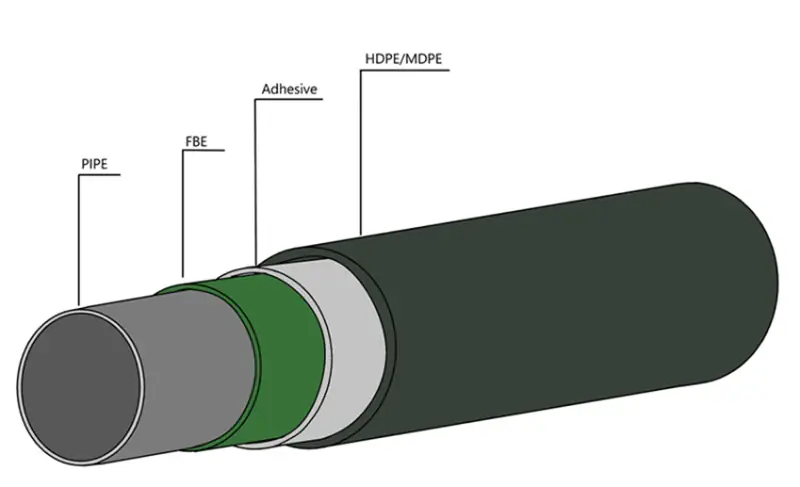
Tête à tête : 3LPE (polyéthylène) vs. 3LPP (polypropylène)
Comparons les deux systèmes sur la base des facteurs les plus importants dans la conception et l'exécution d'un projet.
1. Résistance à la température de fonctionnement : Le facteur décisif
D'un point de vue technique, la température de fonctionnement du pipeline est le facteur le plus important dans cette décision.
- 3LPE : C'est la norme industrielle pour les pipelines fonctionnant à des températures normales. Il offre des performances fiables pour un service continu jusqu'à 80-85°C (176-185°F).
- 3LPP : Il est spécialement conçu pour les applications à haute température. La couche de finition en polypropylène lui confère une résistance à la température nettement plus élevée, ce qui lui permet d'être utilisé en continu jusqu'à 110°C (230°F) et même plus pour les formulations spécialisées.
Un principe clé de la conception des pipelines est que le dépassement de la température limite d'un revêtement peut entraîner un vieillissement accéléré et une défaillance prématurée.
2. Propriétés mécaniques : Dureté et résistance à l'abrasion
La couche extérieure doit protéger le tuyau contre les dommages pendant le transport, l'installation et tout au long de sa durée de vie.
- 3LPP : Le polypropylène est un matériau intrinsèquement plus dur et plus rigide que le polyéthylène. Cela confère au 3LPP une résistance supérieure à l'abrasion, à l'impact, au gougeage et à la pénétration.
- 3LPE : Offre une excellente protection mécanique pour la plupart des conditions standard, mais est un matériau légèrement plus souple et plus flexible.
Cela fait du 3LPP le choix privilégié pour les environnements d'installation difficiles, tels que les terrains rocheux, les forages directionnels horizontaux (HDD) ou les zones où le sol est soumis à des contraintes importantes.
Tableau récapitulatif : Les principales différences en un coup d'œil
| Propriété | 3LPE (polyéthylène à trois couches) | 3LPP (Polypropylène à trois couches) |
| Temp. de fonctionnement max. Temp. de fonctionnement. | ~85°C (185°F) | >110°C (230°F) |
| Résistance mécanique | Excellent | Supérieure (plus dure, plus résistante à l'abrasion) |
| Flexibilité | Plus flexible | Plus rigide |
| Application typique | Standard onshore/offshore pétrole et gaz, eau | Pipelines à haute température, terrains difficiles (HDD) |
| Coût relatif | Standard | Plus élevé |
La recommandation d'Allland Steel : Quel revêtement vous convient le mieux ?
Nos conseils pour choisir entre ces deux excellents systèmes sont clairs et basés sur les besoins spécifiques de votre projet :
- Choisissez 3LPE si : La température de fonctionnement continue de votre pipeline restera inférieure à 80°C et l'environnement d'installation n'est pas exceptionnellement difficile. Pour la grande majorité des oléoducs, gazoducs et conduites d'eau, le 3LPE offre un équilibre optimal entre haute performance, fiabilité et rentabilité.
- Choisissez le 3LPP si : Votre pipeline fonctionnera à des températures élevées (supérieures à 80°C), sera installé dans un environnement difficile ou rocheux, ou nécessitera une résistance maximale aux dommages mécaniques. Bien que le 3LPP ait un coût initial plus élevé, il s'agit d'un investissement rentable pour les projets où sa résistance supérieure permet d'éviter des réparations futures coûteuses et de garantir l'intégrité à long terme de l'actif.
Le choix d'un système de revêtement a des conséquences durables. Les spécialistes de Acier Allland peut vous aider à analyser les données opérationnelles de votre projet afin de faire le choix le plus fiable et le plus efficace.
Pour en savoir plus sur nos capacités en matière de revêtement, veuillez Contactez un spécialiste chez Allland Steel.
Qualité et services
FAQ sur l'assurance qualité et le service : inspection, certificats d'essai d'usine (MTC), traçabilité, emballage et service après-vente pour les tubes en acier.
Dans les projets de construction et d'énergie complexes d'aujourd'hui, nous comprenons qu'une approche “unique” est rarement la solution la plus efficace. Nos clients nous demandent souvent quelles sont nos capacités au-delà de la fourniture de tuyaux standard.
Au Acier Allland, Nous sommes fiers d'être un partenaire de solutions. Nous offrons une gamme complète de services internes à valeur ajoutée conçus pour vous faire gagner du temps, réduire le travail sur site et livrer un produit qui est beaucoup plus proche de vos exigences d'installation finales. Notre objectif est de vous aider à rationaliser la chaîne d'approvisionnement de votre projet et d'en améliorer l'efficacité globale.
Nos services à valeur ajoutée
Nos services sont conçus pour s'intégrer parfaitement à notre fabrication de tuyaux, garantissant une source unique de contrôle de la qualité du début à la fin.
1. Coupe de précision à la longueur
Bien que nous fournissions des tubes de longueur standard, de nombreux projets nécessitent des dimensions spécifiques non standard.
- Notre service : Nous fournissons des services de coupe de précision pour livrer des tuyaux aux longueurs exactes requises par vos dessins techniques.
- Votre avantage : Ce service est particulièrement utile pour les applications de pieux et de structures. Il garantit que les tuyaux arrivent sur le site prêts à être utilisés immédiatement, éliminant ainsi la nécessité d'un découpage sur place, long et coûteux. Cela permet de réduire considérablement les déchets de matériaux, d'améliorer la sécurité sur le site et de respecter des calendriers de construction serrés.
2. Préparation de l'extrémité du tube
Des extrémités bien préparées sont essentielles pour un soudage efficace et de haute qualité.
- Notre service : Nous proposons des préparations finales contrôlées en usine, le plus souvent biseautage pour les applications de soudage bout à bout. Nous pouvons créer des biseaux précis et uniformes qui répondent aux spécifications du projet.
- Votre avantage : Un biseau parfait, de qualité industrielle, assure un meilleur ajustement pour les équipes de soudage, ce qui se traduit par des temps de soudage plus rapides et une soudure de meilleure qualité et plus fiable.
3. Revêtements et revêtements sur mesure
Notre expertise va au-delà des systèmes anticorrosion standard.
- Notre service : Nous travaillons avec nos clients pour appliquer une large gamme de revêtements spécialisés. Il peut s'agir de couleurs RAL personnalisées pour la charpente métallique exposée à l'architecture, de revêtements résistants à l'abrasion (ARO) pour les installations de pipelines sans tranchée (HDD), ou de revêtements internes spécifiques pour la résistance aux produits chimiques ou aux produits.
- Votre avantage : Nous pouvons concevoir une solution de revêtement complète adaptée aux critères esthétiques ou de performance uniques de votre projet, afin que vous n'ayez pas à faire de compromis avec un produit standard disponible sur le marché.
4. Fabrication et fixation des lumières
Pour simplifier davantage votre travail sur place, nous pouvons effectuer une fabrication légère dans notre environnement d'atelier contrôlé.
- Notre service : Cela inclut le soudage de précision de composants tels que les brides, les pattes de levage (essentielles pour la manipulation de pieux de grand diamètre) ou d'autres accessoires spécifiques à un projet.
- Votre avantage : L'exécution de ce travail dans nos locaux est généralement plus sûre, plus rapide et plus rentable que sur un chantier de construction très fréquenté. Cela nous permet de livrer des composants qui sont plus proches de leur état final assemblé, ce qui simplifie votre logistique et votre flux de travail.
L'avantage d'Allland Steel : Une solution unique
Du point de vue de la gestion de projet, l'intégration de ces services à votre approvisionnement en tuyaux offre un avantage significatif. Elle rationalise le processus d'approvisionnement, réduit le nombre de fournisseurs à gérer et confie la responsabilité de la qualité de bout en bout à un seul partenaire de confiance. Notre objectif est de fournir une solution plus complète, et pas seulement un produit.
Discutez de vos besoins spécifiques
Chaque projet présente des défis uniques. Nous vous invitons à nous faire part des vôtres.
Les spécialistes de Acier Allland s'engagent à trouver des solutions innovantes et efficaces qui améliorent la valeur que nous apportons à votre projet. Contactez-nous dès aujourd'hui pour discuter de vos besoins spécifiques en matière de fabrication et de revêtement.
La question la plus fondamentale qu'un client puisse poser est la suivante : “Comment garantissez-vous la qualité ?”. À Acier Allland, Pour nous, la qualité n'est pas une caractéristique à contrôler en fin de chaîne ; c'est un principe fondamental qui est intégré à chaque étape de notre processus, de l'approvisionnement en matières premières à l'expédition finale.
Notre engagement est de fournir non seulement un produit qui répond à une norme, mais un produit qui inspire une confiance absolue dans la sécurité et la longévité de votre projet. Nous y parvenons grâce à notre système de gestion de la qualité complet et en plusieurs étapes.
Un système de gestion de la qualité en plusieurs étapes
Notre philosophie en matière de qualité est celle de la prévention, et pas seulement de la détection. Nous garantissons l'excellence grâce à un processus rigoureux qui comprend les étapes clés suivantes.
1. Inspection rigoureuse des matières premières
Il est impossible de créer un produit fini de haute qualité à partir d'une matière première de qualité inférieure. C'est pourquoi notre processus de qualité commence avant même le début de la production.
- Vérification du fournisseur : Nous nous approvisionnons en tôles et bobines d'acier exclusivement auprès d'usines réputées et préqualifiées.
- Validation du certificat : Chaque lot de matière première entrant est accompagné d'un certificat d'essai de l'usine (MTC), que nous vérifions méticuleusement par rapport aux normes requises.
- Tests indépendants : Nous effectuons nos propres analyses chimiques et essais mécaniques indépendants sur des échantillons de la matière première afin de confirmer qu'elle répond aux spécifications précises du projet. Cela permet de s'assurer que les fondations de votre tuyau sont impeccables.
2. Surveillance et contrôle en cours de fabrication
Au cours du processus de fabrication, nos équipes chargées de la qualité contrôlent les paramètres critiques en temps réel afin de garantir la cohérence et la conformité. Ces paramètres sont les suivants
- Contrôle dimensionnel : Contrôles continus du diamètre, de l'épaisseur de la paroi et de la rondeur pendant les phases de formage.
- Contrôle des paramètres de soudage : Surveillance numérique en temps réel des variables clés de notre procédé de soudage à l'arc submergé (SAW), telles que l'ampérage, la tension et la vitesse de déplacement, afin de garantir une soudure cohérente et de haute intégrité.
- Inspection visuelle : Des inspecteurs formés sont postés à chaque point de transition clé de la ligne de production afin d'identifier toute imperfection de surface.
3. Inspection et essais finaux complets
C'est l'étape finale de vérification, où chaque tuyau fini est soumis à une batterie de tests pour prouver sa qualité.
- Essai hydrostatique : 100% de nos tuyaux destinés à être utilisés sous pression subissent un test hydrostatique. Le tuyau est pressurisé avec de l'eau à un niveau nettement supérieur à sa capacité opérationnelle afin de garantir sa résistance et son étanchéité.
- Essais non destructifs (END) : 100% du cordon de soudure de chaque tuyau est inspecté à l'aide de méthodes CND avancées, telles que le contrôle par ultrasons (UT) et/ou l'inspection par rayons X, afin de détecter toute imperfection sous la surface.
- Essais destructifs : Des échantillons de chaque lot de production sont soumis à une série d'essais destructifs dans notre laboratoire. Il s'agit notamment d'essais de traction (pour vérifier la résistance), d'essais de pliage (pour vérifier la ductilité) et d'essais d'impact Charpy (pour vérifier la résistance à la rupture), qui apportent la preuve définitive des propriétés mécaniques du tube.
4. Traçabilité et documentation complètes
Nous pensons que la transparence est le fondement de la confiance. Notre système de qualité garantit une traçabilité totale de chaque produit. Chaque tuyau est marqué d'un identifiant unique qui permet de remonter jusqu'à son lot de production spécifique, la matière première à partir de laquelle il a été fabriqué et tous les résultats des tests associés. Ces informations sont compilées dans un Type 3.1 Certificat d'essai de broyage (MTC) conformément à la norme EN 10204, qui vous est fournie en tant qu'enregistrement complet de la qualité de votre produit.
La garantie de qualité d'Allland Steel
Notre réputation repose sur la confiance que nos clients accordent à nos produits. Cette confiance est gagnée chaque jour grâce à un engagement inébranlable en faveur de la qualité à tous les niveaux de notre organisation. Lorsque vous vous associez à Acier Allland, Vous vous associez à une entreprise qui se consacre à la performance, à la fiabilité et à la tranquillité d'esprit.
Pour en savoir plus sur nos certifications et nos processus de qualité, contacter un spécialiste d'Allland Steel.
Absolument. De notre point de vue, un tube d'acier livré sans un certificat d'essai d'usine (MTC) complet et précis est un produit incomplet. Nous considérons le CTM comme un élément fondamental de notre offre, car il vous fournit la preuve ultime de la qualité et de la traçabilité complète de vos matériaux.
La fourniture d'un CTM complet avec chaque commande est un élément essentiel et non négociable de notre processus d'assurance qualité.
Quelles sont les informations contenues dans notre CTM ?
Lorsque vous recevez un envoi de Acier Allland, Il sera accompagné d'un MTC qui fournira un résumé complet des propriétés testées du produit. Vous pouvez vous attendre à trouver les informations clés suivantes :
- Description du produit : Y compris la norme (par exemple, API 5L), la qualité (par exemple, X70), le niveau de spécification du produit (PSL) et les dimensions complètes.
- Numéro de chauffage : Un code unique qui permet une traçabilité complète jusqu'au lot spécifique d'acier utilisé pour fabriquer votre tuyau.
- Composition chimique : Une analyse détaillée indiquant le pourcentage précis d'éléments chimiques clés dans l'acier.
- Propriétés mécaniques : Les résultats spécifiques et mesurés des essais destructifs, y compris :
- Limite d'élasticité
- Résistance à la traction
- Élongation
- Résultats de tests supplémentaires : Les résultats de tout autre essai requis par la norme, tels que les valeurs de résilience Charpy ou la pression et la durée de l'essai hydrostatique.
- Déclaration de conformité : Déclaration formelle selon laquelle le produit a été fabriqué et testé en totale conformité avec les exigences de la norme commandée.
Notre adhésion à la norme EN 10204
Afin de garantir la clarté, la cohérence et la reconnaissance mondiale de notre documentation, nos MTC sont délivrés conformément à la norme européenne EN 10204.
- Dans le cadre de nos pratiques habituelles, nous fournissons un Type 3.1 MTC. Ce certificat est validé par notre service de contrôle de la qualité agréé, qui opère indépendamment de notre division de production, ce qui garantit l'intégrité des résultats.
- Pour les projets dont les exigences en matière d'assurance qualité sont les plus strictes, nous pouvons également faciliter la mise en place d'un système d'assurance de la qualité. Type 3.2 MTC, qui implique une co-validation par une agence d'inspection indépendante agréée.
Pour une explication complète des différents types de certificats et de leur importance, nous vous invitons à lire notre guide détaillé sur le sujet.
En savoir plus : Comprendre la norme EN 10204 : La norme pour les certificats d'essai des matériaux
La promesse d'Allland Steel
Le CTM est notre promesse documentée de qualité et de transparence à votre égard. Lorsque vous vous associez à Acier Allland, Vous recevez donc non seulement un produit de qualité supérieure, mais aussi une documentation complète et fiable qui le prouve.
Si vous avez des questions sur l'interprétation de votre certificat ou si vous avez des besoins spécifiques en matière de documentation pour votre projet, notre équipe est toujours là pour vous aider.
Normes et spécifications
Explorer les normes et spécifications des tuyaux FAQ : découvrez les règles API 5L, ASTM, EN et DIN pour les tuyaux en acier afin de garantir une qualité, un grade et une fabrication corrects.
L'une des questions les plus importantes et les plus fréquemment posées dans le cadre de la norme critique API 5L relative aux tuyaux de canalisation concerne la distinction entre PSL1 et PSL2. De notre point de vue de spécialistes de l'industrie, il s'agit plus que d'un détail technique ; c'est une décision fondamentale qui a un impact direct sur la sécurité, la performance et l'intégrité à long terme d'un pipeline.
Notre objectif est de clarifier cette distinction, afin d'aider les ingénieurs, les chefs de projet et les équipes chargées des achats à spécifier le bon produit en toute confiance.
Que signifie PSL ?
PSL signifie Niveau de spécification du produit. L'American Petroleum Institute (API) a créé ces deux niveaux distincts afin de fournir des niveaux clairs d'exigences techniques et de qualité pour les conduites utilisées dans l'industrie du pétrole et du gaz.
- PSL1 : Représente le niveau de qualité standard pour les tubes de canalisation.
- PSL2 : Représente un niveau de qualité supérieur avec des exigences nettement plus strictes en matière d'essais, de composition chimique et de propriétés mécaniques.
Les principales différences : Une plongée plus profonde
Alors que les deux niveaux doivent répondre aux exigences de base de l'API 5L, la PSL2 introduit une série de contrôles plus stricts. Examinons les différences les plus importantes.
1. Composition chimique
D'un point de vue métallurgique, les contrôles chimiques plus stricts pour PSL2 sont fondamentaux.
- PSL2 comporte des limites maximales plus strictes pour des éléments clés tels que le carbone, le phosphore et le soufre. Elle impose également un équivalent carbone maximal (CEQ), qui est essentiel pour garantir une bonne soudabilité.
- PSL1 a des limites chimiques plus souples.
Pourquoi c'est important : L'acier plus propre et plus étroitement contrôlé requis pour la PSL2 permet d'obtenir un tube plus résistant, plus soudable et mieux adapté aux conditions de service exigeantes, en particulier au service acide (H₂S).
2. Propriétés mécaniques
Il s'agit sans doute du domaine de différenciation le plus important.
- PSL2 comporte des exigences minimales obligatoires en matière de résistance à la rupture (mesurée par l'essai d'impact Charpy). Elle prévoit également une limite maximale pour le rapport entre la limite d'élasticité et la résistance à la traction.
- PSL1 n'a pas d'exigences obligatoires en matière de ténacité (sauf si l'acheteur le spécifie en tant qu'exigence supplémentaire).
Pourquoi c'est important : La ténacité est la capacité d'un matériau à résister à la propagation d'une fracture. Pour toute canalisation présentant un risque important, comme les conduites de gaz à haute pression ou celles situées dans des environnements à basse température, la ténacité obligatoire de la norme PSL2 n'est pas négociable pour garantir la sécurité.
3. Processus de fabrication et traçabilité
- PSL2 interdit certaines pratiques, telles que la réparation du corps de la canalisation, qui peuvent être autorisées en vertu de la LSIP1.
- PSL2 exige également une traçabilité totale, ce qui signifie que chaque tuyau peut être retracé jusqu'à la température spécifique de l'acier à partir duquel il a été fabriqué. La norme PSL1 n'exige la traçabilité que jusqu'à ce que tous les tests soient réussis.
Tableau récapitulatif : PSL1 vs. PSL2 en un coup d'œil
| Exigence | PSL1 | PSL2 |
| Composition chimique | Limites standard | Limites plus strictes et CEQ maximum |
| Résistance aux chocs | Non requis (sauf indication contraire) | Obligatoire |
| Rapport entre la limite d'élasticité et la résistance à la traction | Non spécifié | La limite maximale est obligatoire |
| Réparation par soudure de la carrosserie | Autorisé | Non autorisé |
| Traçabilité | Obligatoire jusqu'à la réussite des tests | Exigée tout au long de la production |
La recommandation d'Allland Steel : Comment choisir
Une règle empirique utile consiste à envisager les conséquences d'un échec.
- Choisissez PSL1 pour : Applications standard, moins critiques. Il s'agit notamment des pipelines où les pressions de service et les risques environnementaux sont modérés. C'est un choix fiable et plus économique pour une large gamme d'utilisations générales.
- Choisissez PSL2 pour : Applications critiques pour lesquelles la sécurité et la fiabilité sont des priorités absolues. Il s'agit de la norme requise pour :
- Lignes de transport de gaz à haute pression
- Pipelines offshore
- Pipelines situés dans des zones sensibles sur le plan environnemental ou à basse température
- Applications du service acide (H₂S)
Le coût initial supplémentaire d'une conduite conforme à la norme PSL2 est un investissement judicieux pour l'intégrité des actifs à long terme et l'atténuation des risques.
Notre engagement en matière de conformité
Naviguer dans les normes techniques peut s'avérer complexe, mais notre équipe est là pour vous aider. Acier Allland possède l'expertise éprouvée et les capacités de fabrication avancées pour produire des tubes LSAW et SSAW entièrement conformes aux exigences PSL1 et PSL2 de la dernière édition de l'API 5L.
Pour des spécifications techniques détaillées, veuillez consulter notre site web Page des normes API 5L.
Ou Contactez un spécialiste chez Allland Steel pour s'assurer que le tube que vous commandez répond aux exigences précises de votre projet.
Si le système de revêtement 3LPE est bien connu pour sa protection supérieure des pipelines, la qualité de son application n'est pas une question de supposition. Il est régi par des normes internationales rigoureuses, dont l'une des plus respectées et des plus fréquemment spécifiées est la suivante DIN 30670.
Pour nos clients, la compréhension de cette norme est essentielle pour apprécier le niveau de qualité, de durabilité et de fiabilité à long terme que vous obtenez lorsque vous spécifiez un revêtement conforme. C'est le point de référence qui sépare un revêtement standard d'un système de protection des biens à haute performance et à longue durée de vie.
Qu'est-ce que la norme DIN 30670 ?
DIN 30670 est une norme technique publiée par l DIN (Deutsches Institut für Normung), Elle est publiée par l'Institut allemand de normalisation. Elle décrit spécifiquement les exigences relatives aux revêtements en polyéthylène extrudé à trois couches (3LPE) appliqués en usine sur les tuyaux et les raccords en acier pour la protection contre la corrosion.
Bien que d'origine allemande, les exigences exhaustives et rigoureuses de la norme DIN 30670 lui ont valu d'être adoptée comme référence mondiale en matière de qualité par les propriétaires, les ingénieurs et les fabricants de pipelines du monde entier.
Principaux paramètres de qualité réglementés par la norme DIN 30670
S'engager à respecter la norme DIN 30670, c'est s'engager à fournir des performances vérifiables. Voici les paramètres de qualité essentiels que la norme réglemente, et pourquoi ils sont importants pour votre projet.
1. Épaisseur du revêtement
La norme impose une épaisseur minimale pour la couche extérieure de polyéthylène, qui varie en fonction du diamètre du tuyau.
- Pourquoi c'est important : Du point de vue de la protection des actifs, une épaisseur suffisante est la première ligne de défense contre les dommages physiques. Cela garantit que le tuyau est suffisamment robuste pour résister aux rigueurs du transport, à la manutention sur site et aux contraintes du remblayage lors de l'installation.
2. Résistance au pelage / Adhésion
Ce test crucial mesure la force nécessaire pour décoller le revêtement du substrat en acier sous des angles et à des températures spécifiques.
- Pourquoi c'est important : Il s'agit d'une mesure directe de la force d'adhérence du revêtement. Une excellente adhérence entre les trois couches est fondamentale pour la performance du système. Elle empêche l'humidité de s'infiltrer sous le revêtement et de provoquer la corrosion. Une valeur élevée de résistance au pelage est la marque d'un revêtement correctement appliqué et de haute intégrité.
3. Résistance aux chocs
Ce test évalue la résistance du revêtement en faisant tomber un poids spécifié d'une hauteur déterminée sur le tuyau revêtu. Ensuite, la zone d'impact est testée pour détecter d'éventuelles “vacances” (trous d'épingle ou fissures).
- Pourquoi c'est important : Cela simule les impacts réels qu'un tuyau peut subir au cours de son voyage de l'usine à la tranchée. Un résultat positif démontre que le revêtement est résistant et résilient, et non cassant.
4. Décollement cathodique
Il s'agit de l'un des tests de performance à long terme les plus critiques. Il mesure la capacité du revêtement à résister au “décollement” de la surface de la conduite en présence d'un courant électrique provenant d'un système de protection cathodique, en particulier à un endroit légèrement endommagé.
- Pourquoi c'est important : Une faible valeur de décollement cathodique est essentielle pour la santé à long terme du pipeline. Elle garantit que si une petite fuite se produit, la corrosion sera limitée à cette petite zone et ne se propagera pas sous le revêtement.
L'engagement d'Allland Steel en matière de qualité
Le respect de normes exigeantes est au cœur de notre philosophie de fabrication. Les revêtements 3LPE appliqués à Acier Allland sont conçus et rigoureusement testés pour satisfaire ou dépasser les exigences rigoureuses énoncées dans la norme DIN 30670.
Lorsque vous spécifiez un revêtement 3LPE à partir de Acier Allland, Grâce à notre engagement, vous ne commandez pas seulement un produit, vous investissez dans un système de protection dont la qualité et les performances à long terme ont été vérifiées par rapport à l'un des critères de référence les plus fiables au monde. Cet engagement offre à nos clients une tranquillité d'esprit et une confiance dans la longévité de leurs actifs critiques.
Pour discuter des exigences spécifiques en matière de revêtement pour votre prochain projet, contactez nos spécialistes techniques chez Allland Steel.
Dans le monde des tuyaux en acier au carbone, les normes ASTM A53, ASTM A106 et API 5L sont les trois plus importantes. L'un des points de confusion les plus courants que nous traitons pour nos clients est la compréhension de leurs objectifs distincts. Bien que ces tuyaux puissent sembler similaires, ils sont conçus pour des applications très différentes, et le choix de la bonne norme est une étape essentielle pour garantir la sécurité, la conformité et la rentabilité d'un projet.
Notre objectif est de clarifier les principales différences entre ces spécifications, afin que vous puissiez choisir en toute confiance le bon matériau pour votre application spécifique.
L'objectif principal de chaque norme
La façon la plus simple de comprendre la différence est de commencer par l'application principale pour laquelle chaque norme a été conçue.
- ASTM A53: Il s'agit de la norme générale pour les tuyaux. Elle est principalement destinée aux applications mécaniques et sous pression, ainsi qu'aux utilisations ordinaires dans les conduites de vapeur, d'eau, de gaz et d'air. Il s'agit de la norme pour la plomberie générale et les applications structurelles.
- ASTM A106 : Il s'agit du spécialiste des hautes températures. La norme est rédigée exclusivement pour les tuyaux sans soudure en acier au carbone destinés à être utilisés à haute température et à haute pression. C'est le choix qui s'impose pour des applications telles que les tuyauteries de centrales électriques, les chaudières et les raffineries.
- API 5L: Il s'agit de la norme des professionnels des pipelines. Elle est spécifiquement rédigée pour l'industrie pétrolière et gazière et régit les tuyaux utilisés pour le transport des hydrocarbures (pétrole, gaz) et de l'eau dans les systèmes de transport par pipeline.
Explication des principales différences techniques
Les objectifs différents de ces normes entraînent des différences cruciales dans leurs exigences techniques.
1. Méthode de fabrication
Il s'agit là d'une des distinctions les plus fondamentales.
- ASTM A53 : Ils peuvent être sans soudure ou soudés (typiquement ERW - Electric Resistance Welded).
- ASTM A106 : Est exclusivement sans couture. Il s'agit d'une exigence non négociable pour le service à haute température auquel il est destiné, car elle élimine le cordon de soudure en tant que point de faiblesse potentiel sous contrainte thermique.
- API 5L : Ils peuvent être sans soudure ou soudés (ERW, LSAW, SSAW), couvrant ainsi la large gamme de méthodes de fabrication utilisées dans l'industrie des pipelines.
2. Composition chimique
Du point de vue des matériaux, la composition chimique est adaptée à l'application.
- ASTM A106 : Inclut délibérément du silicium (min 0,10%), ce qui améliore ses performances et sa résistance dans les environnements à haute température. Les contrôles sur les éléments tels que le soufre et le phosphore sont également plus stricts que pour la norme A53.
- ASTM A53 : A des exigences chimiques plus générales.
- API 5L : Elle présente une progression détaillée des exigences chimiques qui deviennent plus strictes avec les grades supérieurs (par exemple, X42, X52, X70) afin de garantir la soudabilité et la ténacité. Les spécifications PSL2 ont des contrôles chimiques particulièrement stricts.
3. Propriétés mécaniques
Les exigences en matière de résistance et de ténacité sont directement liées au service prévu.
- API 5L : Il offre une gamme beaucoup plus large de degrés de résistance (jusqu'à X80 et au-delà) et met fortement l'accent sur la ténacité à la rupture, qui est obligatoire pour la spécification PSL2. Cet aspect est essentiel pour garantir l'intégrité des pipelines de longue distance.
- ASTM A106 & A53 : Ils sont proposés dans quelques qualités courantes (par exemple, qualité A, B, C) avec des exigences de résistance standard et généralement pas d'essais de ténacité obligatoires, sauf spécification du client.
Tableau récapitulatif : A53 vs. A106 vs. API 5L en bref
| Attribut | ASTM A53 | ASTM A106 | API 5L |
| Application primaire | Fluide à usage général, structurel | Service à haute température et à haute pression | Systèmes d'oléoducs et de gazoducs |
| Type de fabrication | Sans soudure ou avec soudure (ERW) | Exclusivement sans couture | Sans soudure ou soudé (tous types) |
| Plage de température | Modéré | Haut | Large gamme, avec une résistance aux basses températures |
| Élément chimique clé | Contrôles généraux | Silicium ajouté pour une résistance à haute température | Contrôle strict basé sur le grade/PSL |
| Notes | Gr. A, B | Gr. A, B, C | Large gamme (par exemple, B, X42, X52, X60, X70) |
Le guide de l'acier Allland : Faire le bon choix
Une erreur fréquente et dangereuse consiste à penser que ces normes sont interchangeables. Notre rôle, en tant que partenaire technique, est de veiller à ce que vous receviez un produit qui n'est pas seulement certifié selon une norme, mais qui est aussi le meilleur produit du marché. correctes pour votre application.
Voici un guide de décision simple :
- Votre application est-elle d'usage général ?, Les installations de l'entreprise peuvent-elles être utilisées à des fins de sécurité, comme de l'eau à basse pression, des conduites d'air ou des supports structurels ? ASTM A53 est le choix le plus judicieux et le plus économique.
- Votre application doit-elle être utilisée à haute température ? (par exemple, conduites de vapeur, tuyauteries de processus) et doivent être sans soudure ? ASTM A106 est le choix obligatoire et le seul approprié.
- Vous transportez du pétrole, du gaz ou de l'eau dans un pipeline ? API 5L est la norme industrielle requise. L'étape suivante consiste à sélectionner le grade et le niveau de LSP appropriés.
Naviguer dans les nuances des normes des tubes en acier est notre expertise. L'équipe technique de Acier Allland est disponible pour examiner les spécifications de votre projet et s'assurer que votre matériau est optimisé en termes de performance, de sécurité et de conformité.
Contactez un spécialiste technique chez Allland Steel pour discuter des exigences de votre projet.
Toute grande structure repose sur des fondations solides. Dans le génie civil moderne, les pieux tubulaires en acier sont la pierre angulaire de cette fondation, et la norme qui régit leur qualité et leur performance est la suivante ASTM A252.
Nous demandons souvent à nos clients des secteurs de la construction et de la géotechnique pourquoi cette norme spécifique est si importante. La raison en est simple : un tuyau fabriqué selon la norme A252 n'est pas une simple section creuse en acier ; c'est un élément structurel spécifiquement conçu pour supporter d'énormes charges et assurer la stabilité des bâtiments, des ponts et des structures marines pendant des générations.
Qu'est-ce que l'ASTM A252 ?
ASTM A252 est la désignation officielle de la spécification standard de l'American Society for Testing and Materials qui couvre les éléments suivants pieux en tubes d'acier avec ou sans soudure.
Son champ d'application est très spécifique. Il couvre les tubes d'acier de forme cylindrique destinés à l'un des deux usages principaux :
- En tant qu'élément permanent et porteur d'une fondation.
- En tant que coque ou enveloppe pour former des pieux en béton coulés sur place.
La distinction essentielle à faire est que le tube A252 est pas destinés au transport de fluides sous pression. L'intégrité structurelle et la performance des fondations sont au centre de ses préoccupations.
Pourquoi l'ASTM A252 est le choix idéal pour les pieux
Bien que d'autres tuyaux puissent sembler similaires, la norme A252 comporte plusieurs caractéristiques qui la rendent particulièrement adaptée aux travaux de fondation.
1. Une attention particulière portée à la limite d'élasticité minimale
Du point de vue de l'ingénierie structurelle, la propriété la plus importante d'un pieu est sa capacité à supporter des charges sans déformation permanente.
- La norme : L'ASTM A252 concerne principalement limite d'élasticité minimale, Il offre trois niveaux distincts :
- Première année : Limite d'élasticité minimale de 30 ksi (207 MPa)
- 2e année : Limite d'élasticité minimale de 35 ksi (241 MPa)
- 3e année : Limite d'élasticité minimale de 45 ksi (310 MPa)
- Pourquoi c'est important : Cela permet aux ingénieurs de sélectionner le grade précis qui correspond à leurs calculs de charge de conception, garantissant à la fois la sécurité et l'efficacité économique.
2. Exigences en matière de rectitude
Un pieu doit être enfoncé directement dans le sol pour fonctionner comme prévu.
- La norme : La norme ASTM A252 contient des tolérances spécifiques pour la rectitude du tube.
- Pourquoi c'est important : Cela permet de s'assurer que le pieu peut être enfoncé efficacement et que la charge est transférée axialement au sol porteur ou à la roche mère. Un pieu qui n'est pas droit peut se déformer sous l'effet de la charge, ce qui compromet l'ensemble de la fondation.
3. Exigences flexibles en matière de produits chimiques pour un meilleur rapport coût-efficacité
Il s'agit d'une caractéristique unique et délibérée de la norme A252.
- La norme : Contrairement aux normes relatives aux conduites sous pression (comme API 5L), l'ASTM A252 ne pas imposent des limites strictes à la composition chimique de l'acier, comme la teneur en phosphore.
- Pourquoi c'est important : Cette flexibilité permet aux fabricants d'utiliser une plus large gamme de sources d'acier. Étant donné que le rôle principal du tube est d'assurer la résistance structurelle et non de contenir des fluides à haute pression ou de résister à des types spécifiques de corrosion, ces contrôles chimiques rigoureux ne sont pas nécessaires. Cela fait du tube A252 un produit de haute qualité. économique et facilement disponible solution pour les travaux de fondation.
L'avantage d'Allland Steel pour les projets de pieux
La construction d'une fondation en laquelle vous pouvez avoir confiance pendant des générations commence par des matériaux sur lesquels vous pouvez compter aujourd'hui. À l'adresse Acier Allland, Nous fabriquons des pieux tubulaires LSAW et SSAW de haute qualité qui satisfont et dépassent les exigences de la norme ASTM A252 dans les trois catégories. Notre capacité à produire des tuyaux de grand diamètre et à paroi épaisse fait de nous un partenaire idéal pour les grands projets d'infrastructure.
Nous comprenons le rôle essentiel que jouent ces produits. Notre engagement en faveur de la qualité garantit que les pieux que nous livrons constitueront la base d'un projet de construction sûr et réussi.
Pour discuter des besoins en pieux de votre prochain pont, bâtiment ou projet maritime, contacter un spécialiste d'Allland Steel.
Dans tout achat industriel, en particulier pour des matériaux critiques comme les tubes en acier, la traçabilité et la vérification de la qualité sont primordiales. Le certificat d'essai d'usine (MTC) - également connu sous le nom de rapport d'essai d'usine (MTR) - est le principal document qui fournit cette assurance.
Une question fréquente et importante que nous recevons, en particulier de la part de clients impliqués dans des projets européens ou de grands projets internationaux, porte sur les points suivants EN 10204 Cette norme est essentielle pour comprendre les différents niveaux de certification des matériaux et ce qu'ils signifient pour l'assurance qualité de votre projet. Cette norme est la clé pour comprendre les différents niveaux de certification des matériaux et ce qu'ils signifient pour l'assurance qualité de votre projet. Notre objectif est de clarifier ce que cette norme implique et ce que vous pouvez attendre des Acier Allland.
Qu'est-ce que la norme EN 10204 ?
La norme européenne EN 10204 spécifie les différents types de “documents d'inspection” qui peuvent être fournis à un acheteur de produits métalliques. En bref, elle crée un système normalisé et universellement compris pour certifier que les propriétés chimiques et mécaniques d'un produit sont conformes aux spécifications de la commande. Elle garantit que le fabricant et l'acheteur parlent le même langage en matière de documentation sur la qualité.
Les principaux types de certificats expliqués
La norme EN 10204 définit plusieurs types de documents, mais dans l'industrie des tubes en acier, les plus pertinents sont le type 2.2, le type 3.1 et le type 3.2.
Type 2.2 : Rapport d'essai
Il s'agit d'un document dans lequel le fabricant déclare que les produits sont conformes à la commande et fournit les résultats d'une inspection non spécifique. Cela signifie que les résultats des tests sont basés sur les procédures de qualité habituelles du fabricant et qu'ils peuvent ne pas provenir du lot réel de matériel livré.
Type 3.1 : Certificat d'inspection 3.1
Il s'agit du certificat le plus courant et le plus largement accepté pour les applications industrielles.
- Ce que c'est : Un certificat délivré et validé par le représentant autorisé du fabricant, qui doit être indépendant du service de fabrication.
- Ce qu'il contient : Il affirme que les produits sont conformes à l'ordonnance et, ce qui est essentiel, il inclut les éléments suivants les résultats d'essais spécifiques effectués sur le lot réel de produits fournis.
- Pourquoi c'est important : Du point de vue de l'assurance qualité, le certificat de type 3.1 constitue le lien essentiel et traçable entre le produit physique que vous recevez et les essais spécifiques qui prouvent sa conformité aux normes requises.
Type 3.2 : Certificat d'inspection 3.2
Il s'agit du niveau de certification le plus élevé de la norme EN 10204.
- Ce que c'est : Un certificat de type 3.1 qui a également été contresigné et validé par un organisme de certification. autorité d'inspection indépendante (tels que Lloyd's Register, DNV, TÜV) ou l'inspecteur agréé de l'acheteur.
- Pourquoi il est utilisé : Ceci est nécessaire pour les applications les plus critiques (par exemple, l'énergie nucléaire, certains composants offshore ou d'appareils à pression) où les spécifications du projet exigent une validation impartiale et externe des résultats d'essais du fabricant.
Quel type de CTM Allland Steel offre-t-il ?
Au Acier Allland, Pour toutes les commandes nécessitant une validation spécifique des matériaux, notre pratique habituelle consiste à fournir un formulaire de demande de validation. Type 3.1 Certificat d'essai de broyage conformément à la norme EN 10204.
Ce CTM assure la traçabilité complète de votre commande, en détaillant les éléments spécifiques :
- Analyse de la composition chimique
- Propriétés mécaniques (limite d'élasticité, résistance à la traction, allongement)
- Résultats de tous les autres essais requis, tels que les essais de résistance aux chocs ou les essais hydrostatiques.
Pour les projets présentant des exigences exceptionnelles en matière d'assurance qualité, nous disposons également d'une grande expérience dans la facilitation de Certification de type 3.2. Nous pouvons nous coordonner avec l'agence d'inspection indépendante de votre choix pour fournir ce niveau supérieur de validation.
Nous pensons que la transparence totale est le fondement de la confiance. Notre adhésion à la norme EN 10204 vous garantit une documentation claire, fiable et internationalement reconnue sur la qualité de vos matériaux.
Si votre projet a des exigences spécifiques en matière de certification, veuillez contacter l'équipe d'Allland Steel pour les examiner en détail.