





Introduction
In construction of civil engineering structures, architecture and high-rise buildings, JIS G3444 is the most popular, widely used standard for carbon steel pipe in Asia and also in the world. But it’s surprising how many global engineers have never heard of its weird unique “STK” grade system, and many even mistake it for the ASTM or API standards that have other names. This article is a definitive technical white paper to understand the JIS G3444 specification. We’ll review its five principal steel grades (ranging from STK290 to STK540), highlight the important differences in chemical and mechanical characteristics, and consider key uses in piling, civil infrastructure and heavy construction so you can specify the best material with total assurance.
What is JIS G3444?
JIS G3444 is the Japanese standard describing “Carbon Steel Tubes for General Structural Purpose.”As its name suggests its main scope is carbon steel tubes for civil engineering, architectural, steel tower, scaffolding, piles, and so on. It is not for fluid transport or pressure service (drainage is addressed in a separate JIS standard, JIS G3454).
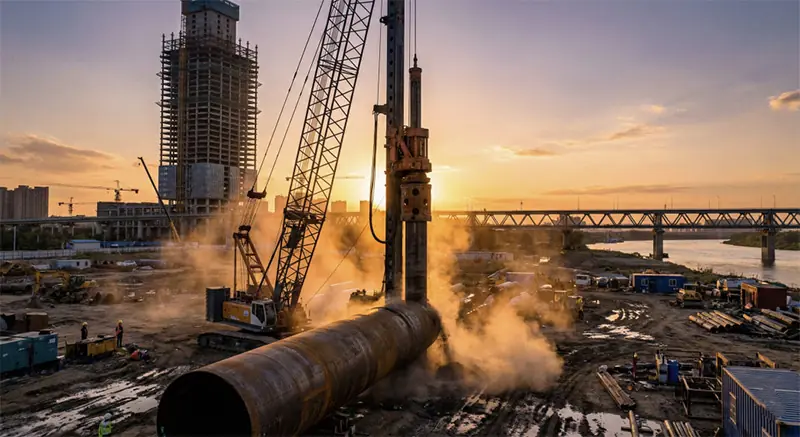
Decoding the Name: What does “STK” Mean?
The designation system is logical but distinct from American standards.
- S: Steel
- T: Tube
- K: Koki (Structural/General)
- The Number (e.g., 400, 490): This is the most critical distinction. The number represents the Minimum Tensile Strength in N/mm² (or MPa).
- Note: This differs from API 5L (where X52 = Yield Strength) or ASTM A500 (where Grade B is arbitrary).
- Example:STK400 steel pipe has a minimum tensile strength of 400 N/mm².
Manufacturing Methods
The standard is versatile regarding production. It covers:
- Seamless: Manufactured from a solid billet.
- Electric Resistance Welded (ERW): For small-to-medium diameters.
- Butt-Welded: (Less common in modern structural use).
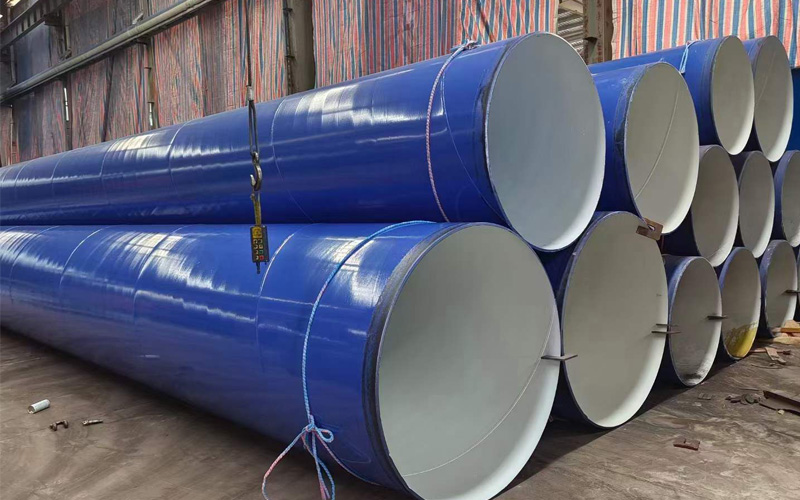
- Automatic Arc Welded: This includes LSAW (Longitudinal Submerged Arc Welded) and SSAW (Spiral Submerged Arc Welded) pipes, which are the primary focus for large-scale infrastructure and Allland’s core capability.
The Core Grades: STK400 vs. STK490
While the standard lists five grades (STK290, STK400, STK490, STK500, STK540), two grades dominate the market: STK400 and STK490.
1. STK400 Steel Pipe (The General Purpose Choice)
- Characteristics: STK400 is also the best-selling grade. It has good ductility and weldability.Its reduced carbon content allows easy forming and welding on the field without elaborate pre-heating treatments.
- Primary Applications: General civil engineering works, standard scaffolding, support columns, fence posts, and light structural frames.
2. STK490 Steel Pipe (The High-Strength Choice)
- Characteristics: STK490 is a significant step up in performance. With a minimum tensile strength of 490 N/mm² and a minimum yield point of 315 N/mm², it is approximately 34% stronger (in yield) than STK400.
- Engineering Value: The result is that engineers can design lighter structures. You can use a thinner wall thickness for the same bearing load, which reduces the total steel tonnage and the load on the foundation.
- Primary Applications: Heavy-duty transmission towers, JIS G3444 piles for large buildings, landslide prevention piles, and massive offshore structural components.
3. STK500 & STK540 (The Ultra-High Strength)
These grades are used in specialty applications for extreme bearing loads, such as very large truss bridges or deep-sea piles.They usually need more precise welding techniques because of the higher strength chemistry.
Quantitative Analysis: Technical Data Sheets
This section provides the data required for engineering calculations.
Table 1: Chemical Composition (%)
| Grade | C (Carbon) | Si (Silicon) | Mn (Manganese) | P (Phosphorus) | S (Sulfur) |
| STK290 | – | – | – | 0.050 max | 0.050 max |
| STK400 | 0.25 max | – | – | 0.040 max | 0.040 max |
| STK490 | 0.18 max | 0.55 max | 1.50 max | 0.040 max | 0.040 max |
| STK500 | 0.23 max | 0.55 max | 1.50 max | 0.040 max | 0.040 max |
| STK540 | 0.23 max | 0.55 max | 1.60 max | 0.040 max | 0.040 max |
Engineer’s Analysis: Note that for STK400, only Carbon is capped (besides P/S), allowing mills flexibility. However, for STK490, the chemistry is much strictly controlled (low Carbon, high Manganese) to achieve high strength while maintaining weldability.
Table 2: Mechanical Properties
| Grade | Min. Tensile Strength (N/mm²) | Min. Yield Point (N/mm²) | Min. Elongation (%) (Longitudinal) |
| STK290 | 290 | – | 30 |
| STK400 | 400 | 235 | 23 |
| STK490 | 490 | 315 | 23 |
| STK500 | 500 | 355 | 15 |
| STK540 | 540 | 390 | 20 |
Key Takeaway: The jump from STK400 to STK490 provides a massive gain in Yield Strength (235 to 315 MPa), which is the primary design parameter for structural columns.
Tolerances & Manufacturing Quality
JIS standards are renowned for their strict adherence to dimensional accuracy. JIS G3444 specifies rigorous tolerances for:
- Outside Diameter (OD): Divided into Class 1, Class 2, and Class 3 tolerances depending on diameter size.
- Wall Thickness: Typically allows for a deviation of + Not Specified / -12.5% (similar to API 5L), but specific tolerances apply based on the manufacturing method.
- Appearance: The tube shall be useful and straight, and the ends shall be cut at right angles to the axis of the tube. The surface should be clean and regular without cracks or flakes that could prevent application.
The Allland Advantage:
Manufacturing large-diameter carbon steel tubes for general structural purposes to these tight tolerances requires advanced equipment. Allland’s LSAW (JCOE) and SSAW production lines are equipped with precision forming presses and automated sizing equipment. This ensures that every pipe—whether a 20-inch foundation pile or a 60-inch tower base—meets the strict geometric requirements of the JIS G3444 specification.
Applications in Civil Engineering
The versatility of the JIS G3444 specification makes it a staple in three key sectors where Allland actively supplies material.
1. Steel Pipe Piling (Piles)
This is the single largest application for large-diameter pipe under this standard.
- Landslide Prevention Piles: In mountainous regions (common in Japan and Asia), heavy-wall STK490 pipes are driven into slopes to prevent soil movement.
- Foundation Piles: Used for bridges, buildings, and port structures.
- Why SSAW? For these applications, SSAW (Spiral) pipe is the preferred manufacturing method due to its ability to produce large diameters and long lengths economically.
2. Steel Towers & Masts
- Transmission Towers: The legs of massive electrical pylons often use high-strength STK490 or STK540 pipe.
- Wind Turbine Foundations: Jacket structures often specify JIS G3444 due to its proven reliability.
- Why LSAW? For the critical, high-stress legs of these towers, LSAW (Longitudinal) pipe is often specified for its superior toughness and thick-wall capability.
3. General Civil Structures
From signposts and lighting columns to strutting systems for subway excavation, STK400 serves as the reliable, weldable backbone of urban infrastructure.
Conclusion
To conclude JIS G3444 is a tough tensile strength based standard which has become the foundation of structural engineering in Asia and provides a well-defined grade system from flexible STK400 through high quality STK490 and STK540. Whether your engineering is for a simple scaffold or a giant infrastructure foundation pile, knowing the chemical and mechanical-specifics demands within this standard is your starting point for structural integrity and project success. At Allland, we have profound knowledge about Japanese industrial standards and long-time experiences to produce large diameter LSAW and SSAW steel pipes under stringent requirements of JIS G3444. Whether your project is based in Japan or is an international infrastructure build employing JIS specifications, we can deliver fully compliant, high quality solutions in structural tubing tailored to your specific project needs.
Frequently Asked Questions (FAQ)
Q1: What is the JIS G3444 equivalent ASTM standard?
A1: There is no single, perfect equivalent, but the closest approximations are:
- For STK400: Roughly equivalent to ASTM A500 Grade B (Round) or ASTM A252 Grade 2.
- For STK490: Roughly equivalent to ASTM A500 Grade C (Round) or ASTM A252 Grade 3.
- Note: Always have a structural engineer verify the mechanical properties before substituting, as chemical requirements differ.
Q2: Does JIS G3444 pipe require hydrostatic testing?
A2: Generally, no. Since JIS G3444 is for “General Structural Purposes,” it is not intended for pressure containment. Therefore, hydrostatic testing is usually not a mandatory requirement of the standard unless specifically agreed upon between the buyer and manufacturer. If you need pipe for fluid pressure, you should look at JIS G3454 (STPG).
Q3: What does the number “400” mean in STK400?
A3: It represents the Minimum Tensile Strength of the steel in N/mm² (or MPa). So, STK400 has a min tensile strength of 400 MPa. This is a key difference from API or some ASTM standards, which often name grades based on Yield Strength (e.g., X52 = 52,000 psi Yield). Be careful not to confuse the two when comparing specs.

ASTM A53 vs. API 5L: A Guide to Selection and Application
In the field of industrial piping, ASTM A53 and API 5L are two key standards that are widely used, but have very different positions. ASTM...

Introduction:Technology differences determine success or failure, and selection needs to be “precise”
In oil and gas transmission, municipal infrastructure and other major projects, the reasonable choice of steel pipe welding process directly affects the project...
Steel Density Analysis: Core Differences between Mild and Medium Carbon Steels and Industrial Applications
The density of steel is one of the key parameters that determine its physical properties and industrial applications. Theoretical state of steel density...
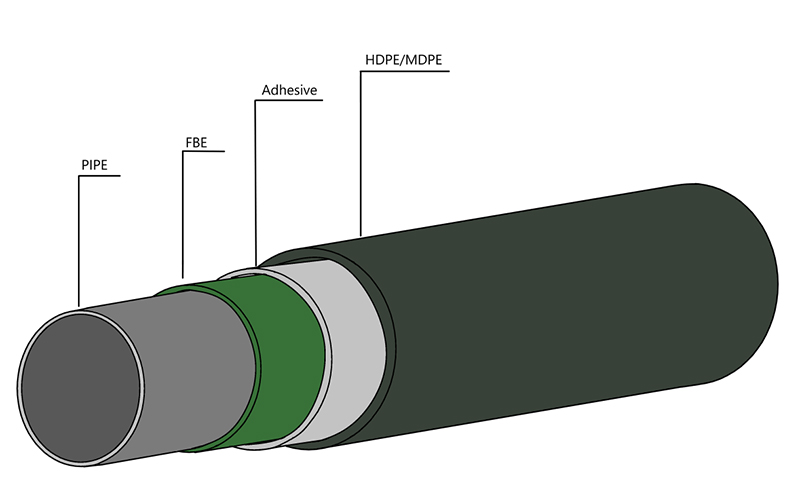
3LPE coated steel pipe: a solid barrier in the field of industrial corrosion protection
In the harsh environment of oil and gas, chemical industry, urban pipe network, etc., the long-term reliability and corrosion resistance of pipeline system...
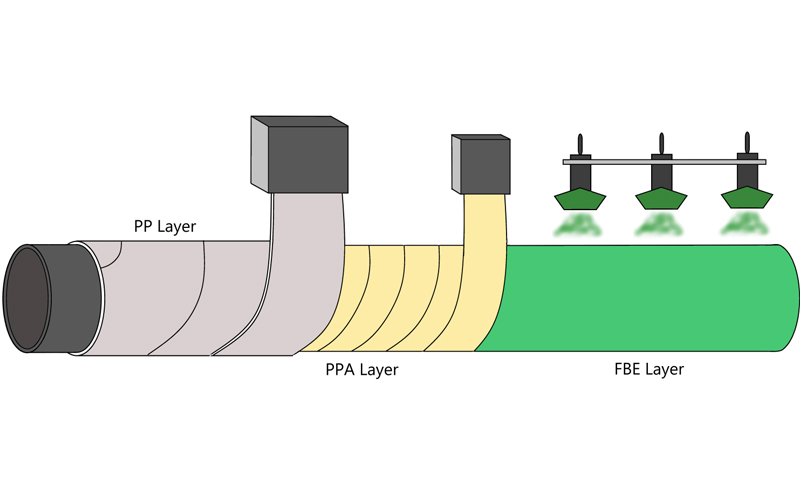
3LPP coated pipe: anti-corrosion guard in high temperature and high pressure environment
In some challenging special environments such as deep-sea oil and gas exploration and high-temperature crude oil transportation, traditional anti-corrosion coatings face significant challenges,...
FBE steel pipe: the technological armor of the steel defense line
I In the icy waters beneath the Norwegian Sea pipeline, a section of FBE Lined Carbon Steel Pipe has been in service for 25...