






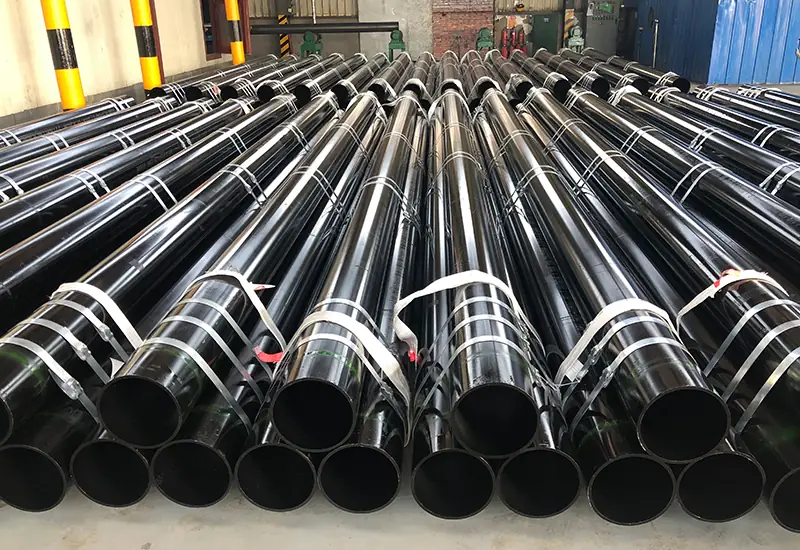
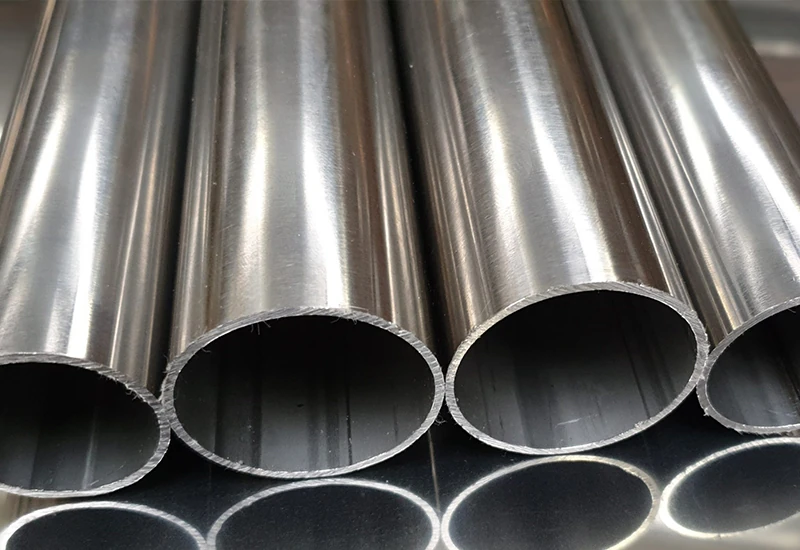

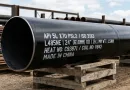
ERW pipe stands for Electric Resistance Welded pipe. It is a type of welded steel pipe manufactured by forming steel strips or coils into a cylindrical shape and joining the edges through high-frequency electrical resistance welding.
Como profesional Fabricante de tubos de acero ERW, Alllandpipes produces ERW pipes according to international standards including API, ASTM, EN, and other specifications, providing reliable steel pipe solutions for global projects.
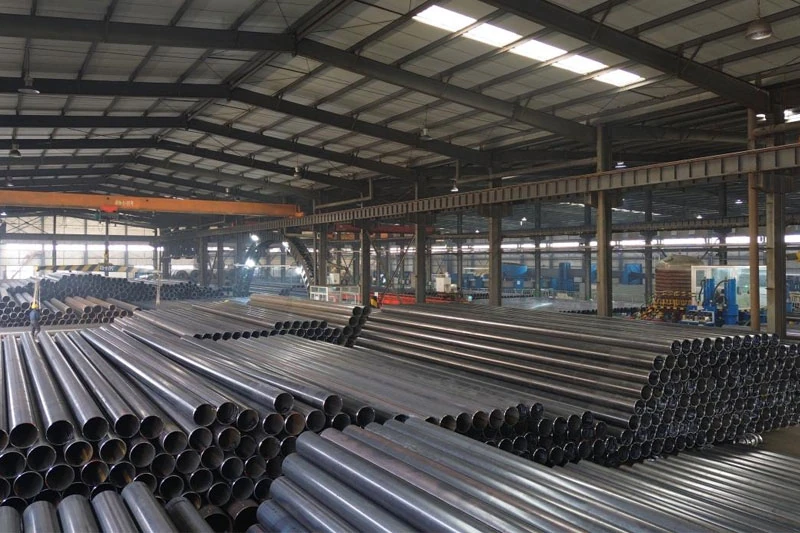
What Does ERW Pipe Mean?
ERW = Electric Resistance Welded
Tubo ERW is a longitudinal welded steel pipe. During manufacturing, steel strips are formed into a round shape, and the edges are heated by electrical resistance before being pressed together to create a strong longitudinal weld seam.
The meaning of ERW can be explained as follows:
| Term | Meaning |
| Electric | Using electrical energy during welding |
| Resistance | Heat generated by electrical resistance |
| Soldado | Joining steel edges through welding |
In simple terms:
ERW pipe means a steel pipe made by rolling steel strip into a cylindrical shape and welding the seam using electrical resistance heating.
Unlike traditional welding methods, modern ERW pipes mainly use high-frequency welding technology, which provides accurate control of weld quality and production efficiency.
What Are the Characteristics of ERW Pipe?
| Característica | Descripción |
| Welding Type | High frequency resistance welding |
| Weld Position | Longitudinal seam |
| Materia prima | Steel coil |
| Production Method | Continuous forming |
| Surface | Smooth and uniform |
| Coste | Economical compared with seamless pipe |
ERW Pipe Sizes and Standards
ERW pipes are available in a wide range of sizes and specifications to meet different project requirements.
Common ERW Pipe Dimensions
| Artículo | Gama |
| Diámetro exterior (OD) | 21.3 mm – 660 mm |
| Espesor de pared (WT) | 1.5 mm – 25 mm |
| Longitud | 6 m / 12 m / Customized |
Customized dimensions are available according to customer drawings and project specifications.
ERW Pipe Manufacturing Standards
Common standards include:
API Standards
- API 5L Line Pipe
- API 5CT OCTG applications
ASTM Standards
EN Standards
- EN 10219
- EN 10217
Other standards such as DIN, JIS, and GB/T can also be supplied according to project requirements.
ERW Steel Pipe Dimensions Table
| Nominal Size (NPS) | Diámetro exterior (OD) | Espesor de pared (WT) | Approx. Weight |
| 1/2″ | 21,3 mm | 2.0 – 3.7 mm | 0.95 – 1.75 kg/m |
| 3/4″ | 26,7 mm | 2.0 – 3.9 mm | 1.21 – 2.44 kg/m |
| 1″ | 33,4 mm | 2.6 – 4.5 mm | 1.98 – 3.38 kg/m |
| 1-1/4″ | 42,2 mm | 2.6 – 4.9 mm | 2.55 – 4.80 kg/m |
| 1-1/2″ | 48,3 mm | 2.8 – 5.1 mm | 3.09 – 5.79 kg/m |
| 2″ | 60,3 mm | 2.8 – 5.5 mm | 3.90 – 7.48 kg/m |
| 2-1/2″ | 73,0 mm | 3.2 – 5.2 mm | 5.43 – 8.63 kg/m |
| 3″ | 88,9 mm | 3.2 – 5.5 mm | 6.58 – 11.29 kg/m |
| 4″ | 114,3 mm | 3.6 – 6.0 mm | 9.83 – 16.07 kg/m |
| 5″ | 141,3 mm | 3.6 – 6.6 mm | 12.22 – 22.16 kg/m |
| 6″ | 168,3 mm | 4.0 – 7.1 mm | 16.18 – 28.26 kg/m |
| 8″ | 219,1 mm | 4.5 – 8.2 mm | 23.75 – 42.55 kg/m |
| 10″ | 273,0 mm | 5.0 – 9.3 mm | 33.00 – 60.10 kg/m |
| 12″ | 323,9 mm | 5.5 – 10.3 mm | 43.20 – 80.00 kg/m |
| 14″ | 355,6 mm | 6.0 – 11.1 mm | 51.00 – 94.00 kg/m |
| 16″ | 406,4 mm | 6.4 – 12.7 mm | 63.00 – 123.00 kg/m |
| 18″ | 457.2 mm | 6.4 – 14.3 mm | 71.00 – 157.00 kg/m |
| 20″ | 508,0 mm | 6.4 – 15.1 mm | 80.00 – 185.00 kg/m |
| 24″ | 609.6 mm | 6.4 – 17.5 mm | 96.00 – 260.00 kg/m |
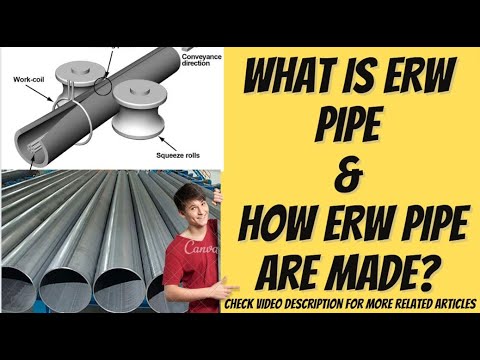
How Is ERW Pipe Manufactured?
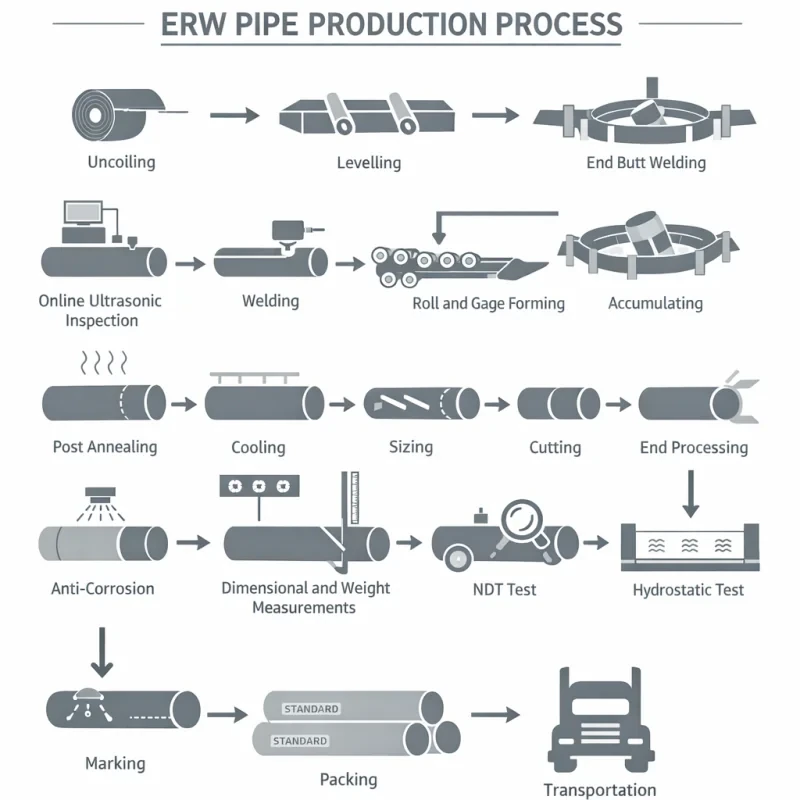
ERW pipe manufacturing is a continuous production process that transforms steel coils into finished welded pipes.
The main manufacturing steps include:
Step 1: Steel Coil Preparation
The production process starts with high-quality steel coils.
- Hot rolled coil
- Carbon steel strip
Step 2: Steel Strip Forming
The steel strip passes through a series of forming rollers.
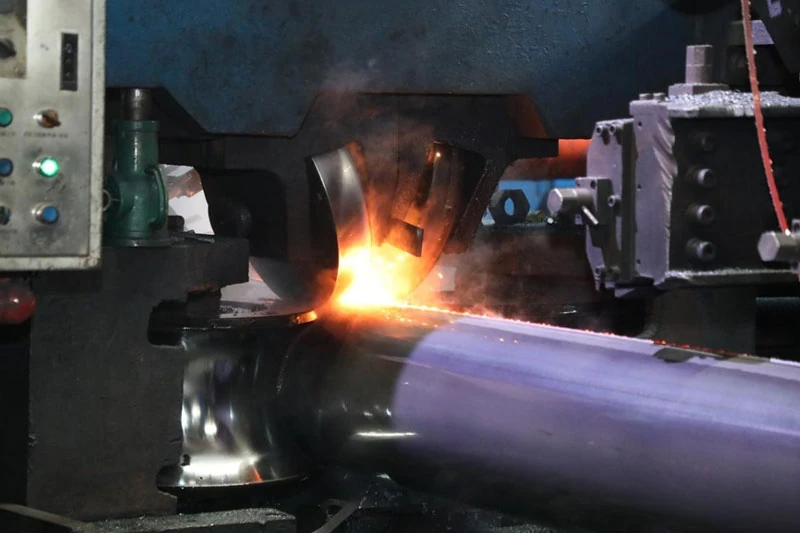
Step 3: High Frequency Resistance Welding
This is the key step of ERW pipe production.
Modern ERW production lines use high-frequency welding technology to achieve stable weld quality and high efficiency.
Step 4: Sizing, Straightening and Cutting
After welding, the pipe passes through sizing equipment.
Main processes include:
- Diameter adjustment
- Pipe straightening
- Cutting into required lengths
- End finishing
Common pipe lengths include 6 meters, 12 meters, or customized lengths according to project requirements.
Step 5: Inspection
- Prueba hidrostática
- UT testing
- Eddy current testing
- Dimensional inspection
ERW Pipe Manufacturing Process Flow Chart
What Are ERW Pipes Used For?
1. Oil and Gas Pipeline
ERW line pipe is commonly used for:
- Gas transportation
- Oil gathering systems
2. Water Transmission
- Municipal water pipelines
- Industrial water systems
3. Fire Protection System
- Fire sprinkler pipe
- Fire fighting pipeline
4. Structural Applications
- Steel structures
- Scaffolding
ERW Pipe vs Seamless Pipe: What’s the Difference?
Both ERW and seamless pipes are widely used steel pipe products, but their manufacturing methods and applications are different.
| Artículo | Tubos ERW | Tubos sin soldadura |
| Método de fabricación | Electric resistance welding | Hot rolling or cold drawing |
| Costura de soldadura | Longitudinal weld seam | Sin cordón de soldadura |
| Velocidad de producción | Faster | Slower |
| Coste | Baja | Más alto |
| Surface Quality | Smooth and uniform | Excelente |
| Aplicación | General pipeline and structural use | High-pressure and critical applications |
ERW pipe is usually preferred when customers need economical solutions with reliable performance, while seamless pipe is selected for applications requiring higher pressure resistance.
FAQ
Q1: What does ERW stand for in steel pipe?
ERW stands for Electric Resistance Welded. It refers to a welded steel pipe manufactured by joining steel strip edges through electrical resistance heating.
Q2: Is ERW pipe better than seamless pipe?
It depends on the application.
ERW pipes are more economical and suitable for general pipeline, water, structural, and medium-pressure applications.
Seamless pipes are preferred for high-pressure, high-temperature, and critical service conditions.
Q3: What is the difference between ERW and HFW pipe?
HFW is a high-frequency welding technology commonly used in modern ERW pipe production. ERW refers to the electrical resistance welding method.
Conclusión
ERW pipe meaning refers to Electric Resistance Welded steel pipe, a widely used welded pipe produced through high-frequency electrical resistance welding.
With advantages including efficient production, accurate dimensions, smooth surfaces, and competitive cost, ERW pipes are widely applied in oil and gas pipelines, water systems, fire protection, and structural projects.
Alllandpipes provides high-quality ERW steel pipes manufactured according to API, ASTM, EN, and other international standards, delivering reliable steel pipe solutions for global customers.

ASTM A53 frente a API 5L: Guía de selección y aplicación
En el campo de las tuberías industriales, ASTM A53 y API 5L son dos normas clave muy utilizadas, pero con posiciones muy diferentes. ASTM...

Introducción:Las diferencias tecnológicas determinan el éxito o el fracaso, y la selección debe ser “precisa”
En la transmisión de petróleo y gas, las infraestructuras municipales y otros grandes proyectos, la elección razonable del proceso de soldadura de tubos de acero afecta directamente al proyecto...
Análisis de la densidad del acero: Diferencias fundamentales entre aceros al carbono suaves y medios y aplicaciones industriales
La densidad del acero es uno de los parámetros clave que determinan sus propiedades físicas y aplicaciones industriales. Estado teórico de la densidad del acero...
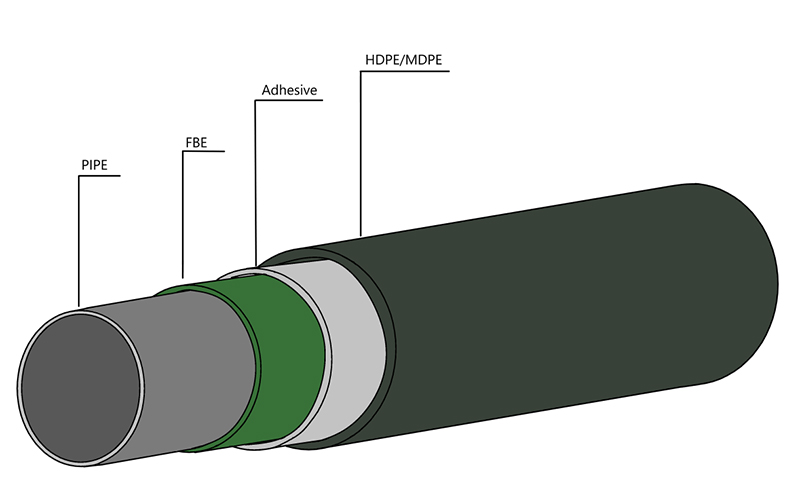
Tubos de acero revestidos con 3LPE: una barrera sólida en el campo de la protección contra la corrosión industrial
En el duro entorno del petróleo y el gas, la industria química, la red de tuberías urbanas, etc., la fiabilidad a largo plazo y la resistencia a la corrosión del sistema de tuberías...
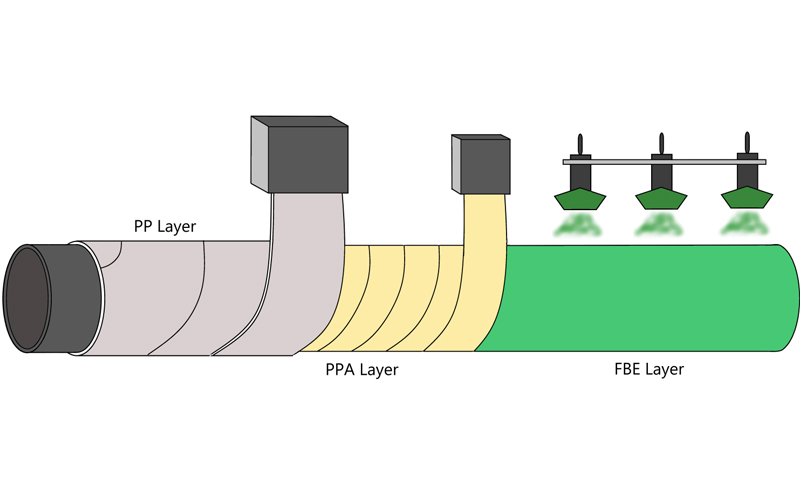
Tubo con revestimiento 3LPP: protección anticorrosión en entornos de alta temperatura y alta presión
En algunos entornos especiales difíciles, como la prospección de petróleo y gas en aguas profundas y el transporte de crudo a altas temperaturas, los revestimientos anticorrosión tradicionales se enfrentan a...
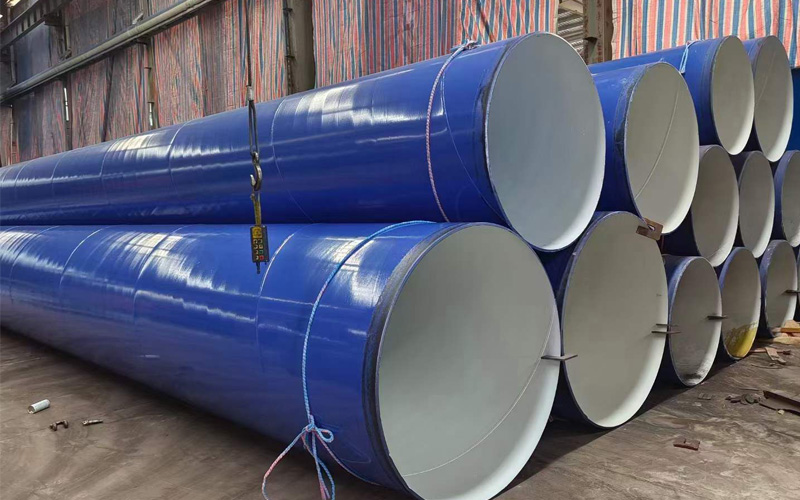
Tubos de acero FBE: el blindaje tecnológico de la línea de defensa del acero
I En las gélidas aguas bajo el oleoducto del Mar de Noruega, una sección de tubería de acero al carbono con revestimiento FBE ha estado en servicio durante 25...