






Introducción
Selecting the right steel pipe is crucial for oil and gas pipeline projects. When procuring steel pipes, contractors must consider not only costs but also material specifications, manufacturing processes, and anti-corrosion performance—factors that directly impact project quality, operational safety, and long-term maintenance costs.
Large-diameter steel pipes are widely used for transporting crude oil, natural gas, and water resources. According to the U.S. Energy Information Administration (EIA), pipelines enable the continuous, high-volume transport of energy and serve as a primary mode of transport for oil and gas.
For buyers working with onshore oil and gas pipeline companies, choosing suitable steel pipes requires a comprehensive evaluation of pipe size, steel grade, manufacturing technology, industry standards, and coating solutions. This procurement guide provides an overview of key steel pipe specifications and purchasing considerations, helping project owners select reliable products, improve pipeline performance, and avoid construction delays caused by avoid construction delays caused by selecting unsuitable products..
What Factors Should Be Considered When Selecting Pipeline Steel Pipes?
Choosing a suitable pipeline steel pipe requires evaluating several technical factors, including application requirements, operating conditions, material grades, and coating systems.
Pipeline Application Requirements
The first step in steel pipe procurement is identifying the pipeline’s specific purpose.
Different transportation systems have different requirements:
| Aplicación | Typical Requirements | Recommended Pipe Types |
| Oil transportation pipelines | High strength, corrosion resistance, long service life | API 5L steel pipe, anti-corrosion coating |
| Natural gas transmission pipelines | High pressure capability, strict safety requirements | High-strength line pipe such as X60-X70 |
| Water transportation pipeline | Large diameter, economical installation | LSAW or Tubos de acero SSAW |
| Offshore projects | Corrosion resistance and structural reliability | Coated steel pipe, advanced protection systems |
For oil and gas projects, buyers should consider whether the pipeline will be installed above ground, underground, or underwater. Offshore applications usually face more challenging environments because seawater exposure increases corrosion risks.
In particular, offshore gas pipeline construction requires careful selection of steel grade, welding quality, and external coating systems to ensure pipeline reliability.
Operating Pressure and Pipe Strength
Pipe wall thickness, manufacturing processes, and material selection all influence a pipeline’s pressure resistance.
During operation, high-pressure gas pipelines must withstand both internal and external pressures while maintaining structural stability; operating temperatures and environmental conditions must also be taken into account.
The API 5L standard is one of the most widely used specifications for oil and gas transmission pipelines. It defines requirements for line pipe used in transporting petroleum and natural gas.
Common API 5L steel grades include: API 5L X42, API 5L X52, API 5L X60, API 5L X65, API 5L X70.
Higher-grade materials generally provide greater strength, allowing pipelines to operate under demanding pressure conditions.
LSAW vs SSAW vs ERW Steel Pipe: Which One Is Better?
Steel pipes used in oil and gas projects are manufactured through different welding processes. The most suitable option depends on project requirements, pipe diameter, pressure conditions, and installation environment.
| Tipo de tubería | Método de fabricación | Principales aplicaciones |
| Tubos de acero LSAW | Longitudinal submerged arc welding | Oil & gas transmission, large diameter pipelines |
| Tubos de acero SSAW | Spiral submerged arc welding | Water pipelines, infrastructure projects, large diameter transportation |
| Tubos de acero ERW | Electric resistance welding | Medium diameter industrial pipelines |
Tubos de acero LSAW
Longitudinal Submerged Arc Welding is widely used in large-scale oil and gas transportation projects.
Advantages include:
- Suitable for large diameter applications
- High dimensional accuracy
- Reliable weld quality
- Suitable for high-pressure transmission systems
For long-distance oil and gas transmission, LSAW steel pipe is often selected because of its strength and structural stability.
Tubos de acero SSAW
SSAW (Spiral Submerged Arc Welding) steel pipe is manufactured through spiral welding technology.
Its advantages include:
- Efficient production process
- Wide diameter range
- Suitable for infrastructure and water transportation projects
SSAW pipes can also be used in some oil and gas projects depending on engineering requirements.
Tubos de acero ERW
ERW (Electric Resistance Welded) steel pipe is commonly used for medium diameter pipeline systems.
Las aplicaciones típicas son:
- Tuberías industriales
- Low and medium pressure transportation
- Utility systems
Based on the information above, purchasers can select the type of steel pipe by considering a range of factors, rather than focusing solely on price.
Anti-Corrosion Coatings Are an Important Consideration
Corrosion is one of the major factors affecting the service life of pipelines. Underground pipelines sustain damage due to direct contact with chemicals in the soil, as well as exposure to moisture and environmental conditions.
For this reason, many oil and gas transportation projects use protective coating systems such as polyethylene coatings and fusion-bonded epoxy coatings.
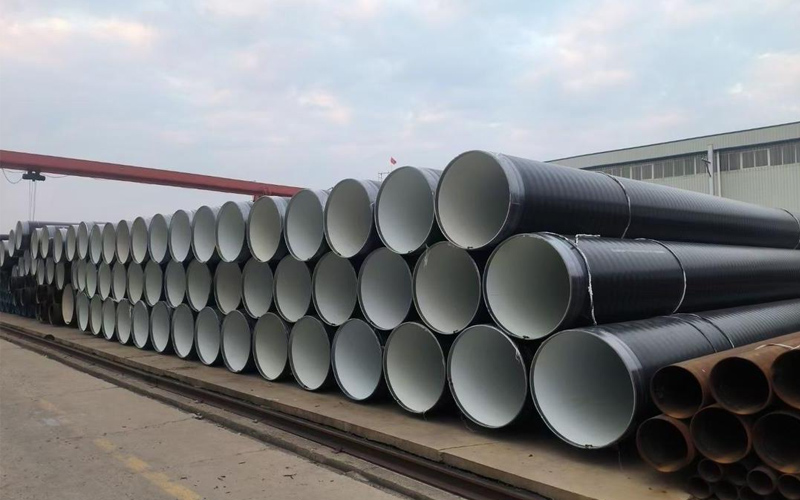
3LPE Coated Steel Pipe
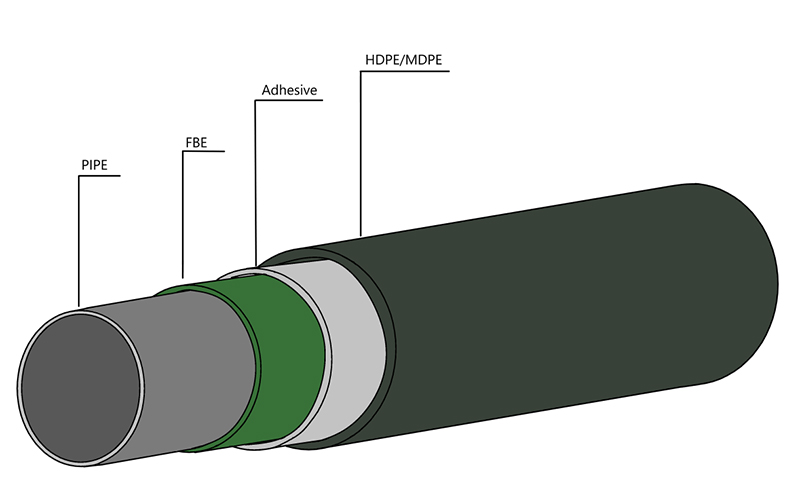
3LPE (Three-Layer Polyethylene) coating is widely used for buried oil and gas pipelines.
The coating system generally consists of:
- Capa de epoxi unida por fusión
- Capa adhesiva
- Capa exterior de polietileno
Principales ventajas:
- Excellent corrosion resistance
- Strong mechanical protection
- Suitable for underground pipelines
Because of these characteristics, polyethylene oil and gas pipe coatings are commonly selected for long-distance transmission pipelines.
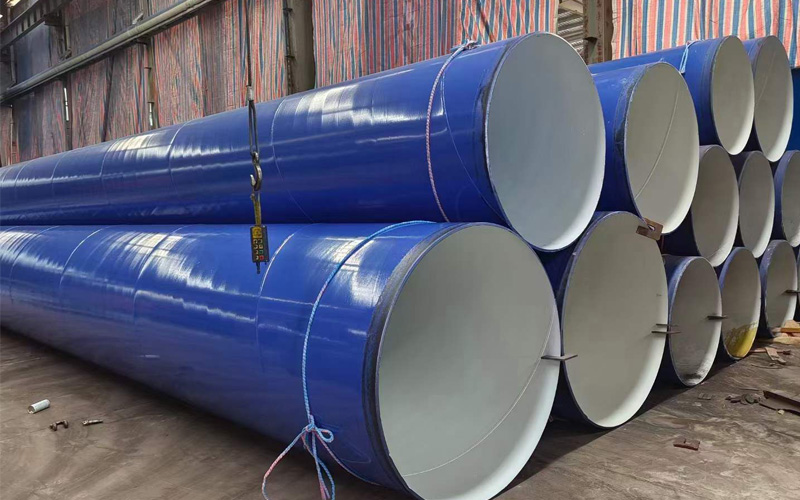
Tubos de acero con revestimiento FBE
FBE (Fusion-Bonded Epoxy) coating provides strong adhesion between the coating and the steel surface.
Advantages include:
- Excellent bonding performance
- Good chemical resistance
- Suitable for internal and external pipeline protection
FBE coating is often used where strong corrosion protection and coating adhesion are required.
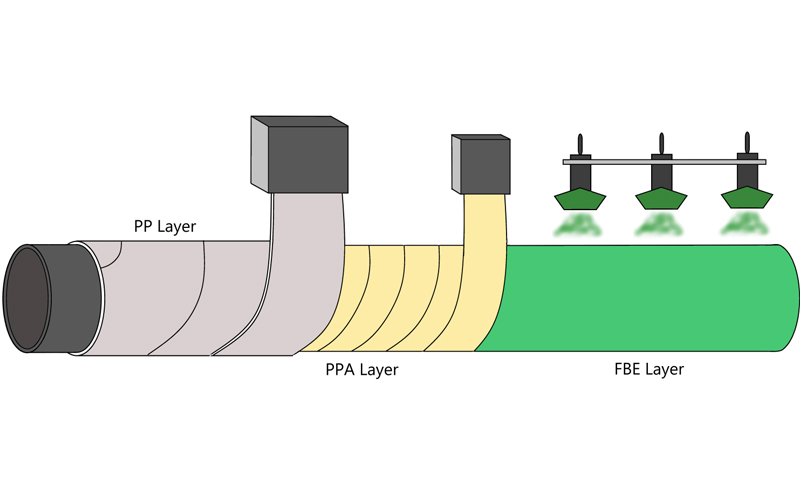
3LPP Coated Steel Pipe
3LPP (Three-Layer Polypropylene) coating is designed for applications requiring higher temperature resistance.
Advantages include:
- Higher temperature resistance compared with standard polyethylene coatings
- Strong mechanical protection
- Suitable for demanding environments
For complex projects, suppliers such as Allland Pipes provide coated steel pipe solutions including:
- Tubo de acero con revestimiento 3LPE
- Tubo de acero con revestimiento 3LPP
- Tubos de acero con revestimiento FBE
These coating systems help improve pipeline durability in different operating environments.
Why Choose Allland 3LPE Coated Steel Pipe for Oil & Gas Pipelines?
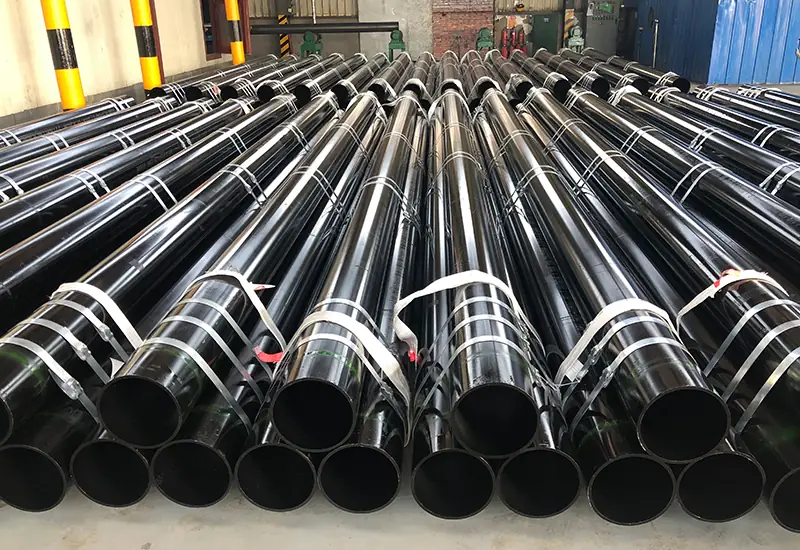
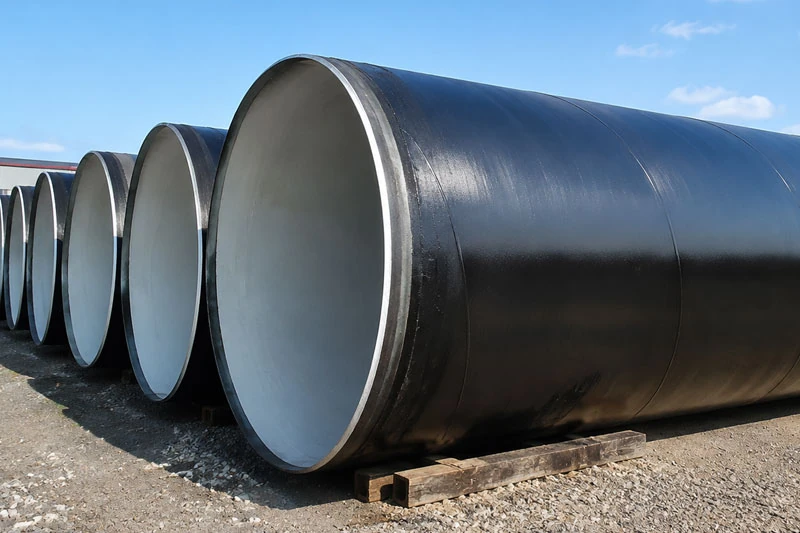
Allland Tubo de acero con revestimiento 3LPE is designed for long-distance oil and gas transmission pipelines where strong corrosion protection and long-term durability are required. This three-layer polyethylene coating system combines a fusion bonded epoxy (FBE) primer layer, a copolymer adhesive layer, and a high-density polyethylene (HDPE) outer layer to provide reliable protection for buried pipeline applications.
The multi-layer structure helps the Tubo de acero 3LPE withstand moisture, soil corrosion, chemical exposure, and mechanical damage during transportation, installation, and operation. It is widely used in oil and gas transmission, water transportation, and other infrastructure projects that require stable pipeline performance.
We also offer a variety of specifications:
| Especificación | Details |
| Diámetro exterior | Φ60mm – 3000mm (2″ – 118″) |
| Espesor de pared | 4.5 – 50mm |
| Longitud | 6 – 18m (20′ – 60′) |
| Tipo de revestimiento | 3LPE (polietileno de tres capas) |
| Normas de calidad | ISO 21809-1, DIN 30670, NFA 49-710, CSA Z245.21 |
With excellent anti-corrosion performance and a long service life, Allland Tubo de acero con revestimiento 3LPE is a reliable choice for pipeline projects across different geographic conditions. By selecting the right coating solution, project owners can reduce maintenance requirements and improve the safety and efficiency of long-distance oil and gas pipeline systems.
International Standards for Pipelines
International standards provide technical guidelines that help buyers evaluate product quality and supplier reliability.
Important standards include:
API 5L
API 5L is widely used for line pipes transporting oil and natural gas.
It covers requirements related to:
- Pipe manufacturing
- Material properties
- Testing requirements
- Product specification levels
ASTM Standards
ASTM standards provide testing and material specifications for many industrial steel products.
ISO Requirements
ISO standards help establish consistent quality management systems and manufacturing procedures.
Before purchasing steel pipes, buyers should confirm:
- Material certificates
- Inspection reports
- Welding quality records
- Coating inspection reports
- Non-destructive testing results
A reliable supplier should provide complete documentation to support project approval and quality verification.
Key Considerations When Selecting a Reliable Steel Pipe Supplier
Choosing the right supplier is as important as choosing the right pipe.
Manufacturing Capability and Product Range
Experienced suppliers should provide different pipeline solutions, including:
- Tubos de acero LSAW
- Tubos de acero SSAW
- Tubo de acero ERW
- Coated steel pipe
A wider product range allows suppliers to recommend suitable solutions for different applications.
Quality Control and Inspection System
Pipeline steel pipe suppliers should have strict quality control procedures covering:
- Raw material inspection
- Welding inspection
- Dimensional inspection
- Mechanical testing
- Coating testing
Compliance with International Standards
For international projects, suppliers should understand requirements from API, ASTM, and ISO standards.
Project Experience and Technical Support
Con experiencia experienced pipeline suppliers can provide better technical assistance during:
- Material selection
- Production planning
- Quality inspection
- Project delivery
FAQ
Q1. Which types of steel pipes are commonly used for oil and gas pipelines?
LSAW steel pipe, SSAW steel pipe, and ERW steel pipe are commonly used for oil and gas pipeline projects. The final selection depends on pipe diameter, pressure requirements, and project conditions.
Q2. What is the difference between LSAW and SSAW steel pipes?
Tubos de acero LSAW are welded longitudinally and are commonly used for large diameter, high-strength transmission pipelines. SSAW steel pipes are spiral welded and are often used for large diameter infrastructure applications.
Q3. Why are 3LPE coatings widely used in oil and gas pipelines?
3LPE coatings provide corrosion resistance and mechanical protection, making them suitable for buried oil and gas pipelines where long-term durability is required.
Q4. How do I choose a reliable oil and gas pipeline supplier?
Buyers should evaluate manufacturing capability, international certifications, quality inspection systems, project experience, and technical support before selecting a supplier.
Conclusión
Selecting the right steel pipe for oil and gas pipeline projects requires a full evaluation of application conditions, pressure requirements, manufacturing methods, coating systems, and international standards. The pipe material and production process should match the project environment because different pipeline systems have different operating conditions and safety requirements.
For large-scale transportation systems, LSAW steel pipe is commonly selected for high-strength transmission applications, while SSAW and ERW pipes can be used for other pipeline applications. Protective solutions such as 3LPE, 3LPP, and FBE coatings also help improve pipeline durability and reduce maintenance problems during long-term operation.
By working with experienced onshore and oil and gas pipe companies, project owners can choose suitable materials based on engineering requirements and construction conditions. A reliable steel pipe supplier can provide stable product quality, technical support, and solutions that meet project standards. This helps build safer, more reliable, and cost-effective pipeline systems for oil transportation, natural gas transmission, and future infrastructure development.

ASTM A53 frente a API 5L: Guía de selección y aplicación
En el campo de las tuberías industriales, ASTM A53 y API 5L son dos normas clave muy utilizadas, pero con posiciones muy diferentes. ASTM...

Introducción:Las diferencias tecnológicas determinan el éxito o el fracaso, y la selección debe ser “precisa”
En la transmisión de petróleo y gas, las infraestructuras municipales y otros grandes proyectos, la elección razonable del proceso de soldadura de tubos de acero afecta directamente al proyecto...
Análisis de la densidad del acero: Diferencias fundamentales entre aceros al carbono suaves y medios y aplicaciones industriales
La densidad del acero es uno de los parámetros clave que determinan sus propiedades físicas y aplicaciones industriales. Estado teórico de la densidad del acero...
Tubos de acero revestidos con 3LPE: una barrera sólida en el campo de la protección contra la corrosión industrial
En el duro entorno del petróleo y el gas, la industria química, la red de tuberías urbanas, etc., la fiabilidad a largo plazo y la resistencia a la corrosión del sistema de tuberías...
Tubo con revestimiento 3LPP: protección anticorrosión en entornos de alta temperatura y alta presión
En algunos entornos especiales difíciles, como la prospección de petróleo y gas en aguas profundas y el transporte de crudo a altas temperaturas, los revestimientos anticorrosión tradicionales se enfrentan a...
Tubos de acero FBE: el blindaje tecnológico de la línea de defensa del acero
I En las gélidas aguas bajo el oleoducto del Mar de Noruega, una sección de tubería de acero al carbono con revestimiento FBE ha estado en servicio durante 25...