




Introduction
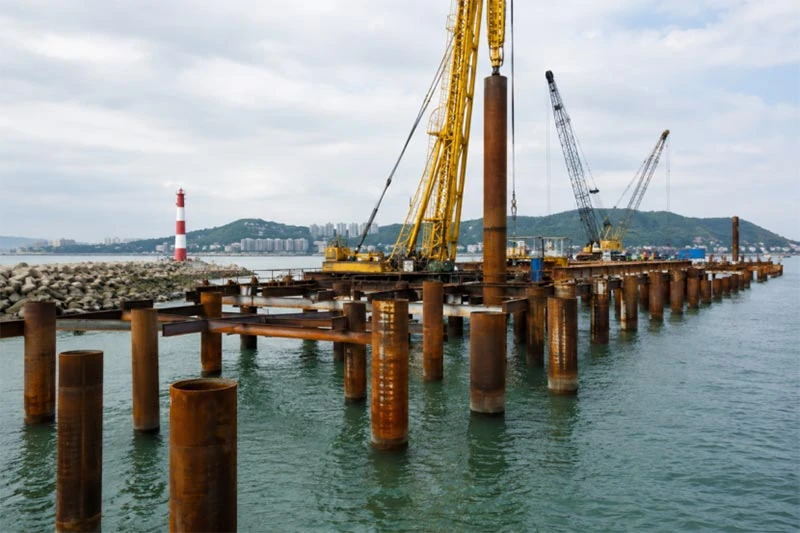
Coastal buildings are faced with both mechanical and chemical pressures, which makes standard carbon steel pipes unsuitable for long-term structures and fluid transportation. Coastal infrastructure such as ports, flood levees and bridge substructures uses steel pipes for two core functions: load-bearing pile foundations and submerged fluid transport. Ordinary steel pipes lack customized yield strength, corrosion margins and manufacturing accuracy and cannot be designed to withstand extreme flood impact loads, salt erosion and unstable seabed. To balance cost efficiency and structural durability, engineers must choose customized structural steel pipe and completely protected corrosion-resistant pipe instead of general-purpose pipe.
8FAQ
Coastal Infrastructure Challenges that Influence Pipe Selection
Flooding Loads and Structural Stability
Flood is one of the most destructive driving forces affecting coastal pipeline components, especially piles embedded in muddy marine sediment. Storm surge will increase the hydrostatic pressure under water, while floating flood debris will affect the exposed steel pipe piling. Thin-walled small-diameter pipes may struggle to distribute uneven loads effectively, which leads to bending deformation and micro-cracks in the weld.
Tidal loading compounds flood-related stress through daily cycles of submersion and exposure. Every fluctuation of seawater will produce periodic tension and compression on the basis of each pipe pile, which will gradually lead to metal fatigue in the course of years of use. Seabed erosion aggravates this instability: flowing salt water washes away the sediments around the pile foundation, reduces the buried depth, and makes the driven cantilever support of steel piles far below the original design and calculations level. When the scouring depth exceeds the engineering safety limits, an unrated thin-walled pile will buckle under the weight of its own superstructure plus flood surge pressure.
In addition, low-grade thin pipes are easy to deform during the driving process of the impact hammer, which makes the pile rows dislocate and weakens the supporting frame of the seawall and pier.
Saltwater Corrosion and Service Life Reduction
Chloride ions in seawater and coastal salt fog will cause accelerated electrochemical corrosion, which will corrode unprotected carbon steel at a faster rate than inland freshwater environment. In the splash zone, pipelines are repeatedly exposed to seawater and oxygen-rich air. It has the fastest oxidation rates among all exposed marine areas. Bare steel here can lose a few millimeters of wall thickness within a few years, eroding the pre-calculated safety margin in the design of each structural steel pipe.
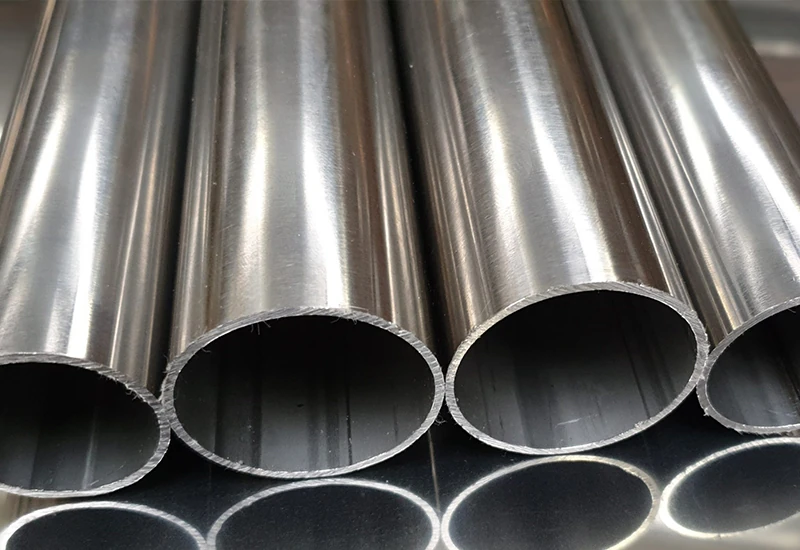
Specifying qualified corrosion-resistant pipe relies on two protection methods: optimized base steel alloy ratios and external anti-corrosion barriers. Ordinary carbon steel can’t prevent chloride penetration, while professional anti-corrosion coating for steel pipe separates steel from salt water and oxygen. Unprotected pipelines will lead to expensive underwater maintenance and early structural strengthening of coastal service.
Multiple independent material tests confirm that uncoated standard carbon steel loses 0.1 mm to 0.3 mm of thickness annually in heavy coastal splash zones, whereas properly coated corrosion-resistant piping cuts annual wall loss to near-negligible measurable levels (Data source: Pipeline Technology Journal).
Offshore and Nearshore Construction Requirements
Coastal and nearshore projects such as ports, flood barriers and coastal roads apply different mechanical demands than true offshore developments such as subsea energy pipelines and offshore platforms. Nearshore pipeline networks are located in shallow water, with large wave turbulence, while deep-water offshore pipelines face huge hydrostatic pressure and stable low-temperature salt exposure.
Pipeline specifications also vary by installation method. Deep-water offshore pipelines require high axial tensile strength to withstand installation and operational loads, while offshore dredging pipelines prioritize abrasion resistance. Under-coated pipes incur exorbitant offshore pipeline maintenance costs due to expensive underwater repairs. Most coastal facilities use steel pipe piles as the foundations, and a floating pipeline for fluid transportation.
Choosing the Right Structural Steel Pipe for Coastal Projects
ASTM A500 Structural Pipe for Load-Bearing Applications
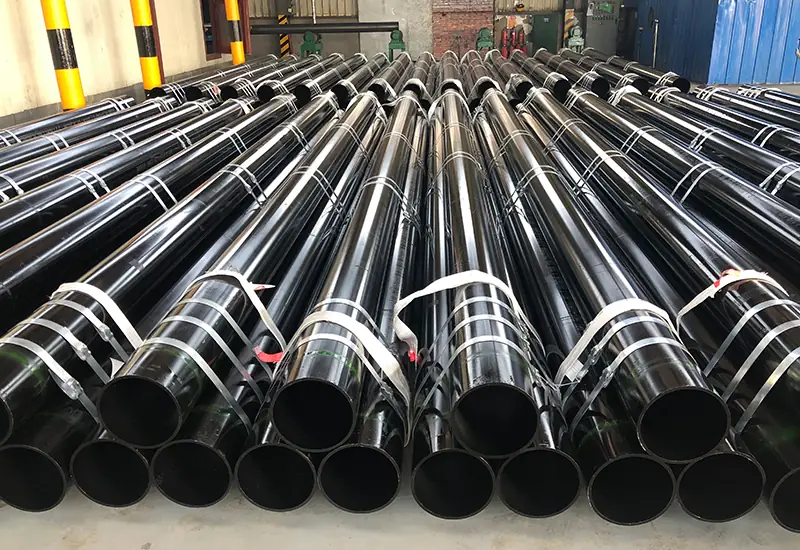
ASTM A500 cold-formed structural tubing is widely used in above-water coastal frameworks and shallow-submersion structural applications. Available in Grade B and Grade C variants, ASTM A500 steel delivers minimum yield strengths ranging from 310MPa to 345MPa, balancing rigid structural performance with excellent field weldability for connecting pile segments and support frames.
For coastal bridge piling, port support and flood barrier support, structural steel pipe manufactured according to ASTM A500 standard keeps a circular geometry under load to avoid deformation or loss of roundness. Its on-site machinability is suitable for coastal construction of a fast track. Still, it is only applicable for shallow nearshore foundations rather than deep subsea pile driving.
ASTM A252 Pipe Piles for Deep Foundations
When construction teams encounter soft, low-bearing marine silt and clay seabed, ASTM A252 classified pipe pile becomes the main deep foundation solution. The standard steel pipe pile is specially designed for deep embedding driven by impact. It has a thick foundation wall material and a standardized metallurgical structure, which can absorb the impact driven by a hammer without cracking or wrinkling.
ASTM A252 has three yield strength grades matching varied seabed soil density. Engineers choose an accurate pipe pile size to bear axial and transverse flood loads. Unlike ASTM A500 structural tubing, ASTM A252 pipe piles are specifically manufactured and qualified for deep foundation applications and pile driving.
API 5L Pipeline for Offshore and Floating Pipeline Systems
Fluid transportation across coastal and offshore waters requires rated pressure pipelines conforming to API 5L, which is the global benchmark for the transportation of hydrocarbon, mud and treated water. The high-yield grades API 5L X52 (minimum yield strength is 359MPa) and API 5L X65 (minimum yield strength is 448MPa) are dominant in the design of offshore pipelines, because they have both tensile strength and fracture toughness in a cold saltwater environment.
Offshore pipeline LSAW pipes typically offer better dimensional control and weld quality consistency than ERW pipes, lowering tidal pressure-induced leak risks. API 5L X52 and X65 are suitable for dredging, wastewater and offshore natural gas pipelines and have mandatory hydrostatic pressure and ultrasonic welding tests to meet the standards of marine laws and regulations.
Design of Pipe Wall Thickness for Submerged and Piling Applications
Why Wall Thickness Matters
In coastal services, pipeline wall thickness is the first line of defense against three core failure modes: structural buckling, corrosion wall loss and driving shock deformation. Engineers refer to the standardized data set of pipe wall thickness charts and select minimum thickness values related to the calculation load, water depth and expected brine corrosion and wear for decades.
All steel pipe piling and marine pipeline designs reserve an independent corrosion allowance apart from structural bearing wall thickness. For example, standard schedule 40 steel pipe usually needs to be upgraded in the coastal area to offset the salt erosion for 20-30 years. Insufficient thickness will lead to flood-induced buckling and premature structural failure in saturated marine soils.
Balancing Strength and Lifecycle Cost
Excessive wall thickness will increase the cost of material, transportation and driving labor, while too small a wall thickness will cause disastrous long-term financial risk due to early replacement and emergency structural maintenance. Carbon steel pipe sizes span dozens of schedule and diameter combinations, requiring precise cross-referencing of soil reports, flood surge modeling data, and corrosion rate projections to hit optimal sizing.
Standard schedule 40 pipe size is suitable for low-load offshore floating pipelines, while deeper foundations require higher schedule ratings or custom thick-wall pipe designs. Although thicker walls increase upfront costs, they often reduce long-term maintenance and replacement expenses throughout the service life of the asset.
3LPE vs 3LPP Coating Systems for Coastal Corrosion Protection
How 3LPE Coated Pipe Protects Coastal Infrastructure
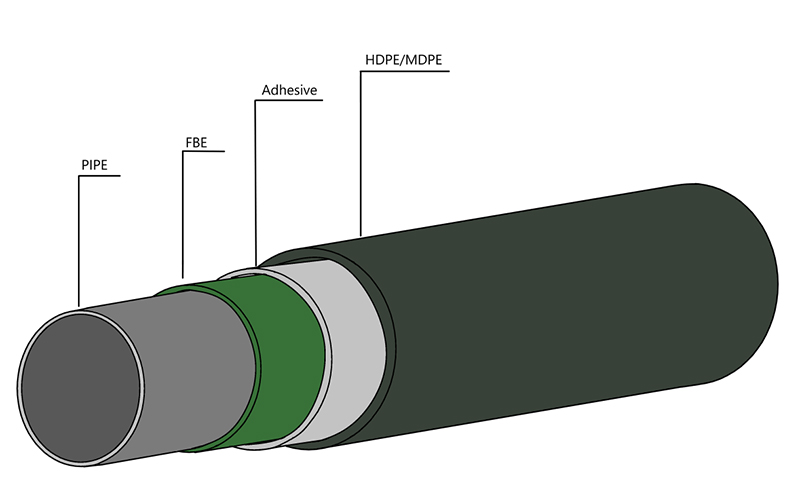
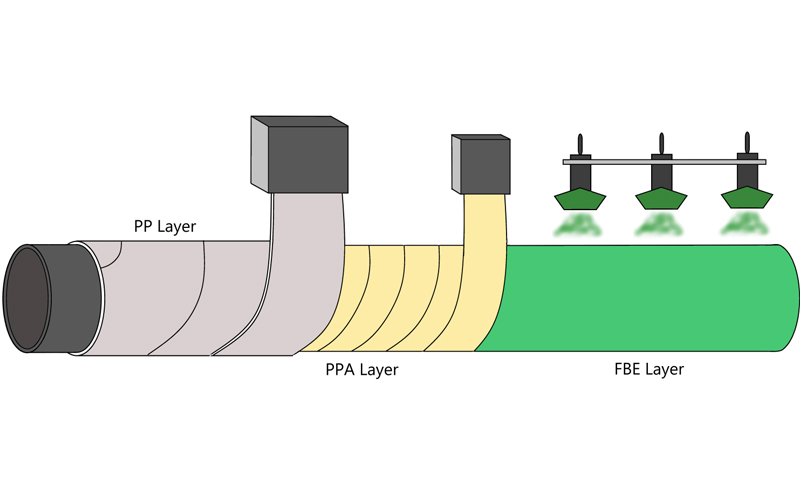
The three-layer polyethylene coating system deployed on a 3LPE-coated pipeline, including fused epoxy (FBE) primer, copolymer adhesive interlayer and high-density polyethylene shell. The FBE primer chemically bonds to cleaned steel surfaces, sealing micro-pores and blocking initial chloride adhesion. The adhesive layer bridges thermal expansion differences between epoxy and polyethylene, preventing delamination under tidal temperature shifts. The outer layer of thick polyethylene forms a flexible, water-impermeable barrier, which is resistant to salt spray, slight impact wear and long-term seawater immersion.
API 5L 3LPE coated line pipe delivers cost-effective corrosion protection for shallow offshore projects. The field data of 30 years have proved that complete coatings can prevent steel from corrosion in medium-temperature seawater, and coated pipelines can be bent in the field without damage to the coating.
Advantages of 3LPP Coated Pipe in Marine Conditions
3LPP coated pipe utilizes a three-layer polypropylene stack engineered for harsher marine operating windows, marketed widely as robust 3pp anti-corrosion pipe. The external 3LPP coating has the same structure as the FBE primer and adhesive of 3LPE, but polyethylene is replaced by high-performance polypropylene resin, which has three marine advantages: provides significantly improved performance, improved thermal stability and extremely high wear resistance.
Due to the continuous temperature limit of 110 C, external 3LPP coating is better than 3LPE coating for high-temperature produced water pipelines. Its hard outer layer can also resist the gouging of the rock seabed and maintain its integrity during piling friction.
3LPP vs 3LPE Coating Comparison
| Property | 3LPE | 3LPP |
| Corrosion Resistance | Excellent | Excellent |
| Abrasion Resistance | High | Superior |
| Temperature Resistance | Moderate (~60°C continuous) | High (~110°C continuous) |
| Upfront Material Cost | Lower | Higher |
| Suitable Applications | Excellent for shallow, moderate-temperature lines/piles | Excellent for deep water, rocky seabeds, high-heat fluid transport |
When choosing between a 3LPP vs 3LPE coating package, the engineers will weigh the operating conditions of the project. Standard corrosion-resistant pipeline used for mild nearshore flood control and cold water transportation uses 3LPE, while deep sea, high temperature or high wear dredging and piling projects specify 3LPP to lock in longer service life of the coating.
Why is LSAW Steel Pipe the Widely Preferred for Floating Pipelines and Offshore Infrastructure?
Floating Pipeline Applications
Floating pipelines are buoyant pipeline systems supported by pontoons or inherent flotation, which are used in coastal dredging, port maintenance, cross-bay water transportation and industrial mud discharge. Unlike buried subsea pipelines, floating pipelines are supported by pontoons or buoyancy systems and remain on or near the water surface.
Wave motion produces repeated bending stresses in dredging and floating pipeline systems. Pipes with poor roundness crack at welds under cyclic flexing, while precision longitudinal welded pipes maintain structural stability long-term.
Benefits of LSAW Steel Pipe
LSAW steel pipe outperforms ERW and seamless pipes for large-scale marine projects thanks to precise manufacturing and uniform structural performance. Its submerged arc weld provides high joint integrity and consistent weld quality, which is critical for the floating pipeline performance of the high-pressure LSAW pipe.
The main mechanical advantages for coastal floods and piling buildings include:
1. Nearly perfect roundness tolerances, which can evenly distribute flood wave and hydrostatic pressure load on the whole pipeline circumference.
2. It can produce large-diameter steel pipes with an outer diameter of 1524mm, which is an ideal choice for large-capacity dredging, floating pipeline and heavy-load offshore piles.
3. Predictable elastic deflection performance under tidal cyclic load.
4. Compatibility with factory 3LPE/3LPP coating application without warping or seam distortion post-coating heat curing.
Allland’s core marine product portfolio centers on precision LSAW manufacturing, pairing API 5L pipe grades, oversized structural pipe, and fully coated assemblies tailored to flood-prone coastal job sites.
Recommend Allland Pipe Solutions for Coastal Infrastructure Projects
LSAW Steel Pipe Solutions
Allland’s precision submerged arc-welded steel pipe series serves heavy-duty coastal structures and transportation tasks. These units are designated for structural steel pipe piles for bridges, offshore platform support frames, high-pressure API 5L floating pipeline and main industrial fluid pipelines across the bay. Steel pipes with sizes ranging from small structure diameters to 1800 mm large diameter have passed the certification of ASTM A500, ASTM A252 and complete API 5L X52/X65 standards.
3LPE and 3LPP Coated Pipe Solutions
Factory-coated corrosion-resistant pipe assemblies ship pre-finished from Allland’s coating facilities, eliminating onsite coating application delays. 3LPE-coated pipe is suitable for standard offshore pipeline networks, while heavy 3LPP-coated pipe is suitable for deep-sea, rock-seabed dredging pipeline and splash zone structural pile support. Before shipment to the coastal construction site, each coating batch undergoes Holiday Detection Testing to verify the absence of pinholes and coating discontinuities.
FAQ
Q 1: What is the best steel pipe for coastal infrastructure projects?
A: The choice depends on the application. ASTM A500 and ASTM A252 are the widely preferred for load-bearing structures and deep foundations, while API 5L (X52/X65) LSAW pipes with high output are the widely preferred for high-pressure floating and offshore pipeline systems.
Q 2: How does pipe wall thickness affect the lifespan of coastal steel pipes?
A: Sufficient wall thickness provides necessary buckling resistance to the driving forces and external flood pressures, while the comprehensive corrosion allowance metal thickness prolongs the service life by absorbing the oxidation loss of brine for decades.
Q 3: What are the advantages of LSAW steel pipe for floating pipeline systems?
A: LSAW pipes offer unmatched structural integrity, close-tolerance roundness, and robust longitudinal welds, allowing floating pipeline sections to flex under tidal wave forces without stress concentration or catastrophic joint failure.
Q 4: Which coating is better for coastal infrastructure: 3LPE or 3LPP?
A: 3LPE is a cost-effective choice for general marine environments with moderate operating temperatures. Because of its excellent wear resistance and high continuous temperature tolerance limit, 3LPP is designated to be used in deep-water installations or rocky grinding seabed.
Q 5: How can corrosion-resistant steel pipes reduce lifecycle costs?
A: By combining the marine grade foundation steel with the 3LPE/3LPP barrier coating applied in the factory, project teams greatly slowed down the local chloride corrosion and reduced the expenses of underwater inspections, emergency maintenance and premature replacement cycles of complete pipeline assets.
Conclusion
Coastal infrastructure cannot rely on universal steel pipes. Reliable marine buildings need specific grades of steel that match the flood, corrosion and erosion conditions on site: ASTM A500 for shallow structural support, ASTM A252 for deep steel pipe piles and API 5L X52/X65 LSAW pipes for offshore and marine fluid transportation systems.
With certified steel grades, 3LPE and 3LPP coatings can prolong the service life of the pipeline by reducing long-term wall loss. 3LPE provides economical and efficient protection for a mild coastal environment, while 3LPP is suitable for deep water, high temperature and abrasive seabed environments. LSAW steel pipe remains the top choice for large-scale floating pipelines due to stable weld performance under cyclic tidal loads.
As a steel pipes supplier, Allland offers certified large diameter steel pipe, LSAW structural pipes and factory-coated anti-corrosion pipes. It provides factory test reports and customized size consultations to help project teams match pipeline solutions with the needs of coastal sites vulnerable to floods, thus achieving long-term durability of the infrastructure.

ASTM A53 vs. API 5L: A Guide to Selection and Application
In the field of industrial piping, ASTM A53 and API 5L are two key standards that are widely used, but have very different positions. ASTM...

Introduction:Technology differences determine success or failure, and selection needs to be “precise”
In oil and gas transmission, municipal infrastructure and other major projects, the reasonable choice of steel pipe welding process directly affects the project...
Steel Density Analysis: Core Differences between Mild and Medium Carbon Steels and Industrial Applications
The density of steel is one of the key parameters that determine its physical properties and industrial applications. Theoretical state of steel density...
3LPE coated steel pipe: a solid barrier in the field of industrial corrosion protection
In the harsh environment of oil and gas, chemical industry, urban pipe network, etc., the long-term reliability and corrosion resistance of pipeline system...
3LPP coated pipe: anti-corrosion guard in high temperature and high pressure environment
In some challenging special environments such as deep-sea oil and gas exploration and high-temperature crude oil transportation, traditional anti-corrosion coatings face significant challenges,...
FBE steel pipe: the technological armor of the steel defense line
I In the icy waters beneath the Norwegian Sea pipeline, a section of FBE Lined Carbon Steel Pipe has been in service for 25...