




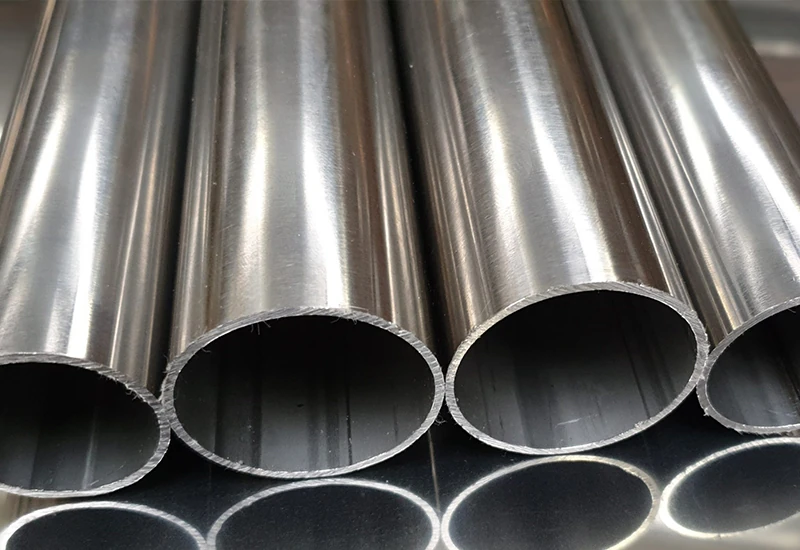


In the realm of global large-scale infrastructure—including oil and gas transmission, offshore engineering, and water conservancy projects—submerged arc welded steel pipes serve as the indispensable “arteries” that underpin modern energy and utility networks. Among all kinds of welded pipes, longitudinal submerged arc welded pipe (LSAW pipe) and spiral submerged arc welded pipe (SSAW pipe) are two main categories of large diameter steel pipe. Although both of them use submerged arc welding technology, their production methods are fundamentally different, resulting in obvious differences in performance, durability and applicability in key applications. This article dissects the core disparities between these two manufacturing processes and reveals the extreme, high-stakes operating conditions where LSAW Pipe is not merely a preferred choice but an absolutely irreplaceable solution. As a leading Chinese steel pipe manufacturer, Hebei Allland Steel Pipe (Allland Pipes) employs cutting-edge JCOE forming technology to produce premium LSAW Pipe that meets the most stringent international standards, offering unparalleled reliability for mission-critical projects worldwide.
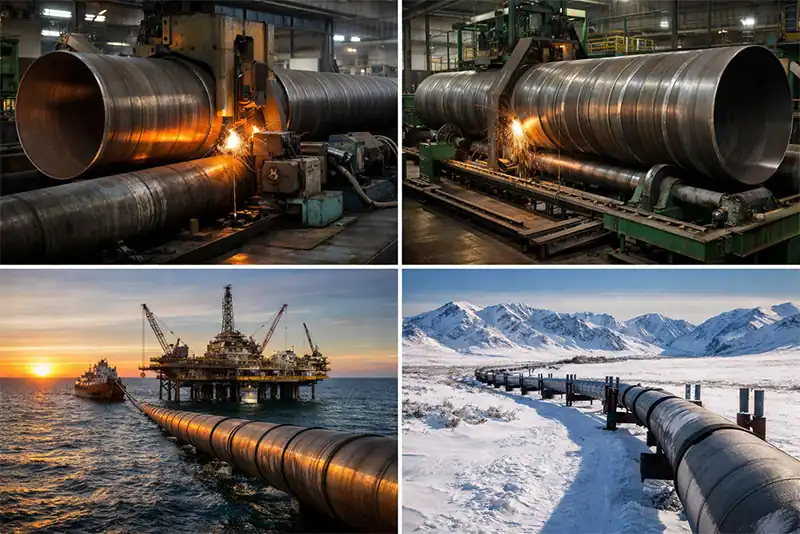
Core Production process of LSAW and SSAW steel pipes
What Is LSAW Pipe? (Longitudinal Submerged Arc Welding & JCOE Technology)
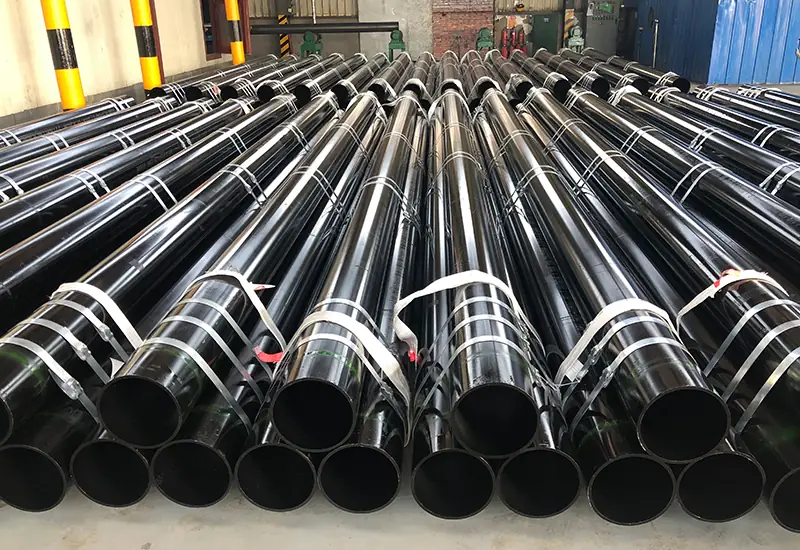
Longitudinal submerged arc welded pipe is made of high quality thick steel plates as the main raw material. The industry-leading JCOE process (adopted by Allland Pipes because of its accuracy and consistency) includes four key successive stages: J-forming, C-forming, O-forming and Mechanical Expansion.
- Steel plate preparation: The original steel plate is subjected to strict ultrasonic testing (UT) to detect internal defects, and then edge milling is carried out to ensure accurate width, parallelism and the best groove geometry for welding.
- Pre-Bending: The plate edges are pre-bent to achieve the required curvature, laying the foundation for uniform cylindrical forming.
- JCOE Forming: The plate is progressively shaped: first into a “J” profile on one half, then a “C” profile on the other, and finally closed into a full circular “O” shape via powerful hydraulic presses.
- Welding: After tack welding, multi-wire submerged arc welding is used to weld the longitudinal seam from the inner and outer surfaces to ensure deep penetration and structural integrity.
- Mechanical expansion: Mechanical expansion of the finished pipe to the final diameter. This key step improves the dimensional accuracy, perfects roundness, and significantly reduces residual stresses in the pipe.
The defining characteristics of LSAW pipe are its short, straight longitudinal weld seam, exceptional dimensional precision (including outstanding roundness and straightness), and minimal residual stress—attributes that directly translate to superior mechanical performance in demanding environments.
What Is SSAW Pipe? (Spiral Submerged Arc Welding Technology)
In contrast, SSAW pipes are made of continuous hot-rolled steel coils. The process is a continuous, high-volume operation.
- Unwinding and leveling: Unwinding and leveling the steel coil to eliminate bending.
- Spiral forming: The flattened steel strip is sent to a series of rollers, which bend the steel strip into a spiral shape at a controlled angle.
- Spiral welding: The spiral weld is continuously welded from the inside and outside by submerged arc welding to form a long spiral weld around the circumference of the pipe.
- Sizing and cutting: Cut the formed pipe into required length, and carry out basic sizing and testing.
SSAW pipes are characterized by their long spiral welds (usually 1.5–3 times the length of the pipe), higher production efficiency in large diameter and medium and low pressure applications, and inherent flexibility in adjusting the diameter of the pipe. However, the spiral forming process will leave high residual stresses, and the long weld presents a large area which is easy to produce potential defects.
In-Depth Multi-Dimensional Comparison: LSAW vs. SSAW
The following table summarizes the basic differences between LSAW pipe and SSAW pipe in key performance indexes:
| Comparison Parameter | LSAW Pipe | SSAW Pipe |
| Raw Material | Thick, discrete steel plates (up to 50mm+ thickness) | Continuous hot-rolled steel coils (typically ≤25mm thickness) |
| Weld Seam | Short, straight longitudinal seam (parallel to pipe axis) | Long, helical/spiral seam (wraps around pipe) |
| Weld Length | Equal to pipe length (e.g., 12m seam for 12m pipe) | 1.5–3x pipe length (e.g., 18–36m seam for 12m pipe) |
| Max Wall Thickness | Up to 60mm (ideal for high-pressure steel pipe) | Typically limited to ≤25mm |
| Residual Stress | Very low (eliminated via mechanical expansion) | High (retained from spiral forming) |
| Dimensional Accuracy | Excellent (±0.2% straightness, perfect roundness) | Good (variable ovality, lower straightness precision) |
| Defect Probability | Low (shorter seam, easier NDT inspection) | Higher (longer seam, complex spiral geometry) |
| Pressure Rating | Ultra-high (ideal for high-pressure steel pipe) | Medium to low pressure only |
| Fatigue Life | Superior (excellent resistance to cyclic stress) | Moderate (lower stress resistance) |
| Typical Cost | 30–50% higher (material & process complexity) | Lower (higher efficiency, coil material) |
Data source: Piping Industry Technical Reference (2026)
1. Weld Length & Defect Risk
The most profound difference lies in weld geometry. The weld length of SSAW pipes is typically 1.5–3 times that of LSAW pipes. A longer weld means that the area susceptible to welding defects (such as porosity, slag inclusions or micro-cracks) is significantly larger. For LSAW Pipe, the short, straight seam simplifies non-destructive testing (NDT) and ensures far fewer potential failure points—a critical factor in safety-critical applications.
2. Load-Bearing Capacity and Wall Thickness Limits
Longitudinal submerged arc welded pipe can be made of ultra-thick steel plates (up to 50-60 mm thick), which can withstand extreme internal pressures required for high-pressure steel pipe applications. SSAW pipe is limited by the maximum thickness of available steel coils (usually ≤ 25 mm), which limits its pressure bearing capacity and excluding it from ultra-high pressure application.
3. Residual Stress and Fatigue Resistance
The mechanical expansion stage in LSAW Pipe production is transformative: it relieves nearly all residual stresses formed during forming and welding. This makes the pipe have excellent resistance to fatigue failure caused by cyclic pressure, thermal fluctuations or external forces. SSAW pipe retains significant forming-induced stresses, making it more vulnerable to crack propagation and fatigue degradation over time.
4. Geometric Dimensional Precision
LSAW pipe delivers unmatched roundness and straightness, ensuring seamless field-fit welding and minimizing stress concentrations at joints. SSAW pipes usually show slight deviations in roundness and straightness, which can complicate installation and reduce the integrity of joints in demanding installations.
The Core Focus: When LSAW Pipe Is Absolutely Irreplaceable
Although SSAW steel pipe perform well in low-pressure applications which are cost-sensitive, longitudinal submerged arc welding pipes are the only feasible choice under the following extreme and high-consequence operating conditions.
1. High-Pressure & Ultra-High-Pressure Oil&Gas Transmission Lines
For high-pressure steel pipe in long-distance pipes (especially API 5L X70, X80, and higher steel grades) traversing populated Class 3/4 areas or requiring maximum burst pressure resistance, LSAW Pipe is the non-negotiable standard. Its short defect-resistant welding, ultra-thick wall capacity and 100% equivalent welding strength of base material eliminate the risk of catastrophic failure, which increases exponentially when SSAW pipes are used under such extreme pressures.
2. Deep-water and Offshore Platform Installations
in submarine environments, offshore pipelines must be able to resist the damage of external hydrostatic pressure (which can exceed 15 MPa at depths of 1,500 meters, and even higher in deeper zones) and can withstand the continuous fatigue caused by ocean currents and wave movements. Under this multi-axial cyclic stress, the long spiral weld of SSAW pipe becomes the weak point of the structure, making it more prone to failure. LSAW Pipe’s uniform stress distribution, minimal residual stress, and exceptional collapse resistance make it the highly preferred choice for critical offshore pipelines under strict DNV-OS-F101 and API 5L PSL 2 offshore specifications.
3. Extremely Cold and Seismically Active Zones
In permafrost regions or earthquake-prone regions, pipes are faced with intense ground motion, thermal cycle and dynamic loads. The excellent low-temperature toughness (Charpy impact energy ≥ 40 Joule at-20 degrees Celsius) and strain-based design ability of longitudinal submerged arc welded pipe make it not break when deformed. SSAW pipe has low impact resistance and high residual stress, and brittle fracture or joint failure is easy to occur under these geo-mechanical stresses.
4. Critical Structural Piling for Mega-Project
For large-diameter large diameter steel pipe used as bearing piles in offshore wind farms, cross-sea bridges, and high-rise foundations, LSAW Pipe delivers unparalleled axial and lateral load-bearing capacity. Its uniform wall thickness, perfect roundness and uniform stress distribution ensure structural stability under large-scale compression and bending load—making it the preferred choice over standard SSAW pipes when dealing with unprecedented axial loads.
How to Choose a Suitable Pipe for Your Project
Optimal SSAW Pipe Applications
SSAW pipe is the economical choice for:
- low-pressure water delivery and irrigation systems.
- Standard foundation piling and structural supports.
- Low-budget large-diameter steel pipe projects has extremely low pressure and stress requirements.
- Short distance and low pressure fluid transmission lines.
Optimal LSAW Pipe Applications
LSAW pipe is indispensable for:
- High-pressure steel pipe for oil and gas transportation.
- Offshore pipelines and deep-water submarine systems.
- Thick-walled structural piling for critical infrastructure.
- Projects that meet strict international standards (API 5L PSL 2, DNV, ISO 3183).
Corrosion Protection Considerations
For harsh environment, both types of pipes need advanced anti-corrosion protection. Allland Pipes enhances the longevity of LSAW Pipe and SSAW pipe with five specialized anti-corrosion production lines, offering 3LPE, 3LPP, and FBE coating systems that extend service life by 30+years in corrosive soil and seawater conditions.
Frequently Asked Questions
Q: Why can’t SSAW pipe be used in deep-sea submarine pipes?
A: It is generally not recommended to use SSAW pipes for offshore pipelines, due to their long spiral welds and the resulting persistent stress concentration. The deep water environment makes the pipe bear extreme external pressure and periodic fatigue caused by ocean current; The spiral seam is far more prone to crack initiation and propagation than LSAW Pipe’s short, straight longitudinal seam. In addition, the low collapse strength and high residual stress of SSAW pipe failed to meet the strict DNV and API 5L offshore standards.
Q: What is the typical price difference between LSAW and SSAW?
A: LSAW pipe is usually 30-50% more expensive than SSAW pipe with the same diameter. This premium stems from higher-cost thick steel plates, the complex JCOE forming process, and additional steps like mechanical expansion. However, in critical applications (offshore pipelines, high-pressure steel pipe), this cost premium is negligible compared to the catastrophic financial and safety risks of pipe failure—making LSAW Pipe the most cost-effective long-term choice.
Q: What international standards do Allland Pipes‘ LSAW pipes comply with?
A: Allland Pipes’ LSAW Pipe products meet the world’s most rigorous standards, including.
- API 5L (PSL 1 & PSL 2, Grades B to X80)
- ASTM A252 (structural piling)
- EN 10219 (European standard)
- ISO 3183 (global line pipe standard)
- DNV-OS-F101 (offshore pipeline specifications)
Conclusion
SSAW pipe provides an economical and efficient solution for low demand and large diameter applications, but its performance limitations becomes a key obstacle in extreme environment. In contrast, LSAW Pipe—with its superior weld integrity, ultra-high pressure capacity, minimal residual stress, and unmatched dimensional precision—stands as the only irreplaceable option for high-pressure steel pipe, offshore pipelines, and other mission-critical infrastructure where safety, durability, and reliability are non-negotiable.Hebei Allland Steel Pipe Co., Ltd. is located in Cangzhou, the “capital of pipe equipment” in China. It is a high-tech enterprise with two advanced JCOE production lines and full set of API 5L certification. If you are sourcing premium LSAW Pipe or comprehensive anti-corrosion solutions for your next demanding project, contact Allland Pipes today for a professional quote and engineered piping solution tailored to your specific requirements.

ASTM A53 vs. API 5L: A Guide to Selection and Application
In the field of industrial piping, ASTM A53 and API 5L are two key standards that are widely used, but have very different positions. ASTM...

Introduction:Technology differences determine success or failure, and selection needs to be “precise”
In oil and gas transmission, municipal infrastructure and other major projects, the reasonable choice of steel pipe welding process directly affects the project...
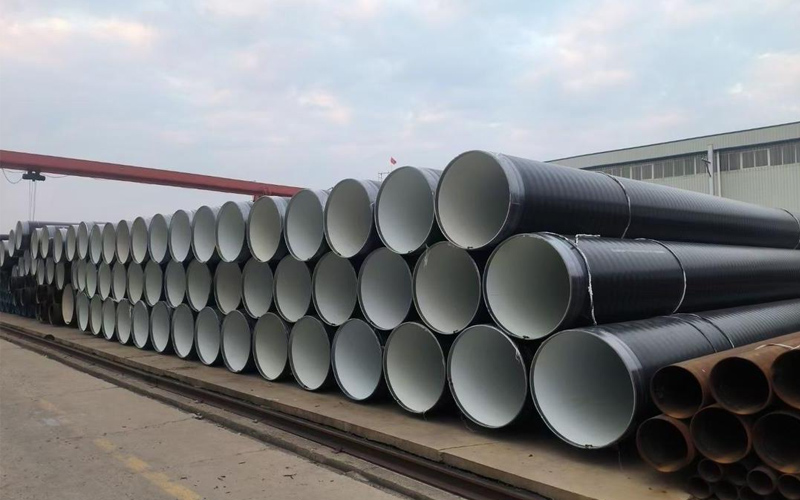
Steel Density Analysis: Core Differences between Mild and Medium Carbon Steels and Industrial Applications
The density of steel is one of the key parameters that determine its physical properties and industrial applications. Theoretical state of steel density...
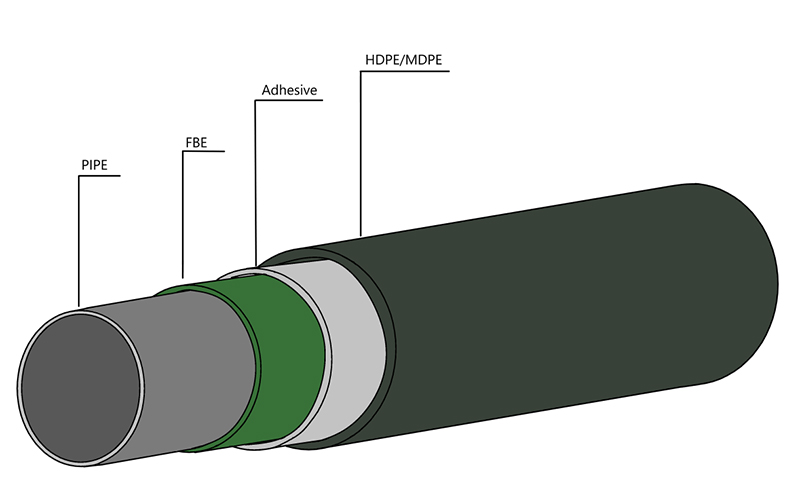
3LPE coated steel pipe: a solid barrier in the field of industrial corrosion protection
In the harsh environment of oil and gas, chemical industry, urban pipe network, etc., the long-term reliability and corrosion resistance of pipeline system...
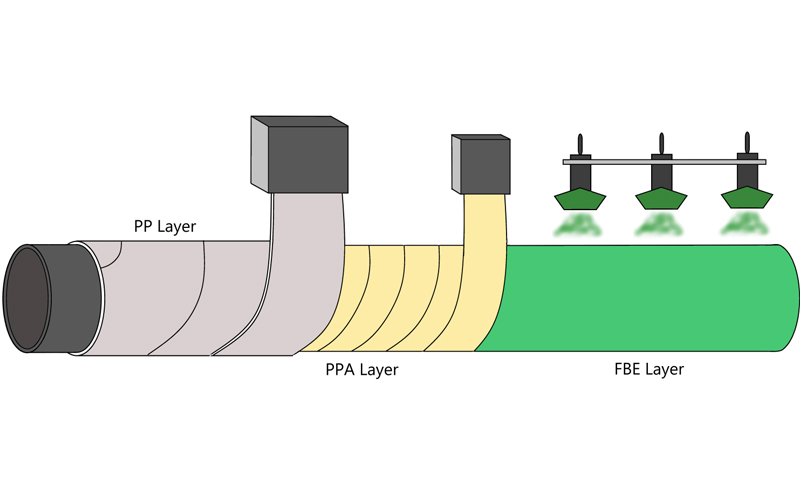
3LPP coated pipe: anti-corrosion guard in high temperature and high pressure environment
In some challenging special environments such as deep-sea oil and gas exploration and high-temperature crude oil transportation, traditional anti-corrosion coatings face significant challenges,...
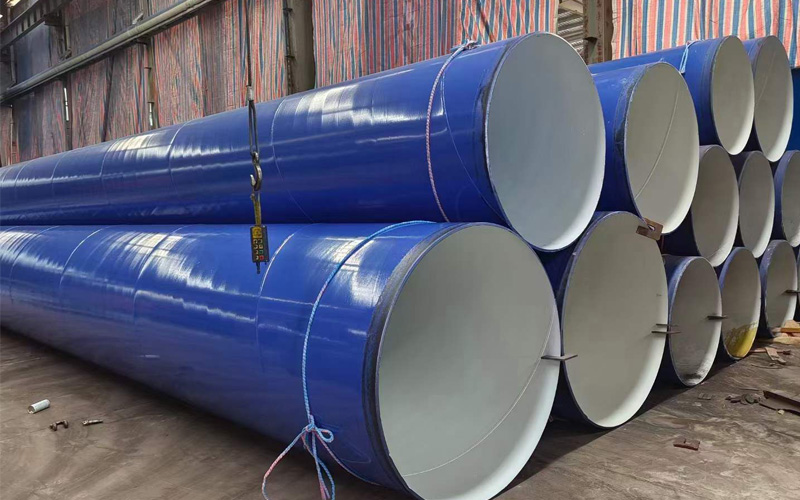
FBE steel pipe: the technological armor of the steel defense line
I In the icy waters beneath the Norwegian Sea pipeline, a section of FBE Lined Carbon Steel Pipe has been in service for 25...