




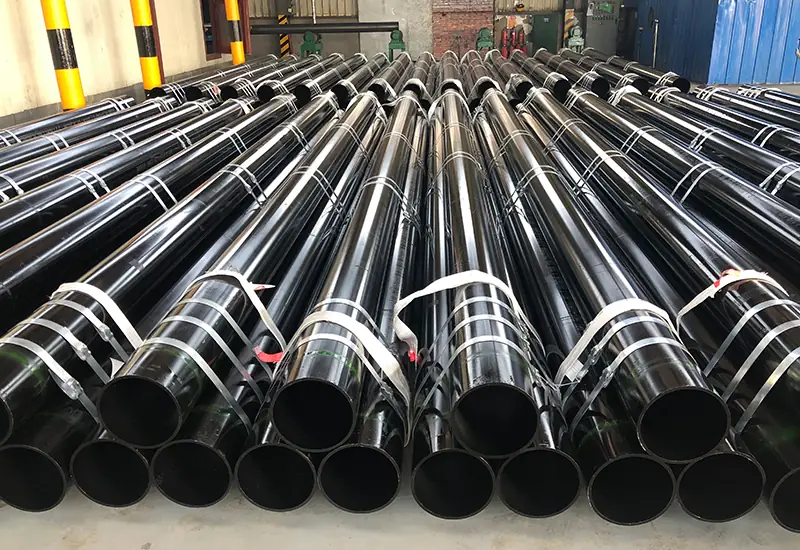


In onshore pipeline construction, connecting large diameter steel pipe sections reliably determines the integrity and service life of the entire project. Field crews face daily challenges, including dimensional mismatch, poor bevel preparation, and inadequate thermal control. Any of these issues can lead to weld failure.
This guide skips the basic classifications. Instead, it provides a technical field-welding reference for engineers and project teams. We will cover bevel design, high-strength steel preheating, consumable selection matching API 5L specification and EN 10217 standards, welded steel pipe procedure execution, and field joint coating integration.
1. Pre-Weld Prep & Verification: Pipe Dimensions and Beveling Controls
1.1 Field Verification of Steel Pipe Dimensions
Before positioning the beveling machine, the QC team must verify geometric dimensions of incoming pipes. Use verified dimensional charts to confirm wall thickness and outside diameter before fit-up.
Key parameters to check include outside diameter of steel pipe and wall thickness. Common references include schedule 40 steel pipe dimensions. Ensure the misalignment (high-low) stays within design code limits.
Different applications require different tolerances. For steel pipe piles, fire sprinkler steel pipe, or large diameter drain pipe, refer to the respective dimensional deviation standards. Field records show that proper verification reduces rework by about 30%.
1.2 On-Site Precision Beveling for ERW and LSAW
Compared to seamless pipes, welded steel pipe products like LSAW pipes may have minor end irregularities from their longitudinal weld seams. This requires attention.
- LSAW steel pipe: These typically have thicker walls. They need machine beveling. A 30° to 35° single V or compound bevel works well. Keep the root face at 1.5mm to 2.0mm. Set the root gap between 2.0mm and 3.0mm.
- ERW pipe: Wall thickness is often standard, like thickness of schedule 40 pipe. Use portable gas cutting with grinding or a pneumatic beveler for rapid preparation. This suits many field conditions.
2. Thermal Management: Preheating Requirements for High-Strength Carbon Steel
2.1 The Metallurgy Behind Crack Prevention
When welding high-strength line pipe grades like API 5L X65, or standard carbon steel materials with heavy wall thicknesses like ASTM A106 and ASTM A53 Grade B, thicker walls and higher carbon equivalent (CE) increase risks. Rapid cooling in the weld and heat-affected zone (HAZ) can form hardened microstructures, increasing the risk of hydrogen-induced cracking.
Understanding the thermal properties of carbon steel helps engineers estimate cooling rates during welding. This applies to structural grades like ASTM A500, as well as high-strength line pipes.
2.2 On-Site Preheat Temperature Guidelines
Set preheat temperature based on ambient conditions and pipe specifications. A typical range is 100°C to 150°C. For onshore pipeline installation methods or offshore pipeline installation in cold or wet weather, use electric heating pads or infrared gas heaters. Ensure even heating across the joint area.
Monitor interpass temperature strictly. Avoid letting it drop too low or rise too high during multi-pass welding. This control is essential for high strength steel pipe.
3. Consumable Selection: Matching Standards and Strength Grades
3.1 Adhering to International Standards (API 5L & EN 10217)
Filler metals must match or slightly exceed the base metal in tensile strength, yield strength, and impact toughness. If the base pipe complies with API 5L or EN 10217 standards, the selected consumables should also meet the corresponding certification requirements. Material traceability and third-party certification are essential for pipeline projects. As a steel pipes supplier, Allland ensures material traceability.
3.2 Welding Process and Consumable Combinations
SMAW (stick welding) is reliable for remote pipelines or harsh onshore pipeline conditions.
- Root pass: Use cellulose electrodes like E6010 or E8010. They provide deep penetration and single-side welding with good back formation.
- Fill and cap passes: Use low-hydrogen basic electrodes like E7018 or E8018. These reduce diffusible hydrogen and improve crack resistance.
GMAW/FCAW (gas-shielded or flux-cored) suits high-productivity projects. This includes offshore pipelay companies or medium-to-large diameter onshore oil and gas lines.
4. On-Site Welding Procedure Specification (WPS) Execution
4.1 Root, Hot, Fill, and Cap: Pass Control
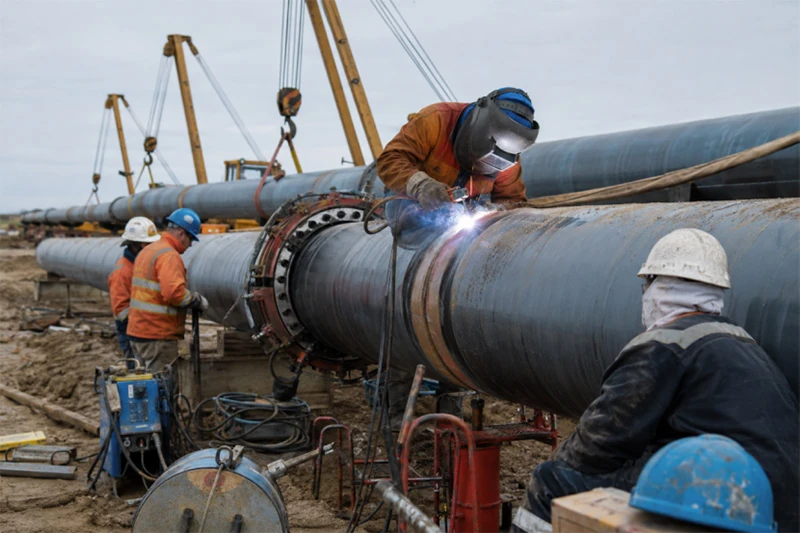
Root pass control is the most critical step. Control the puddle temperature carefully. For large diameter pipes, poor technique can cause root concavity or lack of fusion, especially in flat or overhead positions.
Hot and fill passes: After completing the root pass, remove slag thoroughly with a pneumatic wire brush. Apply the hot pass before the joint cools below the specified interpass temperature. This prevents the root from cooling too fast and cracking.
4.2 Handling the Intersection of Longitudinal & Circumferential Welds
When aligning LSAW steel pipes, offset the longitudinal seams of adjacent joints by at least 100mm or a 30° angle. Avoid overlapping longitudinal seams.
When welding near the seam intersection, thermal stress concentrates. Adjust the welding current slightly to reduce the risk of cracking at the weld intersection. This practice applies to all welded pipe types.
5. Protecting the Joint: Field Joint Coating (FJC) Integration
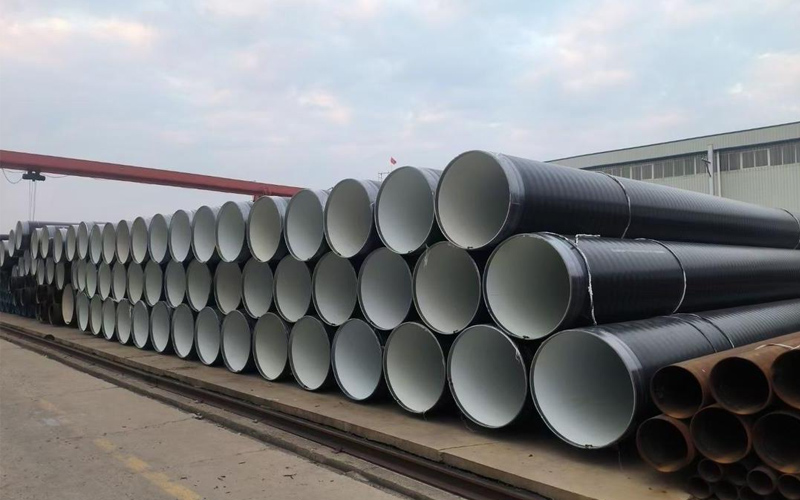
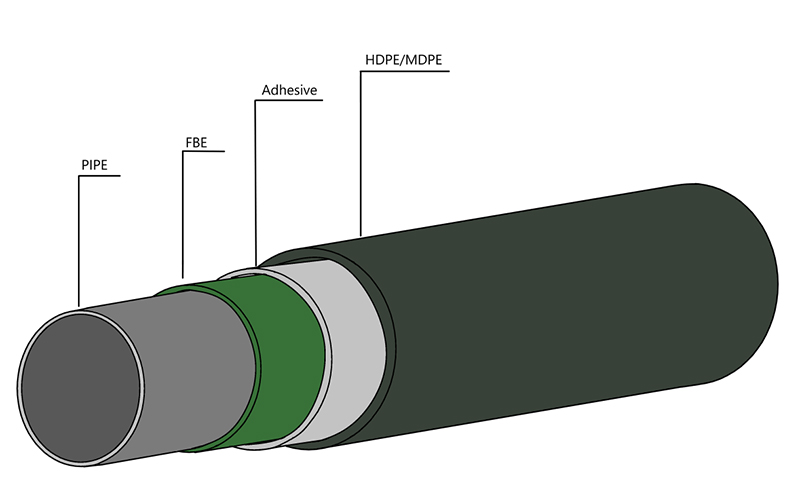
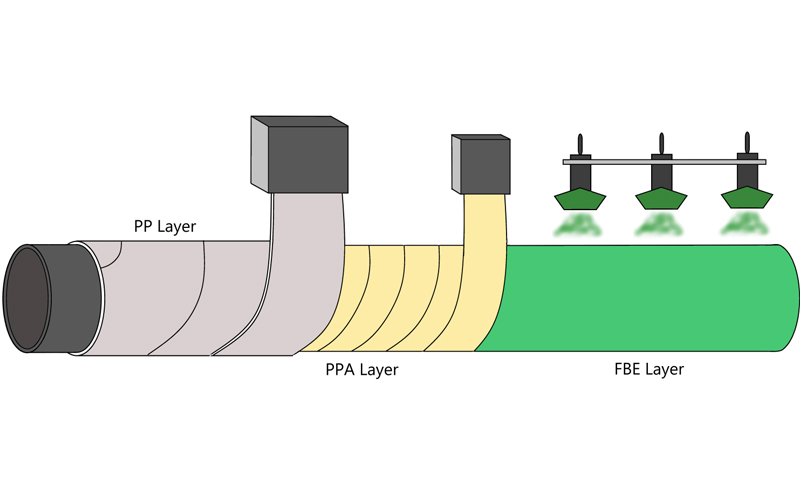
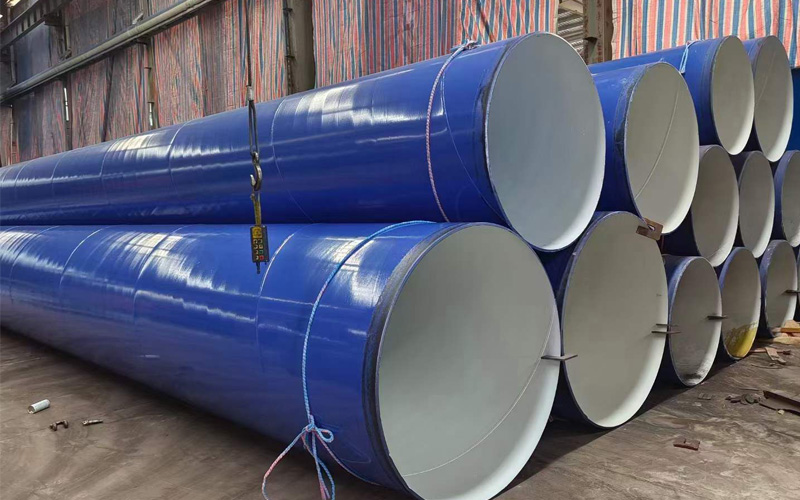
For transport and storage, mills apply anti-corrosion coatings to carbon steel pipes. Common types include 3LPE coated pipe, 3PE coated pipe, FBE coated pipe, or 3PP coated steel pipe. After completing circumferential joint welding and passing inspection, the bare pipe ends need field joint coating to restore protection.
Here are three mainstream field coating methods:
- 3LPE coating process on site: Abrasive blast the weld area to Sa 2.5. Apply medium-frequency induction heating. Then apply two-component liquid epoxy or FBE powder, followed by adhesive and a radiation cross-linked polyethylene heat-shrink sleeve (HSS). This restores the 3LPE steel pipe protection level.
- FBE (Fusion Bonded Epoxy) coating: Suitable for natural gas lines and non-aggressive soil conditions. Control induction heating and electrostatic powder spraying temperatures precisely.
- 3LPP coating process step by step: Designed for offshore oil pipelines and high-temperature, high-pressure media. Polypropylene provides excellent heat resistance and mechanical impact strength.
Allland Pipes operates five in-house anti-corrosion coating lines. They supply custom pre-coated pipes including 3PE anti-corrosion pipe, epoxy coated steel pipe, and other corrosion resistant piping options. Factory coatings have high compatibility with field-applied materials.
6. Quality Control: Non-Destructive Testing (NDT) Protocols
6.1 Strict Verification for Pressure-Bearing and Structural Joints
Before a pipeline goes into service, inspect all field welds using NDT methods. Follow specific design codes tailored to the application: ASME B31.4/B31.8 or API 1104 for oil and gas transmission pipelines, AWWA C206 for potable water lines, and AWS D1.1 for structural applications like driven steel pipe piles. No joint should remain untested.
6.2 Key NDT Methodologies Applied on Site
- Visual Testing (VT): Check for undercut, surface porosity, and excessive reinforcement height.
- Ultrasonic Testing (UT) / PAUT: For thick-wall LSAW pipes, PAUT detects internal lack of fusion, slag, and incomplete root penetration.
- Radiographic Testing (RT): Traditional film radiography verifies volume defects in ring welds for high-grade transmission lines.
- Magnetic Particle Testing (MT): Quickly finds surface and near-surface cracks in the HAZ.
Conclusion: Reliable Pipeline Starts with High-Quality Base Pipes
Connecting LSAW welded steel pipe and ERW pipe on site demands systematic work. From initial dimensional checks and proper beveling to temperature management and final coating, every step depends on the base pipe quality. Good materials make field welding predictable and durable.
Efficient welding depends on high-precision, quality steel pipes. As an experienced steel pipes manufacturer, Allland Pipes produces high-strength LSAW steel pipe, welded pipes, and specialty anti-corrosion products to ISO and API 5L standards. For inquiries about pipe specifications, large diameter steel pipe cost per foot, carbon steel pipe price, or coating options, contact their team for cost-effective solutions.

ASTM A53 vs. API 5L: A Guide to Selection and Application
In the field of industrial piping, ASTM A53 and API 5L are two key standards that are widely used, but have very different positions. ASTM...

Introduction:Technology differences determine success or failure, and selection needs to be “precise”
In oil and gas transmission, municipal infrastructure and other major projects, the reasonable choice of steel pipe welding process directly affects the project...
Steel Density Analysis: Core Differences between Mild and Medium Carbon Steels and Industrial Applications
The density of steel is one of the key parameters that determine its physical properties and industrial applications. Theoretical state of steel density...
3LPE coated steel pipe: a solid barrier in the field of industrial corrosion protection
In the harsh environment of oil and gas, chemical industry, urban pipe network, etc., the long-term reliability and corrosion resistance of pipeline system...
3LPP coated pipe: anti-corrosion guard in high temperature and high pressure environment
In some challenging special environments such as deep-sea oil and gas exploration and high-temperature crude oil transportation, traditional anti-corrosion coatings face significant challenges,...
FBE steel pipe: the technological armor of the steel defense line
I In the icy waters beneath the Norwegian Sea pipeline, a section of FBE Lined Carbon Steel Pipe has been in service for 25...