








Introduction
Corrosion is the single biggest threat to pipeline integrity. For procurement managers and engineers, selecting the right coating is not just about compliance—it is about ensuring the asset survives for decades underground.
Among the various anti-corrosion solutions available, Fusion Bonded Epoxy (FBE) has been the industry workhorse for over 40 years. Known for its superior adhesion and chemical resistance, it is the standard choice for oil, gas, and water transmission lines globally.
What is FBE Coated Pipe?
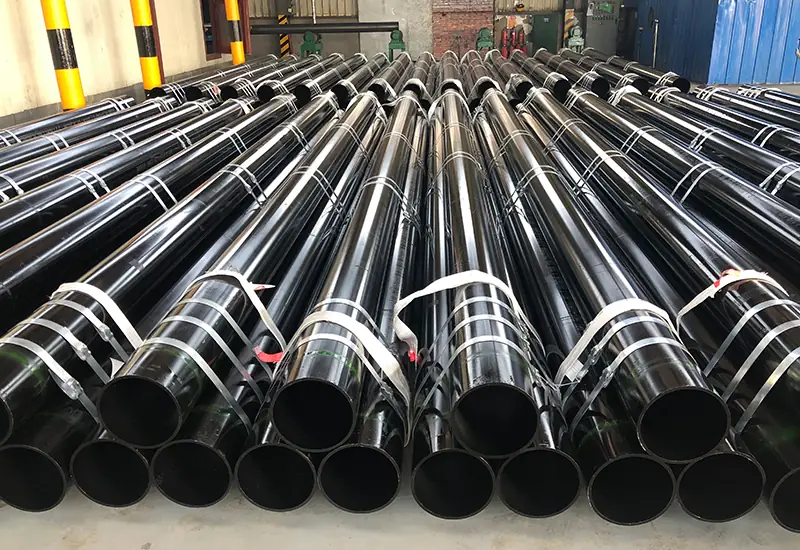
FBE coated pipe (Fusion Bonded Epoxy Pipe) is a steel pipe protected by a thermosetting epoxy powder coating. Applied at high temperatures (typically 230°C+), the powder melts and cures onto the blasted steel surface, forming a hard, smooth, and corrosion-resistant barrier.
The Manufacturing Process
At Allland, we understand that a coating is only as effective as its application process. FBE is not simply “painted on”; it is thermally fused to the steel through a precise chemical reaction. Here is the step-by-step FBE coating process we strictly follow:
Step 1: Surface Preparation (The Foundation)
The most critical factor in FBE performance is adhesion, and adhesion starts with cleaning. We use abrasive blast cleaning to achieve a Near-White Metal finish (Sa 2.5 / SSPC-SP10).
- Cleanliness: This removes all rust, mill scale, and grease.
- Anchor Pattern: Blasting creates a microscopic roughness (40-100 microns) on the steel surface. This “anchor pattern” allows the epoxy to mechanically lock onto the metal. Without this, the coating will peel.
Step 2: Heating
The clean pipe is passed through an induction heating coil. The steel is heated uniformly to a specific temperature range, typically between 230°C and 240°C. Precise temperature control is vital; too cool, and the powder won’t fuse; too hot, and the coating will blister.
Step 3: Powder Application
The heated pipe enters the spray booth. We use high-voltage electrostatic spray guns to apply the FBE powder. The negatively charged powder particles are attracted to the grounded steel pipe. Upon hitting the hot steel, the powder melts instantly into a liquid, flows into the anchor profile, and begins to cross-link (cure).
Step 4: Curing & Quenching
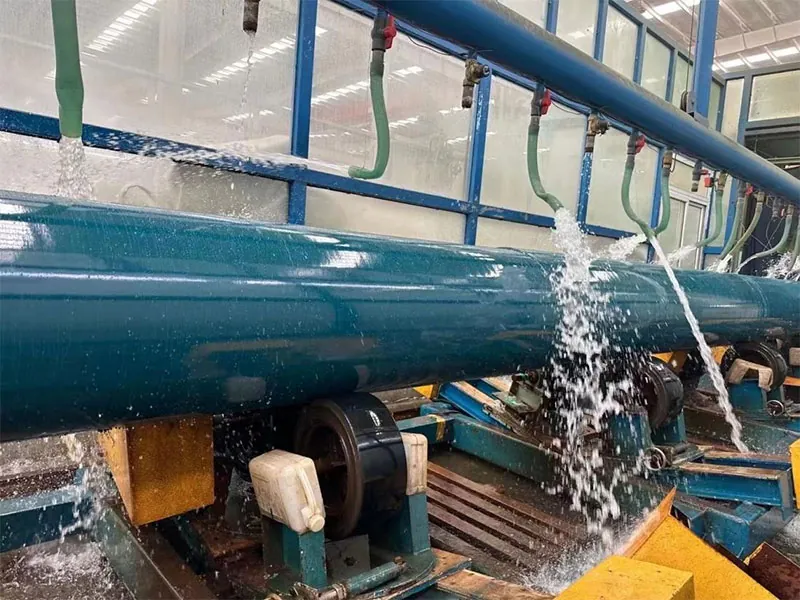
After coating, the pipe travels through a curing tunnel to ensure the chemical reaction is complete. Finally, it passes through a water quench tunnel to cool down rapidly, solidifying the coating into a hard protective shell.
Key Standards & Specifications
When specifying FBE pipes in your tender documents, referencing the correct standard ensures you get the quality you expect. Different industries rely on different governing bodies.
The table below outlines the primary standards Allland complies with:
| Standard | Target Application | Key Feature |
| AWWA C213 | Water & Wastewater | Focus strictly on potable water safety (NSF 61 compliant) and long-term immersion. |
| CSA Z245.20 | Oil & Gas (Global) | The most rigorous testing standard for adhesion & cathodic disbondment. |
| API 5L / ISO 21809 | Oil & Gas Transmission | General requirement for external coating on line pipes used in transportation systems. |
| NACE RP0394 | General Industry | Guidelines for application, curing, and quality control procedures. |
Technical Properties (Data Sheet)
For engineers calculating pipeline longevity and safety margins, raw data is essential. FBE is defined by its ability to withstand harsh conditions.
Here are the typical technical properties of Allland’s FBE coated pipes:
| Technical Property | Typical Value | Test Standard |
| Coating Thickness | 300 – 500 microns (12-20 mils) | CSA Z245.20 / NACE |
| Working Temperature | -40°C to +110°C | — |
| Adhesion (Hot Water) | Rating 1 (No peeling) | CSA Z245.20 |
| Impact Resistance | > 1.5 J (Joules) | ASTM G14 |
| Cathodic Disbondment | < 6.5 mm radius (24h @ 65°C) | CSA Z245.20 |
Advantages of FBE Coating
Why has FBE remained the top choice for decades despite newer technologies?
- Excellent Adhesion: Because the epoxy fuses chemically and mechanically with the steel, it creates a bond that is incredibly difficult to break. It acts as a single unit with the pipe.
- Cathodic Disbondment Resistance: This is the most significant advantage for oil and gas lines. FBE works perfectly alongside Cathodic Protection (CP) systems. Even if the coating is damaged, the cathodic disbondment test results show that corrosion will not spread underneath the surrounding coating (fail-safe mechanism).
- Smooth Surface: The coating provides a glass-like finish, which lowers the coefficient of friction and improves hydraulic efficiency.
Limitations (Is FBE Right for You?)
While FBE is excellent, it is not a universal solution for every environment. Being aware of its limitations prevents costly field repairs.
- Impact Resistance: FBE is a hard, thermoset plastic, which makes it somewhat brittle. During transportation or installation in rocky terrain, it can suffer from mechanical damage (chips or cracks) if handled roughly.
- UV Resistance: FBE is sensitive to sunlight. Long-term exposure to direct sun causes “chalking” (powdering of the surface). It must be buried or protected if stored outside for long periods.
Comparison Note: If your project involves extremely rough rocky terrain or requires long-term outdoor storage, a single layer of FBE might not be enough. For a detailed cost and performance comparison between FBE and polyethylene coatings, read our guide on 3PE vs. FBE Coating.
Types: Single Layer vs. Dual Layer
- Single Layer FBE: The standard anti-corrosion coating discussed above, suitable for most soil environments.
- Dual Layer FBE (ARO): This consists of a base coat of standard FBE followed immediately by a top coat of ARO (Abrasion Resistant Overlay). This is primarily used for Directional Drilling (HDD) projects where the pipe is pulled through soil and needs extra protection against scratches and gouges.
Quality Control
How do we ensure the coating will last 50 years? Every batch at Allland undergoes strict QC testing before leaving our factory:
- Holiday Detection: We perform 100% holiday detection on every single pipe using a high-voltage probe (typically 2000V+). This scans for invisible pinholes or defects. If a spark occurs, the pipe is rejected or repaired.
- Peel Test: We cut a strip of coating and attempt to pull it off to verify the adhesion rating meets CSA or AWWA requirements.
Conclusion
FBE coated steel pipe remains one of the most cost-effective and reliable solutions for underground transmission lines. As long as it is protected from UV exposure and severe mechanical impact during installation, it offers 50+ years of service life.However, proper application is key. A poorly cleaned surface or incorrect temperature will lead to failure. That is why choosing an experienced manufacturer matters.Need high-quality FBE coated pipes meeting AWWA C213 or CSA standards?Allland provides factory-applied coating with full QC reports and competitive pricing.

ASTM A53 vs. API 5L: A Guide to Selection and Application
In the field of industrial piping, ASTM A53 and API 5L are two key standards that are widely used, but have very different positions. ASTM...

Introduction:Technology differences determine success or failure, and selection needs to be “precise”
In oil and gas transmission, municipal infrastructure and other major projects, the reasonable choice of steel pipe welding process directly affects the project...
Steel Density Analysis: Core Differences between Mild and Medium Carbon Steels and Industrial Applications
The density of steel is one of the key parameters that determine its physical properties and industrial applications. Theoretical state of steel density...
3LPE coated steel pipe: a solid barrier in the field of industrial corrosion protection
In the harsh environment of oil and gas, chemical industry, urban pipe network, etc., the long-term reliability and corrosion resistance of pipeline system...
3LPP coated pipe: anti-corrosion guard in high temperature and high pressure environment
In some challenging special environments such as deep-sea oil and gas exploration and high-temperature crude oil transportation, traditional anti-corrosion coatings face significant challenges,...
FBE steel pipe: the technological armor of the steel defense line
I In the icy waters beneath the Norwegian Sea pipeline, a section of FBE Lined Carbon Steel Pipe has been in service for 25...